New Era of Türkiye–Belgium Relations
The Belgian Economic Mission led by Queen Mathilde reflects Türkiye’s growing strategic and economic influence. The visit highlights deepening cooperation in defense, trade, energy, and technology, while also demonstrating Belgium’s visionary approach toward long-term partnership with Türkiye.
Introduction
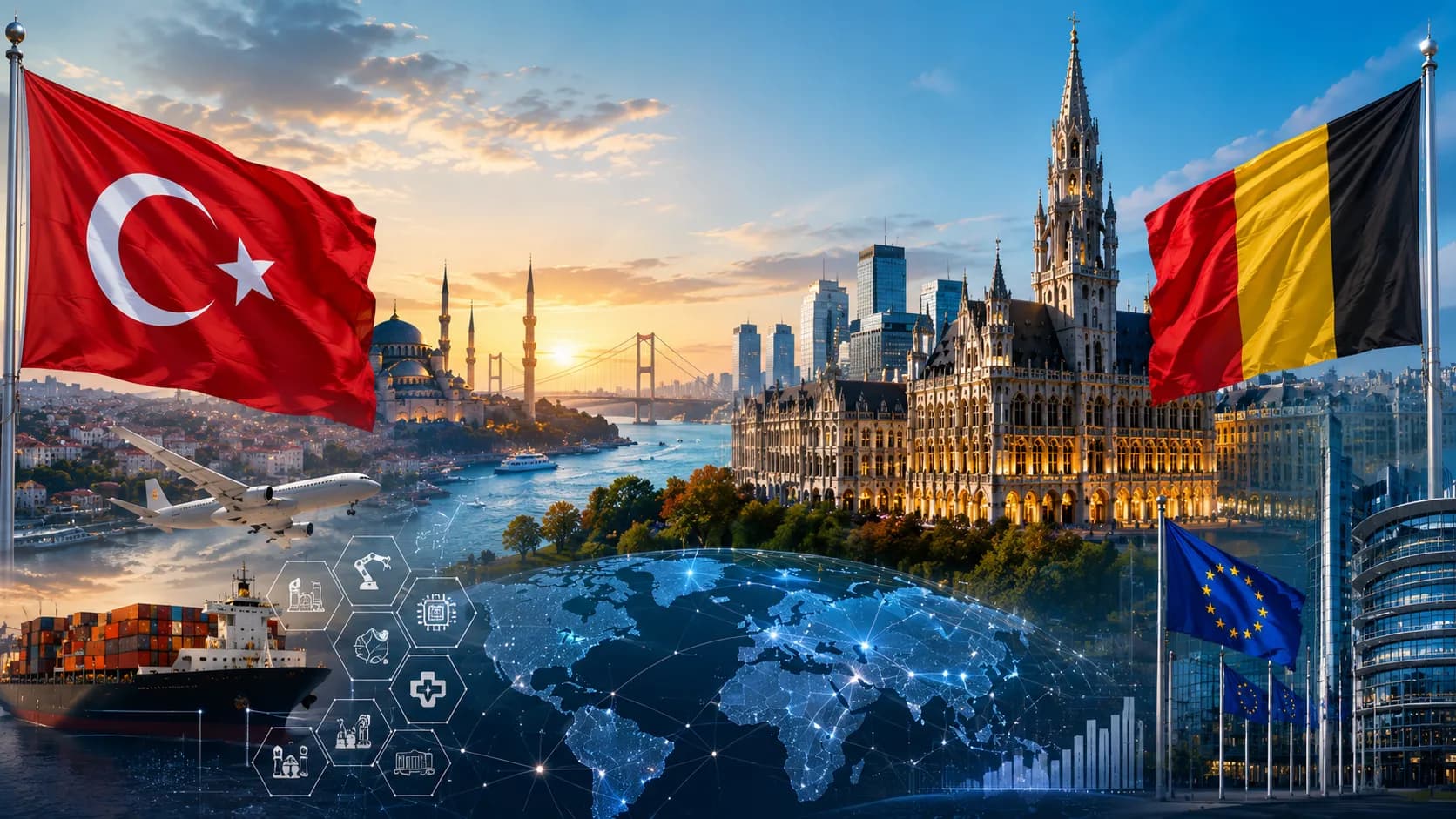
The Economic Mission visit to Türkiye, to be held between 10–14 May under the leadership of Mathilde of Belgium, represents a significant development in terms of demonstrating the strategic level reached in Türkiye-Belgium relations in recent years. The delegation includes Deputy Prime Minister and Minister of Foreign Affairs Maxime Prévot, Minister of Defense and Foreign Trade Theo Francken, Minister-President of the Brussels-Capital Region Boris Dilliès, Minister-President of the Flemish Government Matthias Diependaele, Vice Minister-President of the Walloon Government Pierre-Yves Jeholet, as well as 428 private sector representatives. The composition of the delegation demonstrates that the visit is regarded not merely as a diplomatic engagement, but as a comprehensive act of economic diplomacy.
The visit also highlights that Türkiye’s increasing economic, political, and strategic influence at both regional and global levels is being more closely followed by European states. Simultaneously, Belgium appears to be adopting a visionary foreign policy approach capable of interpreting changing global balances by considering Türkiye as a strategic partner extending beyond Europe.
Türkiye’s Rising Regional and Global Power
In recent years, Türkiye has demonstrated remarkable progress in fields ranging from defense industry and energy diplomacy to logistics networks and industrial production capacity. Positioned as a strategic hub connecting Europe, the Middle East, the Caucasus, and Africa, Türkiye stands out not only because of its geographical location, but also due to its production capacity, young population, dynamic private sector, and resilience during periods of crisis.
Belgium’s decision to organize an Economic Mission to Türkiye at the highest level after a 14-year interval may be interpreted as an indication of Ankara’s growing influence within the international system. The prioritization of strategic sectors such as energy, defense industry, aviation, technology, healthcare, logistics, and digitalization within the visit program demonstrates that Türkiye is no longer viewed solely as a market country, but also as an actor capable of technological innovation, industrial production, and shaping regional security architecture.
Economic data also supports this transformation. Bilateral trade volume between Türkiye and Belgium reached 9.2 billion dollars in 2025. Türkiye’s exports amounting to 5 billion dollars reveal the strength of Turkish industry and production capacity within the European market, while Belgian investments in Türkiye reaching 9.3 billion dollars during the 2002–January 2026 period indicate international investors’ confidence in the Turkish economy.
Türkiye’s Reliable Partnership and Cooperation Policy
Another important aspect of the Belgian Economic Mission’s visit is the international recognition of Türkiye’s reliable and stable approach in alliance relations. Cooperation between Türkiye and Belgium, particularly within the framework of NATO, has become increasingly visible in the fields of security, defense, and connectivity.
Türkiye has emerged as a country capable of maintaining diplomatic dialogue during crises, assuming mediation roles in regional conflicts, and pursuing a multidimensional foreign policy. This has encouraged European countries to evaluate their relations with Türkiye not only from an economic perspective, but also through the lens of strategic security cooperation.
The inclusion of Defense and Foreign Trade Minister Theo Francken in the delegation and the anticipated intergovernmental agreements in defense and aviation indicate a deepening of bilateral security cooperation. Furthermore, Türkiye’s growing importance for Europe in terms of energy security, transportation corridors, and supply chains demonstrates Belgium’s long-term strategic perspective toward relations with Türkiye.
In addition, the approximately 300,000 Turkish citizens living in Belgium constitute a strong social and economic bridge between the two countries. The contributions of the Turkish community to Belgium’s economy, social life, and entrepreneurial ecosystem reinforce the societal dimension of bilateral relations.
Belgium’s Visionary Approach and Economic Diplomacy
Belgium’s Economic Mission programs, organized twice annually, demonstrate the importance attached to economic diplomacy within the Belgian political system. These missions are not limited to commercial engagement; rather, they are considered strategic initiatives shaping Belgium’s long-term economic partnerships.
This comprehensive visit to Türkiye reveals Belgium’s visionary approach in accurately interpreting transformations within the global economy and strengthening relations with emerging centers of power. At a time when Europe is experiencing economic transformation and debates over energy security and supply chain resilience are intensifying, enhancing relations with Türkiye constitutes a strategic choice for Belgium.
The Türkiye-Belgium Economic Forum, intergovernmental agreements, company visits, and B2B meetings scheduled during the visit are expected to deepen bilateral economic relations on an institutional basis. New partnerships in areas such as technology, digitalization, healthcare sciences, banking, and defense industry are anticipated not only to produce short-term commercial benefits, but also to elevate economic integration between Europe and Türkiye to a more advanced level.
Conclusion
The Economic Mission visit led by Queen Mathilde of Belgium may be considered a sign of a new era in Türkiye-Belgium relations. The visit demonstrates that Türkiye’s increasing economic and strategic power is being more strongly recognized by Europe. At the same time, Türkiye’s understanding of reliable partnership, multidimensional diplomatic capacity, and production-oriented economic structure are becoming increasingly important for European countries.
Belgium’s approach in this process reflects a visionary foreign policy perspective focused on strategic cooperation beyond short-term calculations. Therefore, this visit may be regarded not only as an important development for bilateral economic relations, but also as a significant turning point for the future of Europe-Türkiye relations.
Botakoz Unbayeva
Contributing writer at EUReflect.
Follow EUReflect
See more of our reporting on Google
Mark EUReflect as a preferred source and our stories are ranked higher for you in Top Stories, Discover and Google News — and carry a “preferred” badge when they are cited in AI results.
Add EUReflect as a preferred source