Pakistan–Uzbekistan: A New Regional Nexus
Pakistan–Uzbekistan relations have evolved from cautious diplomacy into a strategic, economy-driven partnership centered on trade, transit, and regional connectivity. Pakistan positions itself as a gateway linking landlocked Central Asia to global markets via its ports, while Uzbekistan seeks diversified access routes and energy cooperation. Despite security and infrastructure challenges—particularly in Afghanistan—the partnership has the potential to reshape regional integration across South and Central Asia.
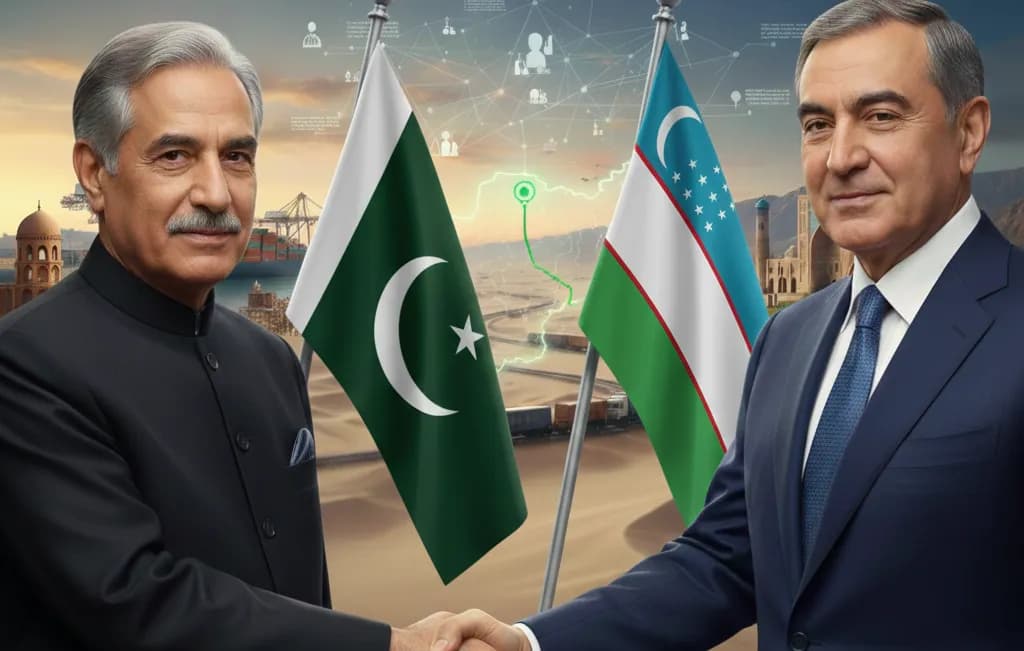
Pakistan and Uzbekistan have connected more deeply to each other in the recent past, and this has become a major part of Pakistan's overall plan to change its image as a regional trade and transit center. Prime Minister Shehbaz Sharif's visit to Tashkent in 2025 clearly indicates that Pakistan is making a strategic change faster than expected and that the relationship between the two countries has changed from being characterized by cautious diplomatic friendliness to being a practical partnership based on common economic interests and geographic reasoning along with the countries' mutual aim of cutting down the reliance on the old traditional trade routes.
Pakistan sees Uzbekistan as not a mere partner but a way to access the even larger Central Asian market consisting of consumer goods and energy. On the other hand, Uzbekistan sees Pakistan as an extra and direct route to the world trade and harbor that every Central Asian country, especially the ones in the midst of seeking economic qualifications, must not let go even in case of a slight challenge.
Sharif's trip was very close in time to his visit to Azerbaijan and is consistent with Islamabad's updated foreign policy that is centered on economic relations and regional interactions. The agreements in industry, power, finance, and military are not only signaling the change of the relationships but also indicating that they are deepening. The strategy of Pakistan is to take the route through its territory that becomes the critical corridor linking the landlocked heart of Central Asia with the Arabian sea thus establishing itself as the transport, energy, and logistics hub between regions that have long been separated by geography and political instability.
The UPTTA (the Uzbekistan–Pakistan Transit Trade Agreement) along with the Preferential Trade Agreement has been the first important step in the direction of smooth and fast movement of goods as well as reduction of tariffs on the already existing key items. Signing the $1 billion trade agreement in 2023 and the plans of starting direct flights have already been the signs of growing and flourishing ties.
Uzbekistan's interest is also of strategic importance. At the same time, the country is the most populated in the region, and the second biggest economy. By implementing its aggressive modernization plan under President Shavkat Mirziyoyev, Uzbekistan is keen to open up the market, have a wide array of partners, and become integrated with the region.
The shortest and cheapest route to access the international market for Uzbekistan would be through the ports of Pakistan, especially through Karachi and Gwadar, while Pakistan's increasing demand for energy would lead to a gas and electricity partnership. Shared concerns about the regional security situation, which is uncertain in the case of Afghanistan, have further deepened the interest alignment. Afghanistan stands as the geographical barrier to both countries and is the crucial point where connectivity should be established so that it is meaningful.
However, the prospects of Pakistan-Uzbekistan cooperation come with difficult structural issues. There are still gaps in infrastructure, the border regimes across Afghanistan are inconsistent, and the regional security conditions are fluctuating, all these have continued to block the realization of the transit ambitions to the full. In addition to this problem, both countries have to deal with the conflicting interests of mighty powers whose influences are instrumental in determining the connectivity of Central Asia, China with its Belt and Road corridors, Russia with its traditional economic and military ties, and the West with its selective investments. In this jam-packed geopolitical arena, Pakistan and Uzbekistan should take care that their bilateral vision does not merely become the victim of external rivalries or is not only considered as a marginal aspect in the bigger context of great-power designs.
Despite these constraints, the trajectory of Pakistan–Uzbekistan relations is unmistakably upward. Sharif’s participation in the Pakistan–Uzbekistan Business Forum, designed to facilitate B2B engagements, signals a shift toward private-sector-driven cooperation and long-term commercial linkages. For both countries, economic partnership is now seen as a foundation for a more stable and interconnected region. If Islamabad and Tashkent can sustain this momentum, address security bottlenecks and align their connectivity frameworks with regional stakeholders, their cooperation has the potential to reshape economic geography across Eurasia. In this context, Pakistan–Uzbekistan ties are no longer just a bilateral relationship, they are a critical element in the emerging architecture of regional integration linking South Asia, Central Asia and the broader Eurasian space.
Uroosa Khan
Contributing writer at EUReflect.
Follow EUReflect
See more of our reporting on Google
Mark EUReflect as a preferred source and our stories are ranked higher for you in Top Stories, Discover and Google News — and carry a “preferred” badge when they are cited in AI results.
Add EUReflect as a preferred source