Pension Reform: Belgium Between Budget Discipline and Social Uncertainty
The Belgian pension reform led by Bart De Wever aims to ensure long-term sustainability amid population ageing and rising public debt. It introduces a bonus–malus system, aligns public and private pension rules, and removes some privileges, but has triggered significant political and social debate.
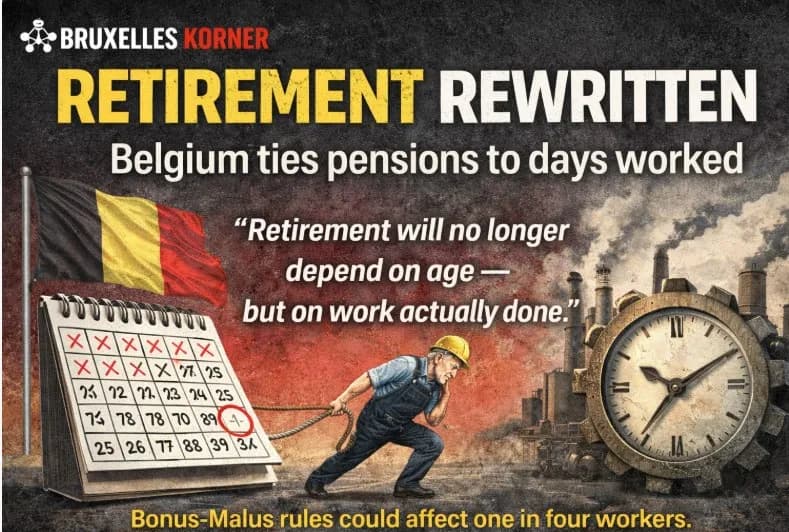
The pension reform initiated by the Belgian federal government led by Bart De Wever marks one of the most significant social a points of the decade in Belgium. Behind more than400 pages of technical legislation, the so-calledArizona coalition is attempting to answer a fundamental question: how can a retirement system be financed when confronted with rapid population ageing and rising public debt?
While the stated objective is long-term sustainability, the implementation of the reform is already raising serious questions. Between the introduction of abonus-malus mechanism, the disappearance of certain specific pension schemes, and the temporary inability of the online portalmypension.be to provide reliable estimates, Belgian citizens are entering a period of uncertainty rarely seen in the country’s social policy.
“Pensions will no longer depend on age… but on the number of days worked.”
A Pension System Under Demographic Pressure
The reform is based on a widely shared observation:Belgium’s pension system is becoming increasingly difficult to finance.
The country faces several structural challenges:
•rapid population ageing,
•high life expectancy,
•arelatively low employment rate,
•andpublic debt projected to reach 116% of GDP by 2029.
Within this context, pensions represent one of the largest expenditures of the Belgian state. According to government projections, the reform should reducethe cost of ageing by 1.7 percentage points of GDP by 2070.
However, the initial budgetary ambition has already been revised downward. While the government originally announced€2.4 billion in savings by 2029, the latest adjustments reduce the expected figure to€1.8 billion.
In other words, the reform remains structural, but itsshort-term fiscal impact appears more limited than initially announced.
Bonus–Malus: Working Longer to Avoid Penalties
The most emblematic measure of the reform is the introduction of abonus-malus system, designed to encourage longer careers.
The principle is straightforward: workers who leave thelabourmarket too early may face areduction in their pension, while those who extend their careers may receive abonus.
To avoid themalus, several conditions must be met:
•at least 35 years of career,
•7,020days of effective work,
•and156 days of work per year of career, compared with104 days previously.
Although this technical adjustment may appear minor, it fundamentally changes the logic of the pension system.
Itparticularlypenalizes:
•interruptedcareers,
•part-timeworkers,
•and individuals who experience periods of unemployment or illness.
According to the Minister of Pensions Jan Jambon,nearly one in four Belgians could be affected by the malus.
“When we work, we don’t count. But when pensions are calculated, everything will becounted.”
A Gradual Alignment Between Public and Private Sectors
Another objective of the reform is to reduce historical differences between pension regimes.
The case ofstatutory civil servants is particularly emblematic.
Until now, their pensions were mainly calculatedon the basis ofthe last ten years of salary, usually the most favorable years of a career. This system will gradually be aligned with the private sector model.
Eventually, civil servants’ pensions will be calculated overthe entire career — up to 45 years, a transformation that will be implemented progressively until2062.
Several specific mechanisms will also disappear:
•automatic pension indexation adjustments,
•certainpreferentialcalculation coefficients,
•and most notably themedical retirement pension.
The End of Medical Retirement for Civil Servants
One of the most sensitive measures concerns the abolition ofmedical retirement pensions within the public sector.
Currently, a civil servant deemed medically unfit for work can be placed in early retirement. StartingApril 1, 2026, this mechanism will disappear for new cases.
Civil servants concerned will instead fall under the standardinvalidity insurance regime managed by National Institute for Health and Disability Insurance,similar to private-sector employees.
The reform addresses a long-standing criticism: the previous system sometimes allowed relatively young public servants to permanently leave thelabour market.
However, it also implies asignificant financial transfer:
•€89 million in savings for the pension budget
•€126 million in additional costs for the health insurance system
The difference will partly be offset by introducingsocial security contributions for public employers, which were previously exempt.
Teachers at the Centre of Concerns
The education sector may be one of the most affected by this reform.
The figures arestriking:
•60,951 civil servants received a medical retirement pension in 2023
•10,917 French-speaking teachers were among them
•representing18% of the total.
TheFédérationWallonieBruxelles, already facing structural budgetary difficulties, could therefore be particularly exposed.
With more than123,000 teachers, and an increasing number on long-term sick leave, the abolition of medical retirement may create additional financial pressure.
At this stage, authorities acknowledge that it istoo early to estimate the exact budgetary impact.
mypension.be: An Information Blackout
Beyond political debate, the reform will also have a direct impact on citizens:a temporary lack of reliable information regarding their pensions.
The simulation platformmypension.be, widely used by Belgian workers to estimate retirement dates and pension amounts, must be completely recalibrated to integrate the new rules.
As a result, pension estimates will betemporarily suspendedonce the reform is adopted.
The planned timeline is gradual:
•Summer 2026: information on recognised career days
•Autumn 2026: first estimate of the earliest possible retirement date
•Mid-2027: estimation of pension amounts
•End of 2027: full simulations under different scenarios
During this transition period, millions of workers will therefore have to plan their futurewithout precise visibility regarding their retirement income.
A Structural Reform, but Politically Fragile
The pension reform clearly aims toensure the long-term sustainability of Belgium’s social model.
Yet the political debate remains intense.
According to some parliamentary analyses, uncertainties surrounding the reform could still createan additional budget gap of more than €3 billion by 2029.
Furthermore, theBelgian Court of Audit has already warned about the fragility of current fiscal projections.
In other words, even with this reform, Belgium will likely needadditional structural adjustments in the coming years.
Conclusion: A Necessary but Contested Reform
Belgium’s pension reform represents aprofound shift in social policy philosophy.
It introduces three key principles:
•working longer,
•reducingsector-specificadvantages,
•andcontrolling the cost of demographic ageing.
But it also highlights a political reality: pension reform remains one of themost sensitive decisions any government can take.
Behind fiscal calculations lies a fundamental issue for millions of citizens —the financial security of their retirement.
In a country where social balances have historically been fragile, the concrete implementation of this reform will likely becomeone of the most closely monitored political dossiers of the coming years.
In Summary
The reform changes the philosophy of the system:
•Before: age + minimum career
•Tomorrow: effective career + age
Which ultimately means thatretirement will increasingly be defined by the workactually performed throughout one’s professional life.
“In the new reform, retirement will no longer be measured by age… but by the work actually accomplished.”
Kadir Duran
Contributing writer at EUReflect.
Follow EUReflect
See more of our reporting on Google
Mark EUReflect as a preferred source and our stories are ranked higher for you in Top Stories, Discover and Google News — and carry a “preferred” badge when they are cited in AI results.
Add EUReflect as a preferred source