Putin and Xi put trade and energy first a day before Trump joins them
Vladimir Putin and Xi Jinping talked for more than two hours in Shenzhen on Wednesday, covering energy, finance and trade and, the Kremlin says, a settlement in Ukraine. No deals were announced; Europe and Central Asia will now watch Thursday's three-way summit with Donald Trump for any shift on sanctions, payments and gas.
The presidents of Russia and China, Vladimir Putin and Xi Jinping, met in Shenzhen on Wednesday 18 November, as China hosts this year's Asia-Pacific Economic Cooperation (APEC) leaders' week. Neither side announced a signed agreement or a gas contract. The Kremlin's transcript says the talks went on over a working breakfast with Foreign Minister Sergei Lavrov and presidential aide Yuri Ushakov; China's foreign ministry has published a Chinese-language readout.
Russian state news agency TASS reported that the talks ran for more than two hours from around noon local time. Russian officials had said energy and finance would come first, then a smaller session on foreign policy including Ukraine and North Korea, according to AFP. Afterwards, Kremlin spokesman Dmitry Peskov told Russian state news agency RIA Novosti that the leaders had discussed a settlement in Ukraine and that Putin had briefed Xi on his recent contacts with US envoys Steve Witkoff and Jared Kushner; Azerbaijan's APA carried the same account.
Later on Wednesday Xi greeted US President Donald Trump at Shenzhen's Bao'an airport, returning the welcome Trump gave him in the US in September, the Chinese foreign ministry said; CNBC also reported the arrival. On Thursday Xi hosts both men at what Beijing calls the China-Russia-US summit, which spokeswoman Mao Ning has described as the first face-to-face meeting of the three leaders, DPA reported.
All facts are as of 14:30 Brussels time on 18 November.
Business on the table
Ushakov set out Moscow's economic agenda two days earlier. "Naturally, energy and finance, high technologies, artificial intelligence, etc.," he said, according to Interfax. His delegation list leaned towards energy and money: Energy Minister Sergei Tsivilev, Deputy Prime Minister Anton Siluanov, the heads of Sberbank, VEB and Rosatom, and the bosses of Gazprom and Rosneft, Alexei Miller and Igor Sechin.
For companies, the line that matters sits in Beijing's account. There, Xi asks for a steadier, more predictable climate for investors and protection of the lawful interests of each side's firms, keeping current trade while adding new business. CNBC, citing Chinese state media, reported the same call. The readout also has Putin naming trade, energy and education as fields to deepen.
No contract for Power of Siberia 2 was announced. That pipeline would almost double the gas Russia sells to China, yet Putin's state visit to Beijing in May ended without a deal on it, The Moscow Times reported.
Trade itself has recovered. Putin told Xi that two-way trade had stayed above $200bn for several years and should grow this year, the Kremlin transcript shows; Ushakov put the first three quarters of 2026 at $216.4bn, against a record $245bn for all of 2024. Chinese customs data cited by The Moscow Times in January showed a 6.9 per cent fall in 2025, to $228.1bn, as Chinese car sales to Russia slumped and oil prices dropped. In the first half of 2026 trade rose 25.6 per cent to $134.2bn, according to Russia's trade mission in China.
The message to Europe
Hours before the talks, Putin used his speech to the APEC CEO Summit to attack Brussels. "The EU is losing its industrial capacity and competitive edge," he said, blaming its exit from the Russian market and the loss of cheap Russian energy. He claimed the dollar and euro share of Russia's export payments had dropped from 85 per cent in 2021 to 9 per cent, a figure EUReflect could not check independently, and said Moscow "did not turn our backs on the dollar or the euro". He also called for broad economic ties between the Eurasian Economic Union (EAEU) and China.
Brussels has been tightening in the other direction. The EU's 21st sanctions package, adopted on 23 July, put 51 more entities under stricter dual-use export controls, among them firms in Kazakhstan, Kyrgyzstan, Türkiye, the UAE, India and mainland China and Hong Kong. It also barred dealings with a Kyrgyz bank tied to SPFS, Russia's financial messaging system. For traders in Central Asia, a deeper Russia-China payments channel raises the cost of getting compliance wrong.
European capitals have a second worry. Euronews, drawing on AFP and AP, reported unease in Kyiv and across Europe that the three leaders could decide Ukraine's future without them. German President Frank-Walter Steinmeier has said Xi told him any Ukraine negotiations must involve Europe, RFE/RL reported.
What is still unknown
Whether Thursday's summit ends with a joint statement. Ushakov said on 16 November that one would follow, DPA reported.
Whether Putin and Trump hold separate talks. At Xi's reception for APEC leaders on Wednesday evening the two shook hands and exchanged a few words, a TASS correspondent reported; the BBC called it their first in-person encounter since the Alaska summit of August 2025. Ushakov said they would "definitely meet tomorrow" at and after the APEC plenary, TASS reported, but EUReflect found no White House confirmation of a bilateral meeting by 14:30 Brussels time.
How often Putin and Xi have met this year. AFP counts five contacts, one by video. The Kremlin version of Xi's remarks calls this their third in-person meeting; the Chinese readout has Putin saying four.
From China, Putin goes to Tajikistan on 19–20 November for talks with President Emomali Rahmon, the Kremlin said. Further reading: our coverage of the SCO summit in Bishkek, APEC as an opening for China-US cooperation and how Russia uses Chinese-linked technology on the battlefield.
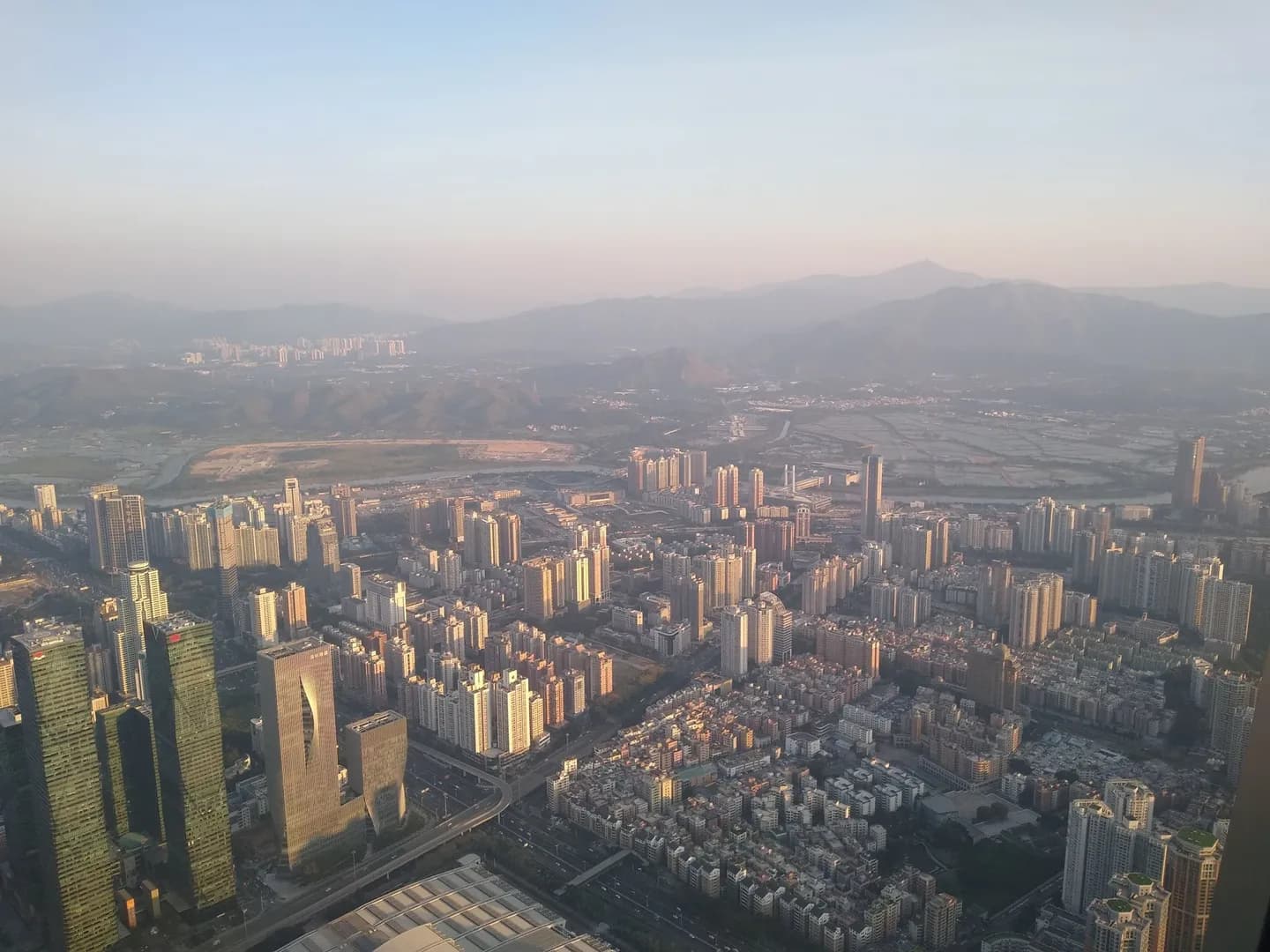
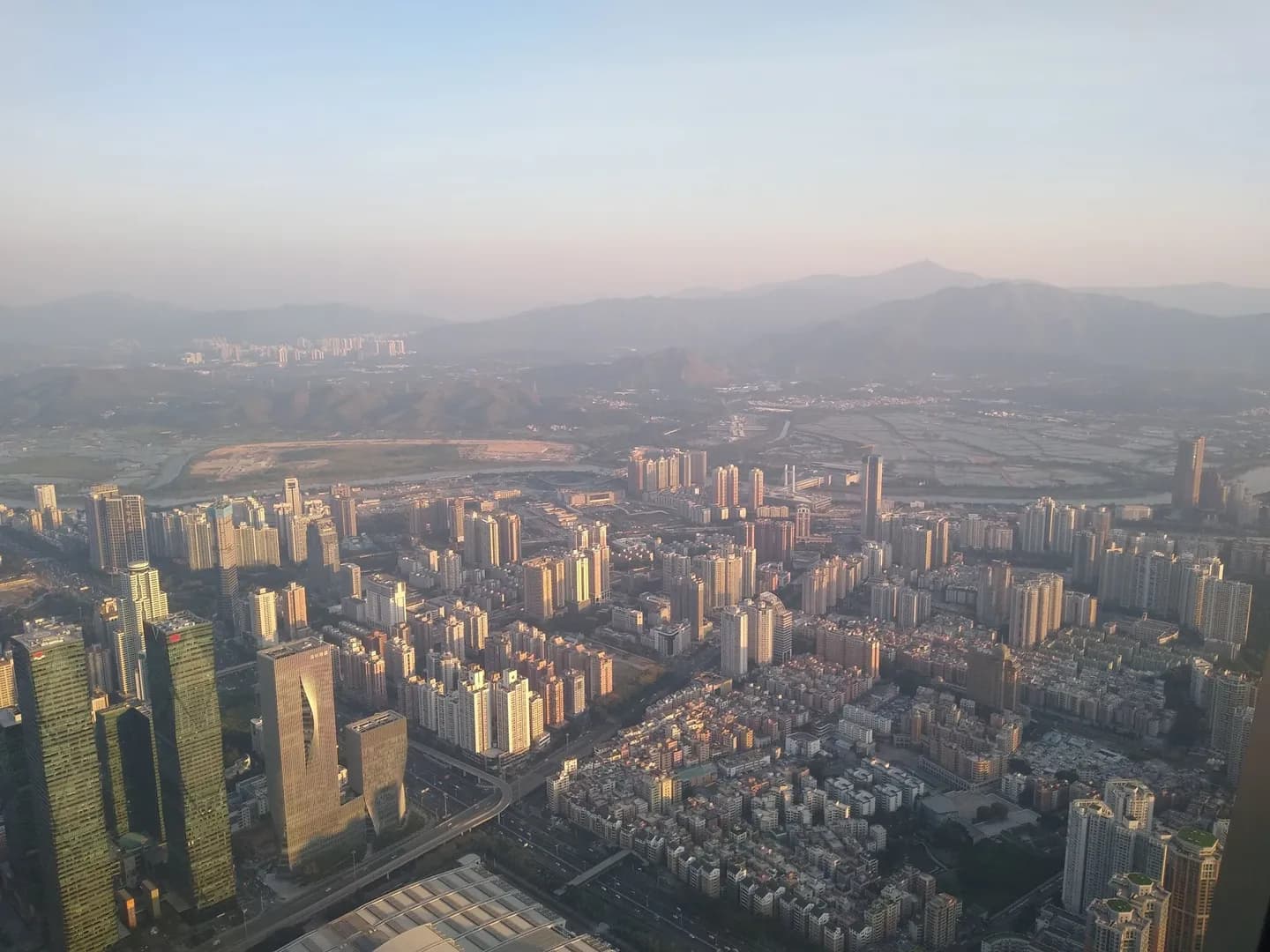
Main image: Shenzhen, the southern Chinese city hosting this week's APEC leaders' meetings, seen from the Ping An Finance Centre observation deck (file photo, 2019). Photo: Mx. Granger / Wikimedia Commons, CC0.
Related Topics
EUReflect News
Site Administrator
Follow EUReflect
See more of our reporting on Google
Mark EUReflect as a preferred source and our stories are ranked higher for you in Top Stories, Discover and Google News — and carry a “preferred” badge when they are cited in AI results.
Add EUReflect as a preferred source