Taiwan's Pivot to Self-Reliance: Asymmetric Defense
A pause in U.S. arms sales to Taiwan is pushing the island toward self-reliance and asymmetric defense — drones, mobile missiles, and indigenous production — though gaps in air defense coverage and institutional inertia remain major hurdles on the road to full strategic autonomy.
Introduction
The long-standing security relationship between Washington and Taipei has entered turbulent waters. Following a high-profile summit between U.S. President Donald Trump and Chinese President Xi Jinping, reports emerged that a $14 billion arms package to Taiwan had been placed on hold. According to Defense News, defense analysts across the region are now warning that any sustained interruption in U.S. arms transfers would accelerate Taiwan's push toward indigenous military capabilities — and, crucially, toward an unconventional warfare doctrine that relies less on expensive hardware and more on distributed, harder-to-destroy systems.
A Shift in Political Signals
For decades, U.S. arms sales to Taiwan have served a dual purpose: they provide tangible military hardware while simultaneously functioning as a diplomatic signal of American commitment to the island's security. When that pipeline is disrupted, even temporarily, the political message is impossible to ignore. Analysts quoted in Defense News argue that the delay could cause Beijing to reassess American resolve, potentially lowering the threshold for coercive action in the Taiwan Strait.
This tension is not entirely new. As researchers writing for The Diplomat have documented, Washington and Taipei have long disagreed over what Taiwan actually needs. The U.S. has consistently pushed Taiwan to invest in cost-effective, rapidly deployable asymmetric tools — drones, mobile missile launchers, anti-ship missiles — rather than prestige platforms like fighter jets and early-warning aircraft. Taiwan's military establishment, meanwhile, has resisted fully abandoning conventional forces, arguing that some baseline of symmetric capability is necessary to deter lower-intensity gray-zone provocations on a daily basis.
The Asymmetric Option: Drones, Missiles, and Indigenous Production
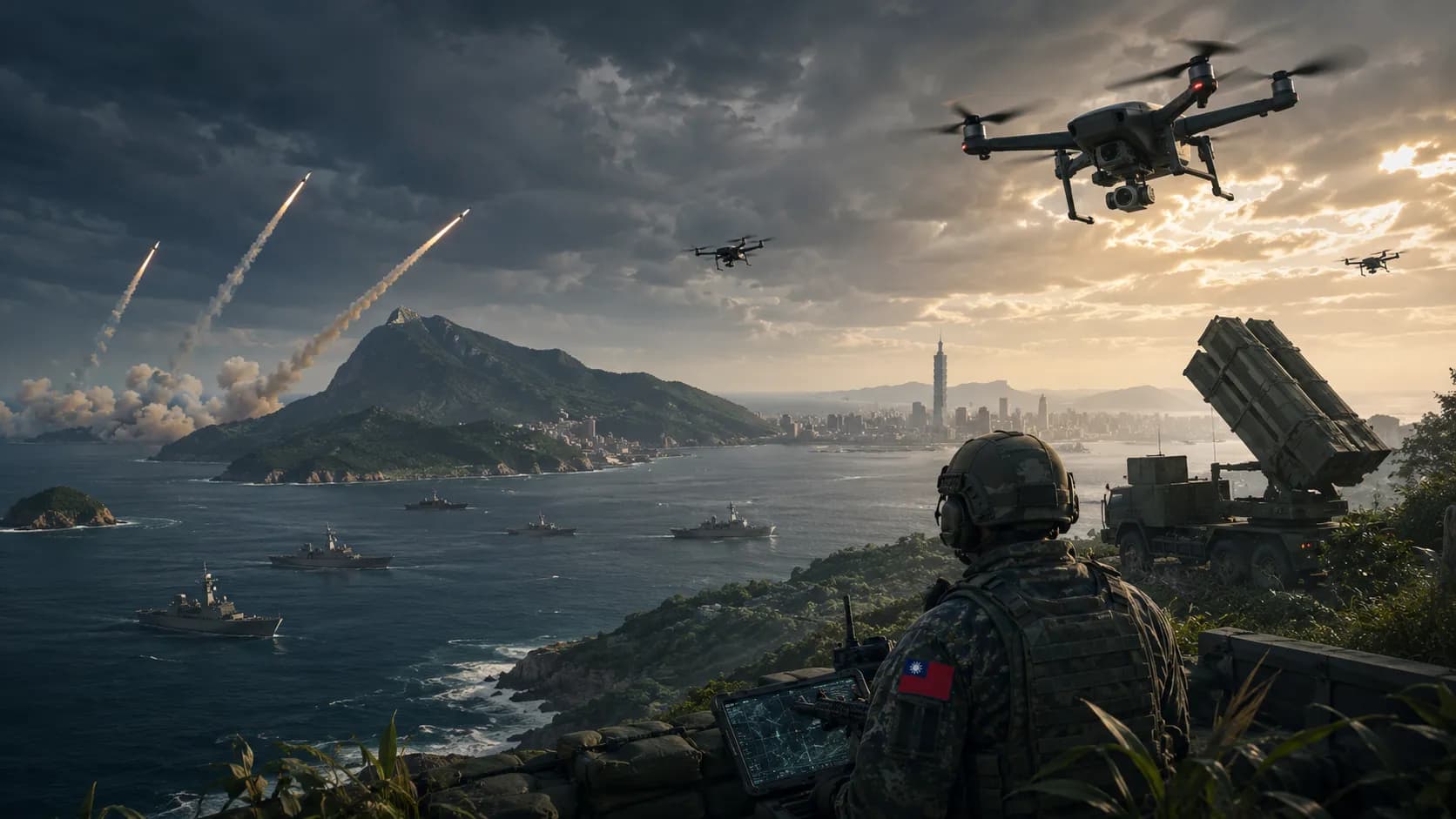
The logic of asymmetric warfare is straightforward: a smaller force compensates for numerical disadvantage by raising the cost of an attacker's victory beyond what is politically or militarily acceptable. For Taiwan, this translates into dense networks of anti-ship missiles, mobile rocket artillery systems such as HIMARS, swarms of unmanned aerial vehicles, and hardened coastal defenses — systems that are cheap to produce, easy to disperse, and difficult for an invader to neutralize in a first strike.
Taiwan's Overall Defense Concept (ODC), developed under former Chief of the General Staff Admiral Lee Hsi-min, laid out this framework clearly: rather than matching China's military might platform for platform, Taiwan should maximize its geographic advantages and make an amphibious assault prohibitively costly. President Lai Ching-te's eight-year modernization program, announced in February 2026, reflects this thinking, explicitly targeting "asymmetric capabilities across seven major categories." The temporary pause on PAC-3 missile batteries and other items from the stalled U.S. package is already prompting Taipei to accelerate domestic drone manufacturing and expand its own munitions production lines.
Limits of Self-Sufficiency and the Gap That Remains
Despite the strategic appeal, Taiwan faces real obstacles in replacing American hardware with homegrown alternatives. Domestically produced munitions are not yet fully networked into a comprehensive, integrated defense architecture. Taiwan also lacks sufficient air-defense interceptors to protect critical infrastructure across the entire island — a gap that PAC-3 systems from the now-paused deal were specifically meant to fill. Even if Taipei fast-tracks indigenous production, defense analysts note that some of the most sophisticated systems — advanced radar integration, certain missile components — will remain dependent on foreign supply chains for years to come.
There is also an institutional resistance to change. Generations of Taiwanese officers have trained in conventional warfare doctrines, and career advancement within the armed forces has historically rewarded expertise in legacy platforms. A rapid pivot to asymmetric systems introduces genuine uncertainty for military personnel and could, if handled poorly, hollow out institutional knowledge before new capabilities mature.
Conclusion
The potential interruption of U.S. arms transfers to Taiwan, whatever its ultimate diplomatic resolution, has clarified a strategic reality that many analysts had long anticipated: Taiwan cannot afford to outsource its defense planning entirely to Washington. The island is now being nudged — perhaps pushed — toward a model of greater self-reliance, centered on the kind of distributed, low-cost, high-lethality capabilities that make any would-be aggressor pause. The road to genuine strategic autonomy is neither short nor smooth, but the current moment may well prove to be the catalyst that finally moves Taiwan's defense posture decisively in that direction.
Botakoz Unbayeva
Contributing writer at EUReflect.
Follow EUReflect
See more of our reporting on Google
Mark EUReflect as a preferred source and our stories are ranked higher for you in Top Stories, Discover and Google News — and carry a “preferred” badge when they are cited in AI results.
Add EUReflect as a preferred source