The $1bn Pledge: Can Pakistan–Kazakhstan Deliver This Time?
Despite diplomatic optimism, Pakistan’s pledge to raise trade with Kazakhstan to $1bn faces structural limits. Weak logistics, unreliable infrastructure, policy inconsistency, and poor implementation capacity mean ambitious targets risk remaining symbolic unless backed by concrete institutional reforms.
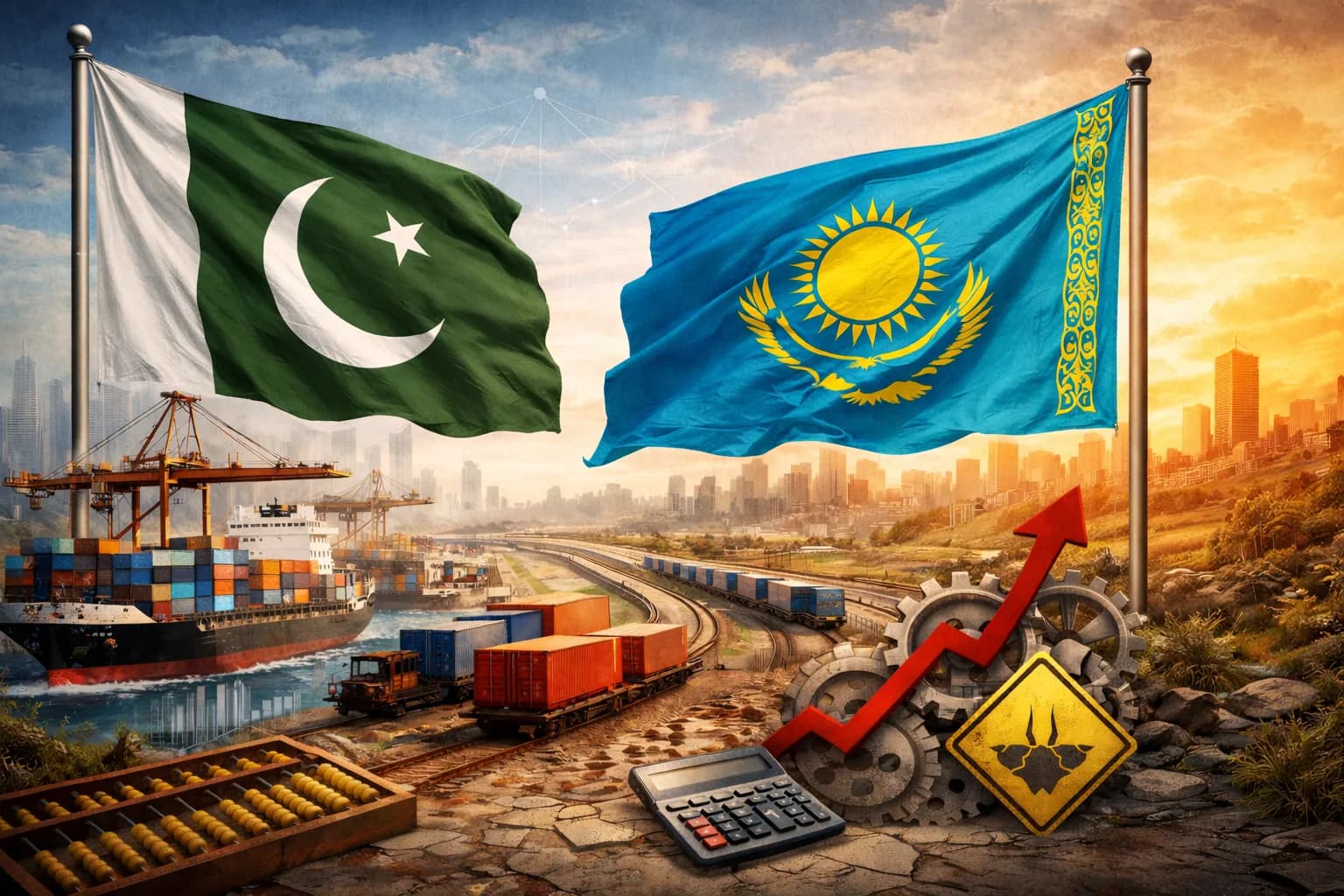
The recent high-level visit of Kazakhstan’s President Kassym-Jomart Tokayev to Islamabad has been framed as a diplomatic success, marked by warm statements, ceremonial honours, and an ambitious pledge to raise bilateral trade between Pakistan and Kazakhstan to$1 billion within a year. While such announcements create positive headlines, public policy demands amore sober assessment. The central question is not whether cooperation is desirable; it is,but whether Pakistan currently possesses the institutional and economic capacity to deliver on such commitments.
Pakistan–Kazakhstan trade stands at roughly $250 million, a modest figure that reflects years of limited commercial engagement. Expecting a fourfold increase in twelve months ignores the structural barriers that have constrained trade growth so far. Trade expansion is driven by supply chains, logistics efficiency, financial facilitation, and regulatorycertainty, notpolitical declarations.
Pakistan’s economic history offers little evidence that ambitious targets alone lead to outcomes. Export strategies have frequently failed due to inconsistent policies, weak coordination among ministries, and a lack of follow-through. Without a clearly defined, sector-wise roadmap supported by institutional reforms, the $1bn target risks becoming symbolic rather than achievable.
Pakistan’s reliance on Memorandums of Understanding as indicators of progress is a recurring weakness. MoUs express intent but do not bind governments or businesses to action. The country has signed hundreds of such documents over the past decade with minimal economic impact. What remains missing is an implementation framework with deadlines, performance indicators, and accountability. Unless each agreement is tied to measurable deliverables and monitored by a dedicated joint mechanism, these MoUs may simply add to Pakistan’s expanding archive of unimplemented commitments.
Much of the optimism surrounding the Kazakhstan partnership rests on Pakistan’s promise of regional connectivity. Access to Karachi and Gwadar ports could, in theory, help Kazakhstan diversify its trade routes amid geopolitical disruptions inEurasia. However, most proposed corridors pass throughAfghanistan, a region where security, governance, and regulatory predictability remain fragile.
Beyond regional instability, Pakistan’s domestic infrastructure poses serious challenges. Railways suffer from inefficiency, logistics costs are among the highest in the region, and customs procedures remain slow and discretionary. Without addressing these internal bottlenecks, Pakistan cannot credibly market itself as a reliable transit hub.
Energy cooperation and joint industrial ventures have been highlighted as key areas of collaboration. Yet Pakistan’s track record in the energy sector, marked by contractual disputes, circular debt, and abrupt policy shifts, undermines investor confidence. Foreign partners evaluate risk through experience, not assurances. Industrial cooperation faces similar constraints. Frequent tax changes, complex regulations, and weak contract enforcement continue to discourage long-term investment. Without legal certainty and policy stability, large-scale Kazakh investment is likely to remain cautious.
Diplomatic warmth and personal praise between leaders may strengthen political ties, but economic outcomes depend on institutions rather than individuals. Pakistan’s deeper economic problems, low productivity, a narrow export base, and chronic balance-of-payments pressures, cannot be addressed through foreign visits alone. Publicly celebrating ambitious targets without preparing the domestic economy risks creating unrealistic expectations. When such promises remain unfulfilled, they deepen public cynicism and weaken the credibility of future initiatives.
Pakistan frequently asserts that it is transitioning from geopolitics togeoeconomics. This partnership with Kazakhstan offers a genuine test of that claim. Success would require reforms in customs, logistics, taxation, and tradefacilitation areas that demand political discipline rather than diplomatic ceremony.If Pakistan fails to move beyond rhetoric, the initiative will reinforce perceptions that the country excels at announcements but struggles with execution.
For this partnership to yield results, Pakistan must:
•Adoptrealistic, phased trade targets instead of headline figures
•Establish a permanent Pakistan–Kazakhstan implementation body
•Modernise rail, port, and customs systems
•Guarantee regulatory and tax stability for investors
•Actively support exporters with credit and market access
Thus, the Pakistan–Kazakhstan trade pledge reflects genuine opportunity, but opportunity alone does not generate trade. Without institutional reform and disciplined implementation, the $1bn target will remain aspirational. The coming year will determine whether Pakistan can finally convert diplomatic goodwill into economic performance or whether this episode will be remembered as another case of ambition outpacing reform.
Uroosa Khan
Contributing writer at EUReflect.
Follow EUReflect
See more of our reporting on Google
Mark EUReflect as a preferred source and our stories are ranked higher for you in Top Stories, Discover and Google News — and carry a “preferred” badge when they are cited in AI results.
Add EUReflect as a preferred source