The AI Race: Where the US and China Draw Their Strength
China's DeepSeek built a competitive model with a team of about 200 engineers, while Moonshot's Kimi K3 launch rattled Silicon Valley.
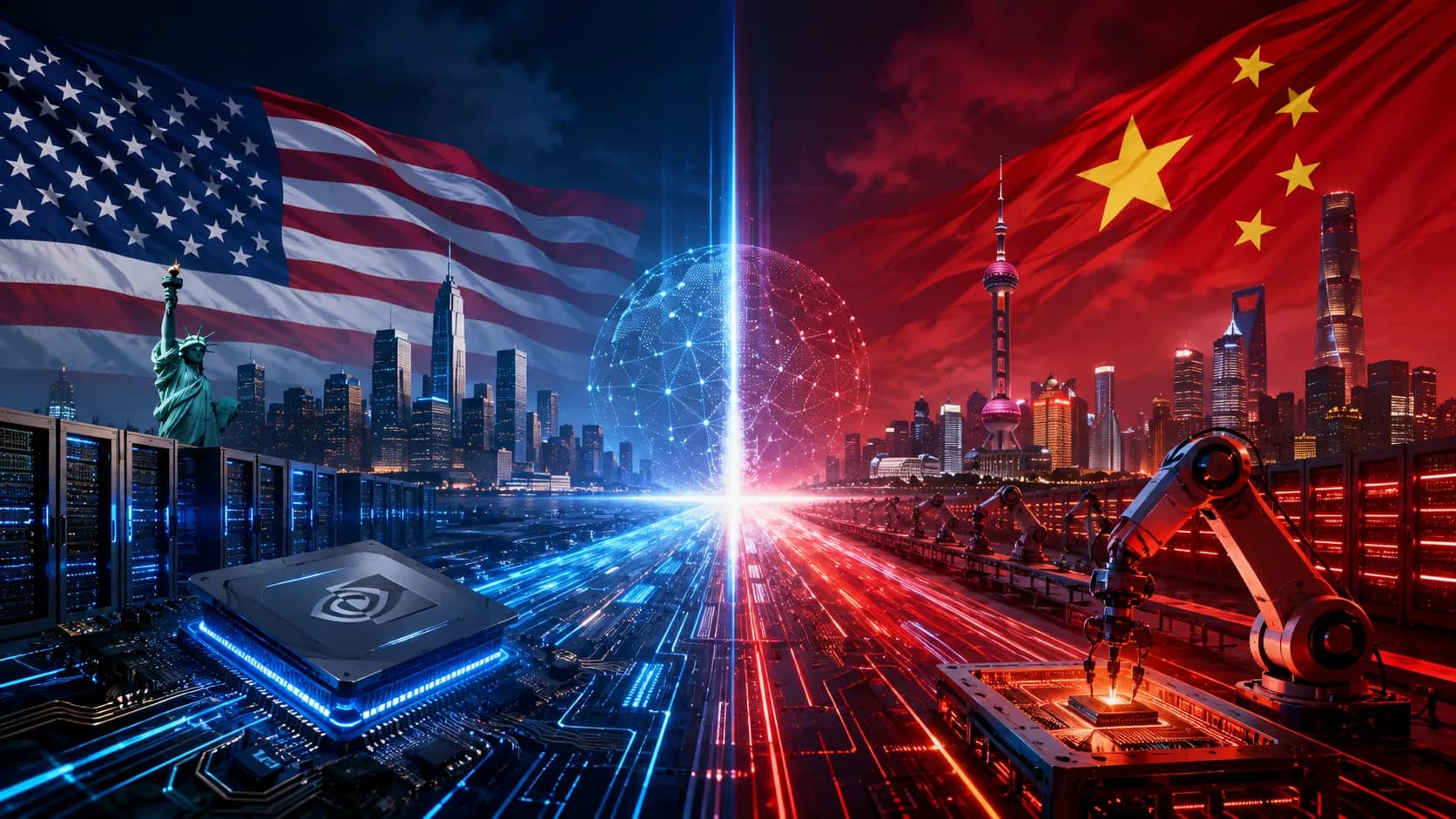
As 2026 unfolds, the global artificial intelligence race has become a strategic contest waged directly between governments, not just tech companies. The United States and China are each placing trillion-dollar bets across chip manufacturing, data center investment, and frontier model development. Here's where each side's strength comes from.
The United States: Capital and Chip Dominance
The United States has built the world's most advanced AI research ecosystem. According to Raedan Institute's analysis, this strength rests on the concentration of top researchers in the US, access to the most advanced semiconductor hardware — produced by Nvidia and manufactured in Taiwan — and the largest domestic market of early commercial AI adopters. Washington has also shifted from a largely hands-off approach to an active industrial policy, driven partly by concern over China's AI capabilities.
The numbers back this up: according to Wikipedia's compiled data, US AI investment exceeded $700 billion in 2026. Google, Microsoft, Meta, and Amazon together announced spending plans of more than $1 trillion for 2025-2026, much of it financed through debt markets. Deep private-sector dynamism and research depth remain the core of the American approach, as noted in Investing.com's coverage of BofA Global Research.
China: Speed, Scale, and State-Backed Efficiency
China's strength lies in a very different playbook: state-led scaling, lower energy costs, and centralized control over the critical minerals essential for hardware production, as Investing.com's BofA-based analysis points out. Chinese labs have shown they can produce highly competitive models on lean budgets. According to Foreign Policy, Moonshot's launch of Kimi K3 sent shockwaves through Silicon Valley, and DeepSeek demonstrated that a team of roughly 200 engineers could build a model with strong benchmark performance and offer it to users worldwide for free.
China's momentum also carries a geopolitical dimension. As The China Academy reports, President Xi Jinping used his keynote at the 2026 World AI Conference to emphasize China's commitment to providing international public goods in AI — signaling that Beijing sees its AI strength as extending beyond domestic capability into global influence and rapid real-world deployment, particularly in manufacturing and robotics.
Conclusion
Both powers draw on fundamentally different sources of strength — the US on capital depth, chip supply chains, and private-sector innovation; China on state-backed scale, cost efficiency, and rapid deployment. Together, these two very different models are what's driving the pace of the global AI race forward.
Alvara Merrick
Contributing writer at EUReflect.
Follow EUReflect
See more of our reporting on Google
Mark EUReflect as a preferred source and our stories are ranked higher for you in Top Stories, Discover and Google News — and carry a “preferred” badge when they are cited in AI results.
Add EUReflect as a preferred source