Small EU States Turn Brussels Funding Into Tech Power
Latvia's EU-backed investments are shifting from basic digital services to deep tech, including a federal cloud and advanced digital skills, as part of its recovery plan.
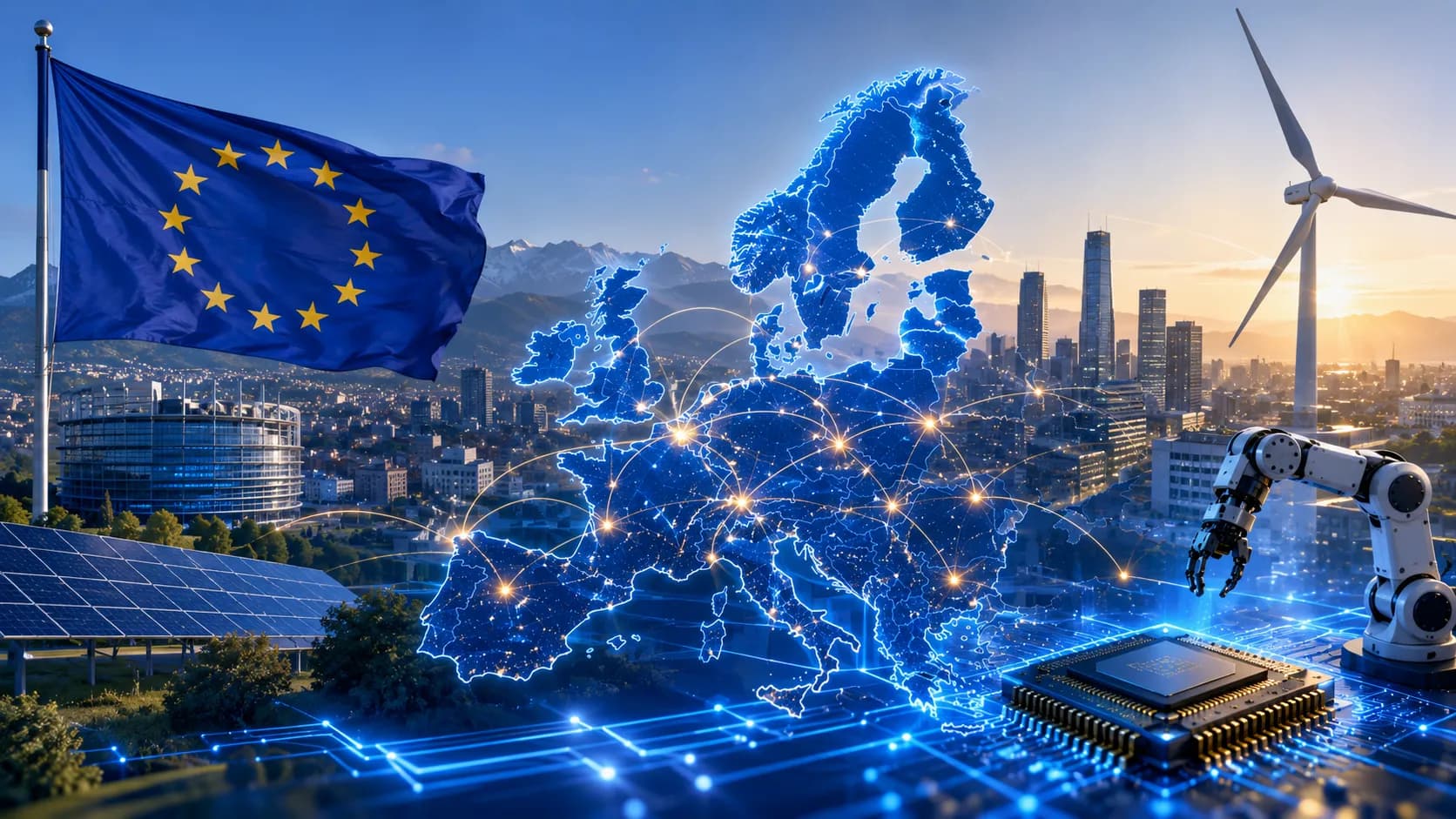
Europe’s smaller economies are increasingly using European Union funding to overcome one of their biggest disadvantages in the global technology race: scale.
Countries such as Estonia, Latvia, Lithuania, Malta, Cyprus, Slovenia and Croatia cannot match the domestic investment capacity of Germany, France or other major European economies. But EU financing mechanisms are allowing smaller member states to invest in artificial intelligence, cybersecurity, semiconductors, digital public services, high-speed connectivity and advanced research at levels that would be considerably more difficult to finance through national budgets alone.
The trend has become increasingly visible in 2026 as Brussels seeks to reduce technological differences between EU members while strengthening Europe’s overall competitiveness against the United States and China.
Billions Flow Into Digital Transformation
The EU's support does not come through a single technology fund.
The Recovery and Resilience Facility, Cohesion Policy, Horizon Europe and the Digital Europe Programme operate together, financing infrastructure, research institutions, startups, digital skills and the adoption of advanced technologies.
Digital Europe alone has an overall budget exceeding €8.1 billion, targeting areas including supercomputing, artificial intelligence, cybersecurity, advanced digital skills and semiconductor capabilities. It also supports European Digital Innovation Hubs that help SMEs and public institutions adopt new technologies.
The broader scale is much larger. According to the European Commission's 2026 Digital Decade assessment, national digital roadmaps contain 1,934 measures worth €289.3 billion, including €205.9 billion from public budgets.
For Europe's smaller economies, access to this wider financial ecosystem can significantly accelerate technological development.
Estonia Builds on Its Digital Advantage
Estonia is already internationally recognized for digital government, but EU resources are helping the country move beyond basic digitalisation.
According to the Commission's 2026 assessment, approximately €208 million of Estonia's Recovery and Resilience Plan contributes to digital transformation, while around €400 million of Cohesion funding is also contributing to the country's digital transition.
The next challenge is increasingly sophisticated: cybersecurity, AI capabilities and ICT talent.
Estonia therefore illustrates how EU funding can evolve from supporting basic infrastructure toward financing the technological capabilities required for the next generation of the digital economy.
Latvia Moves Toward Deep Technology
Latvia represents another important example.
EU-backed investment has helped the country develop digital public services, SME digitalisation, connectivity and skills. Its Recovery and Resilience Plan includes major investments in public-sector digitalisation, business transformation and digital skills, alongside the development of the Latvian Federal Cloud.
The country's ambitions are now moving further.
The Commission's latest assessment highlights Latvia's expanding startup ecosystem as well as cooperation in quantum technologies and semiconductors across the Baltic region. Latvia already has strong 5G coverage, although fibre infrastructure, SME digitalisation and cybersecurity remain important weaknesses.
This transition demonstrates how EU funding can help smaller countries move from consuming technology toward participating in its development.
Malta Uses EU Funding to Overcome Scale
For Malta, the impact of European financing is particularly visible because of the country's small population and economy.
Approximately €68 million from Malta's Recovery and Resilience Plan contributes to digital transformation, while another €110 million in Cohesion funds is allocated toward the country's digital transition.
These figures may appear relatively modest compared with investment in Europe's largest economies. Relative to Malta's size, however, they represent substantial technological development capacity.
The broader strategic objective is clear: small states do not need enormous domestic markets if European financing allows them to build specialized technological niches connected to the wider EU Single Market.
Croatia and Slovenia Expand Their Technology Base
Croatia provides an even larger example of this investment model.
Around €1.5 billion from Croatia's Recovery and Resilience Plan contributes to digital transformation, while approximately €900 million in Cohesion funds is directed toward digital development.
Slovenia, meanwhile, is positioning itself in several technologies traditionally associated with Europe's largest industrial economies.
The country is participating in European initiatives covering semiconductors, cloud computing, AI and quantum technologies. Its national Digital Decade roadmap contains 82 measures with a budget of approximately €555 million, while roughly €500 million from its Recovery and Resilience Plan contributes to digital transformation.
For Slovenia, the challenge is increasingly not infrastructure alone but transforming technological capabilities into globally competitive companies.
Lithuania Connects Rural Regions to the Digital Economy
Lithuania is also using European financing to address structural disadvantages.
Its Recovery and Resilience Plan includes €73 million for connectivity, including very-high-capacity networks, 5G and fibre infrastructure in rural and remote regions.
Such investment demonstrates another dimension of EU technology policy.
Brussels is not only financing AI laboratories or semiconductor projects. It is also financing the underlying digital infrastructure that allows smaller and geographically dispersed economies to participate in Europe's technology market.
Closing Europe’s Innovation Gap
Perhaps the clearest expression of this strategy is Horizon Europe's Widening Participation and Spreading Excellenceprogramme.
The European Commission officially classifies 15 countries — including Croatia, Cyprus, Estonia, Latvia, Lithuania, Malta, Slovakia and Slovenia — as “Widening countries.”
The programme is specifically designed to strengthen research institutions, scientific networks and innovation ecosystems in countries where research and innovation capabilities remain below Europe's strongest regions.
New instruments introduced in 2026 are supporting research management and cooperation between European Centres of Excellence.
The objective is increasingly strategic.
Europe cannot become technologically independent if advanced research, AI, semiconductor capabilities and innovation remain concentrated in only a handful of large countries.
Small Countries Could Become Specialized Tech Hubs
The emerging European model therefore does not require Malta, Estonia or Slovenia to become another Germany.
Instead, Brussels is effectively helping smaller states develop specialized technological capabilities while connecting them to a continental research, investment and industrial network.
Estonia can specialize in digital government and cybersecurity. Latvia and Lithuania can deepen their roles in Baltic technology and digital infrastructure. Slovenia can participate in semiconductors, quantum technology and AI. Malta and Cyprus can use their smaller administrations and markets as environments for rapid digital experimentation.
The significance extends beyond individual countries.
For the EU, reducing technological differences between member states is becoming part of its broader competition with the United States and China. Europe's smaller economies are therefore no longer simply recipients of regional development assistance.
Increasingly, they are becoming laboratories for Europe's technological transformation.
Alvara Merrick
Contributing writer at EUReflect.
Follow EUReflect
See more of our reporting on Google
Mark EUReflect as a preferred source and our stories are ranked higher for you in Top Stories, Discover and Google News — and carry a “preferred” badge when they are cited in AI results.
Add EUReflect as a preferred source