The Bangui Arrangement
The Central African Republic has agreed to accept third-country deportees from the US under a deal struck in Bangui in May. The arrangement, part of Trump’s broader African deportation network, raises urgent legal and human rights concerns over due process and international protection law.
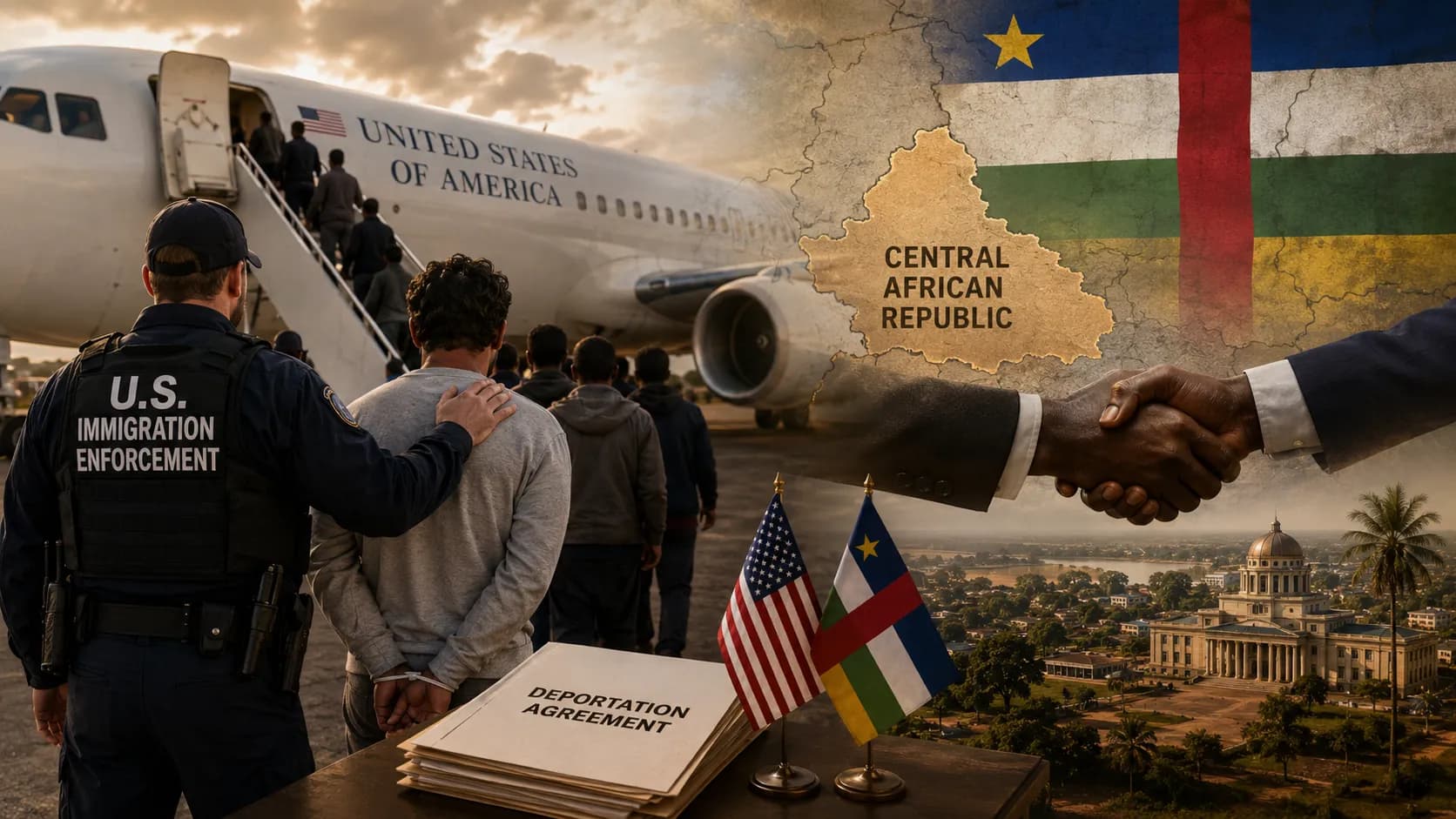
The Central African Republic has agreed to receive migrants deported by the United States who are nationals of other countries, two sources with direct knowledge of the arrangement confirmed to Reuters on Sunday. The development marks a significant expansion of the Trump administration’s controversial third-country deportation programme, which has seen the United States negotiate bilateral agreements with a growing number of African nations to facilitate the removal of individuals who cannot, for legal or diplomatic reasons, be returned directly to their countries of origin.
The deal places the Central African Republic — one of the world’s poorest and most fragile states, home to approximately 5.5 million people and still recovering from decades of recurring armed conflict and political instability — alongside a short but growing list of African countries that have entered into such arrangements with Washington. Previous agreements have been concluded with the Democratic Republic of Congo, Ghana, Sierra Leone, and Equatorial Guinea, according to sources cited in earlier Reuters reporting. In each case, the agreements have been characterised by a notable lack of transparency, with Senate Democrats describing them as costly, opaque, and legally questionable.
The latest revelation has intensified scrutiny of a deportation strategy that critics say systematically bypasses the legal protections afforded to migrants under United States immigration law, and which rights organisations argue may place vulnerable individuals in countries where they have no cultural, linguistic, or personal ties — and where the state’s capacity to receive and integrate them is severely limited.
The Bangui Agreement: Diplomacy Behind Closed Doors
According to a Central African government official who spoke to Reuters on condition of anonymity, the agreement was formally discussed during a meeting held on 18 May in Bangui, the country’s capital. The talks were led on the American side by Christian Jové Ehrhardt, the State Department’s Deputy Assistant Secretary in the Bureau of Population, Refugees and Migration — a senior figure whose bureau oversees U.S. engagement on international migration and humanitarian affairs.
The Central African official confirmed the substance of the arrangement in unambiguous terms. “Central African Republic will indeed take in, within the framework of agreements with the U.S., immigrants deported by American authorities,” the official stated. A diplomat based in the region, also speaking anonymously, independently corroborated the account, confirming that a deal had been reached between the two governments.
The precise operational details of the agreement remain unclear. Neither source was able to provide information on the nationalities of those who would be sent to the country, the total number of individuals anticipated, or the timeline for the commencement of deportation flights. However, the existence of at least one concrete attempt to implement the arrangement has already been documented in the American legal system. On 22 May, U.S. District Judge Lee Rosenthal issued a temporary restraining order blocking the deportation of a Turkish national, after court filings revealed that American officials had been planning to remove the individual to the Central African Republic as early as 26 May. The case offers a rare window into the operational mechanics of a programme that has, until now, largely been shielded from public view.
Washington has consistently maintained that all deportations carried out under these agreements are lawful and that deportees are afforded full due process. The Department of Homeland Security reiterated this position in response to Reuters’ enquiries, while directing specific questions about the terms of the agreements to the State Department. Neither the Central African presidency nor the State Department responded to requests for comment.
Legal Concerns and Human Rights Implications
At the heart of the controversy surrounding the third-country deportation programme lies a fundamental legal tension. In many of the cases documented so far, individuals targeted for removal under these arrangements had previously obtained legal protections from United States immigration courts — protections specifically granted to prevent their repatriation to countries where they face a credible risk of persecution, torture, or other serious harm. Human rights organisations argue that by transferring such individuals to third countries, the U.S. government is effectively circumventing the judicial determinations of its own courts.
The implications are profound. An individual who has been granted withholding of removal or protection under the Convention Against Torture, for example, may find themselves deported not to their home country — where the court determined they faced danger — but to a third country with which they have no connection, and where the legal basis for their protection may not be recognised or enforced. Critics contend that this practice not only undermines the integrity of the U.S. immigration court system but may also violate binding obligations under international law, including the principle of non-refoulement, which prohibits the transfer of individuals to places where they face serious risks to their safety.
Senate Democrats have raised these concerns directly, describing the third-country agreements as both legally questionable and financially costly, with cumulative expenditures estimated in the tens of millions of dollars. The administration has not publicly disclosed the full financial terms of individual agreements, and the criteria by which partner countries are selected have not been made transparent. The combination of high costs, limited oversight, and serious legal questions has prompted calls from civil liberties advocates and members of Congress for a comprehensive review of the programme.
For the Central African Republic — a country that has itself been the subject of international humanitarian concern for decades, and where large portions of the population have been displaced by ongoing internal conflict — the capacity to receive, house, and integrate an unknown number of foreign nationals with no prior connection to the country remains deeply uncertain. The country’s fragile institutional infrastructure and severe resource constraints raise additional questions about the welfare of those who may be sent there under the terms of the agreement.
IOM Involvement and the Geopolitical Context
The International Organization for Migration (IOM), the leading intergovernmental body responsible for migration assistance worldwide, has confirmed that it will play a role in supporting deportees upon their arrival in the Central African Republic. An IOM official told Reuters that the agency would be involved in providing assistance to individuals once they reach the country, consistent with the role the organisation has already played in relation to third-country deportees sent to other African nations, including the Democratic Republic of Congo.
The involvement of the IOM is significant both practically and symbolically. Practically, it suggests that the logistical infrastructure for receiving deportees is being put in place, lending credibility to reports that the programme is further advanced than official silence might suggest. Symbolically, the IOM’s participation lends a degree of institutional legitimacy to an arrangement that has otherwise attracted considerable criticism. The agency’s engagement does not, however, address the underlying legal and ethical objections raised by rights groups, which relate not to the conditions of arrival but to the fundamental lawfulness of the removals themselves.
The United States has this year awarded $85 million to the IOM for its operations in the Central African Republic — a substantial investment that predates the deportation agreement but which may take on new significance in light of the agency’s confirmed role. An IOM spokesperson did not immediately respond to a request for comment on the specifics of the arrangement or on how the agency reconciles its humanitarian mandate with participation in a programme that rights groups say may violate international protection standards.
The geopolitical dimensions of the agreement are also notable. The Central African Republic, under President Faustin-Archange Touadera — who secured a third term in elections held in December — has in recent years forged a close security partnership with Russia, relying heavily on Russian military personnel and the Wagner Group’s successor forces to maintain internal stability. At the same time, Touadera has signalled a renewed openness to Western engagement, particularly in relation to the country’s substantial endowment of critical minerals. Analysts suggest the deportation agreement may be understood partly in this context — as a signal of Bangui’s willingness to accommodate Washington’s priorities in exchange for continued U.S. financial support and diplomatic goodwill.
Conclusion: A Policy Under Scrutiny
The agreement between the United States and the Central African Republic to accept third-country deportees represents a further escalation of a contentious immigration enforcement strategy that has drawn sustained criticism from legal scholars, human rights advocates, and members of the U.S. Congress. By expanding the network of African partner countries willing to receive individuals with no prior connection to their territories, the Trump administration is pushing the boundaries of what immigration law has traditionally permitted — and doing so, critics argue, with insufficient transparency and inadequate judicial oversight.
For the individuals caught in the mechanism of these arrangements — people who, in many cases, have spent years building lives in the United States and have obtained legal protections through its courts — the consequences are potentially devastating. To be deported not to one’s home country but to a third state, often one of the poorest and most unstable in the world, without linguistic familiarity, social networks, or legal standing, represents a profound rupture. The full human cost of this policy remains to be seen.
As the programme continues to expand, and as more details emerge through court proceedings and investigative reporting, the pressure on Washington to provide a full public accounting of its third-country deportation agreements is likely to grow. The coming weeks, as the Central African Republic deal moves from negotiation toward implementation, will provide a critical test of both the administration’s legal arguments and its stated commitment to due process for all those subject to removal.
Botakoz Unbayeva
Contributing writer at EUReflect.
Follow EUReflect
See more of our reporting on Google
Mark EUReflect as a preferred source and our stories are ranked higher for you in Top Stories, Discover and Google News — and carry a “preferred” badge when they are cited in AI results.
Add EUReflect as a preferred source