The Impact of Nutrition on Periodontal Health
Periodontal health has relations with numerous factors like health of the individual, nutrition, oral hygiene, genetic influences and environmental conditions. It’s certain that receiving adequate nutrition has a crucial role in maintaining health, particularly for periodontal health. Healing after periodontal surgery, oral tissue tends to heal itself more effectively than other tissues, although with an aided balanced diet it could be made to progress faster. There is a correlation between tooth loss, periodontal health and nutrition. Moreover bone formation and periodontal regeneration are also affected by vitamins, minerals and trace elements. The aim of this review is to understand the relationship of diet, periodontal health and periodontal healing in a more detailed fashion.
INTRODUCTION
Periodontitis is explained as “a chronic inflammatory disease affecting supportive tissues of the teeth”. If untreated, it leads to the loss of the alveolar bone and loss of teeth over time (Newman et al., 2012; Pihlstrom et al., 2005). An important amount of people suffer from this disease frequently, which makes it one of the most prevalent epidemics worldwide. Various factors can trigger the infection; The primary cause is poor oral hygiene, which leads to the formation of dental plaque containing microorganisms, more specifically biofilm. In addition to these local elements, a number of systemic factors such as diabetes, cardiovascular diseases, and pregnancy have also been associated with periodontitis. Moreover, habits such as smoking tobacco, cracking hard shelled nuts with bare teeth and drug abuse also contribute to the progression of periodontitis.
1.Nutrition and Periodontitis
A variety of nutrients have impact on periodontal health. There are two types of nutrients: micronutrients and macronutrients. Micronutrients are foods that the human body requires in small amounts. For example vitamins and minerals. Macronutrients are nutrients that are required in larger amounts. For example carbohydrates, proteins and fats. The effects of nutritional intervention studies that aims to improve the quality of life and wellbeing of patients with periodontal disease have been discussed.
Dental plaque is a biofilm layer made of bacteria and organic substances that attaches to the surfaces of teeth. If it is not removed, it hardens into calculus, which creates a breeding ground for periodontal pathogens (Haffajee et al., 1983). High sugar consumption, especially sucrose, promotes plaque formation and increases the risk of dental caries and periodontal diseases by supporting bacterial acid production. In contrast, lactose is less harmful to teeth. Therefore, limiting sugar intake and combining it with proper oral hygiene and professional plaque removal can help improve periodontal health.
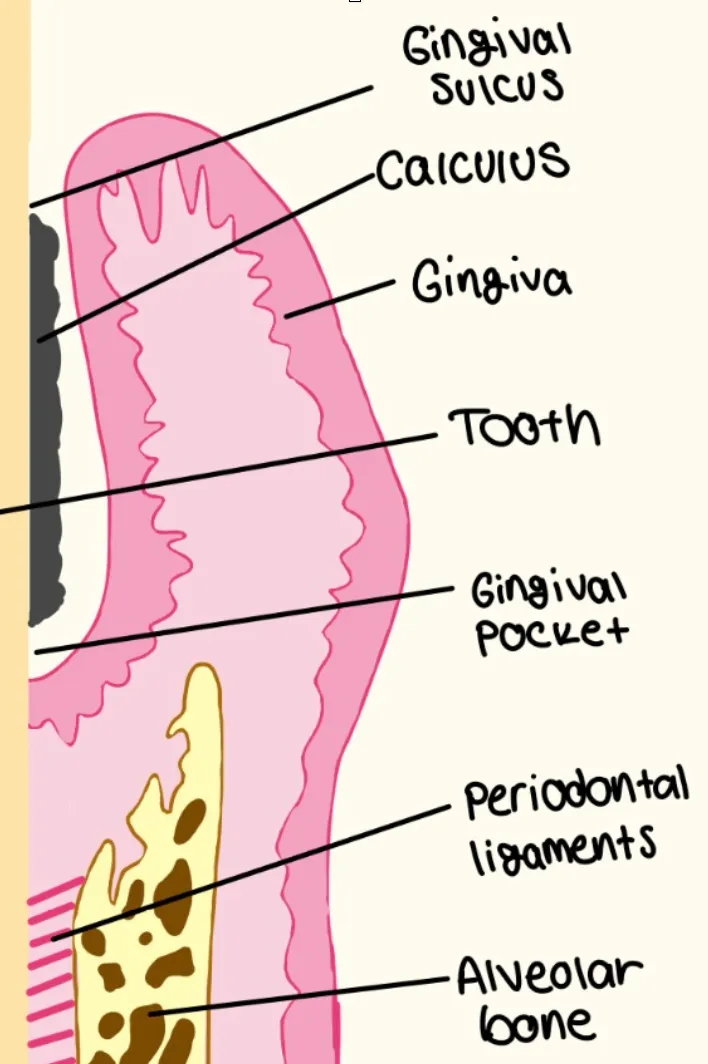
Source: Figure created by the author.
Management of periodontitis is mainly achieved by removing the causative factors (dental plaque, microbial biofilm, and calculus) by means of scaling with oral hygiene instructions. The relationship of calculus, gingival pocket, and periodontal tissue is shown in figure 1. Antibiotics are considered effective in severe conditions or in the case of systemic involvement. Implant therapy is used commonly to replace the lost teeth due to extensive and uncontrolled degeneration of bone and periodontal tissues. Regarding taking care about periodontal diseases, the body’s immune system responses with inflammatory factors, to give more detail, leukocytes. Once they come in contact with a strange body, they release reactive oxidative species (ROS), which neutralizes the foreign bodies, along with nearby tissue, not separating the tissues whether they are affected or not (Richards & Rutherford, 1988).
2.Vitamins and Periodontal Health
Vitamin A is a fat soluble vitamin that is essential for maintaining epithelial integrity and continuing normal immune function. Dietary sources include eggs, liver, carrots, broccoli, and leafy vegetables etc. as a reliable source of Vitamin A (Najeeb et al., 2016). The vitamin B is a water soluble complex includes vitamins B1, B2, B3, B5, B6, B7, B9, and B12. These vitamins are essential for cell metabolism, tissue repair, and proliferation (Neiva et al., 2003). Vitamin C is a water soluble vitamin that is essential for collagen synthesis and acts as a potent antioxidant. Deficiency leads to scurvy, which patients are usually characterized with bleeding and inflamed gums. Vitamin C containing dentifrices have demonstrated reduced gingival inflammation and increased antioxidant activity. Vitamin D is a fat soluble vitamin that plays a key role in mineral absorption and bone metabolism. Vitamin E is a fat soluble antioxidant that protects cell membranes from oxidative damage. It is found in nuts, seeds, cereals, meat, and fish. Vitamin K is a fat soluble vitamin that required for blood coagulation and bone related protein synthesis. It is often found in green leafy vegetables such as spinach.
3.Dietary Minerals and Trace Elements
Calcium is essential as the primary element of bone and tooth formation, healthy muscle and nerve function. Dietary sources include dairy products, leafy vegetables, nuts, and seeds. Magnesium supports bone metabolism and cellular function. Iron is necessary for hemoglobin synthesis and enzyme activity. Iron deficiency causes anemia and oral symptoms such as mucosal pallor and recurrent ulcers. Zinc is a trace element involved in immune regulation, wound healing, and antioxidant defense. Fluoride strengthens enamel and cementum through the formation of fluoroapatite and inhibits bacterial growth. It is widely used in dentifrices and gels for caries prevention. Although fluoride has minimal direct effects on periodontal tissues, overall it supports oral health.
4.Specific Conditions
Pregnancy causes hormonal and physiological changes that increase susceptibility to gingivitis and periodontitis. Gastrointestinal symptoms such as vomiting may reduce nutrient intake. Adequate nutrition, particularly antioxidant-rich foods, fiber intake, and reduced sugar consumption, is important for maintaining periodontal health. Proper oral hygiene and nutritional counseling are essential during pregnancy. Also aging is associated with tooth loss, reduced chewing efficiency, altered taste, and nutritional deficiencies. Individualized dietary advice and nutritional counseling can improve periodontal outcomes and quality of life in older adults.
Conclusion
As my conclusion, it’s certain that there is an indivisible relation between nutrition and periodontal health which should lead us to be careful about what we consume. High carbohydrate intake, poor oral hygiene, obesity, deficiencies of vitamins and trace elements and genetic disorders can be a cause of periodontal diseases. However, being aware of these conditions might prevent the disease from occuring in the first place. Studies reveal that periodontitis has affected a great number of people over the years, so it should be considered as one of the effective epidemics such as COVID-19. You are what you eat!
Nutritional status plays a critical role in periodontal health, inflammation control, and tissue healing. Antioxidants, vitamins, minerals, and trace elements show promising benefits as saver to periodontal therapy. However, current evidence is insufficient, and more well-designed clinical studies are needed to establish clear dietary recommendations. Integrating nutritional assessment and counseling into periodontal care may improve treatment outcomes and overall oral health.
REFERENCES
Najeeb, S., Zafar, M. S., Khurshid, Z., Zohaib, S., & Almas, K. (2016). The role of nutrition in periodontal health: An update. Nutrients, 8(9), 530. https://doi.org/10.3390/nu8090530
Newman, M. G., Takei, H., Klokkevold, P. R., & Carranza, F. A. (2012). Classification of diseases and conditions affecting the periodontium. In M. G. Newman, H. Takei, P. R. Klokkevold, & F. A. Carranza (Eds.), Carranza’s clinical periodontology (12th ed., pp. 45–67). Elsevier.
Armitage, G. C., & Robertson, P. B. (2009). The biology, prevention, diagnosis, and treatment of periodontal diseases: Scientific advances in the United States. Journal of the American Dental Association, 140(Suppl. 1), 36S–43S. https://doi.org/10.14219/jada.archive.2009.0356
Deas, D. E., Moritz, A. J., Sagun, R. S., Gruwell, S. F., & Powell, C. A. (2016). Scaling and root planing versus conservative surgery in the treatment of chronic periodontitis. Periodontology 2000, 71(1), 128–139. https://doi.org/10.1111/prd.12114
Pihlstrom, B. L., Michalowicz, B. S., & Johnson, N. W. (2005). Periodontal diseases. The Lancet, 366(9499), 1809–1820. https://doi.org/10.1016/S0140-6736(05)67728-8
Preshaw, P. M., Alba, A. L., Herrera, D., Jepsen, S., Konstantinidis, A., Makrilakis, K., & Taylor, R. (2012). Periodontitis and diabetes: A two-way relationship. Diabetologia, 55(1), 21–31. https://doi.org/10.1007/s00125-011-2342-y
Haffajee, A. D., Socransky, S. S., & Goodson, J. M. (1983). Clinical parameters as predictors of destructive periodontal disease activity. Journal of Clinical Periodontology, 10(3), 257–265. https://doi.org/10.1111/j.1600-051X.1983.tb01274.x
Socransky, S. S., Haffajee, A. D., Cugini, M. A., Smith, C., & Kent, R. L. (1998). Microbial complexes in subgingival plaque. Journal of Clinical Periodontology, 25(2), 134–144. https://doi.org/10.1111/j.1600-051X.1998.tb02419.x
Neiva, R. F., Al-Shammari, K., Nociti, F. H., Soehren, S., & Wang, H. L. (2003). Effects of vitamin B-complex supplementation on periodontal wound healing. Journal of Periodontology, 74(3), 338–344.
Beren Yakup Polat
Contributing writer at EUReflect.
Follow EUReflect
See more of our reporting on Google
Mark EUReflect as a preferred source and our stories are ranked higher for you in Top Stories, Discover and Google News — and carry a “preferred” badge when they are cited in AI results.
Add EUReflect as a preferred source