The Sea Behind China’s Economy
New CSIS data shows $6.4 trillion in trade moved through the South China Sea's eight key chokepoints in 2024, with over $2.4 trillion passing through the Malacca and Taiwan straits alone.
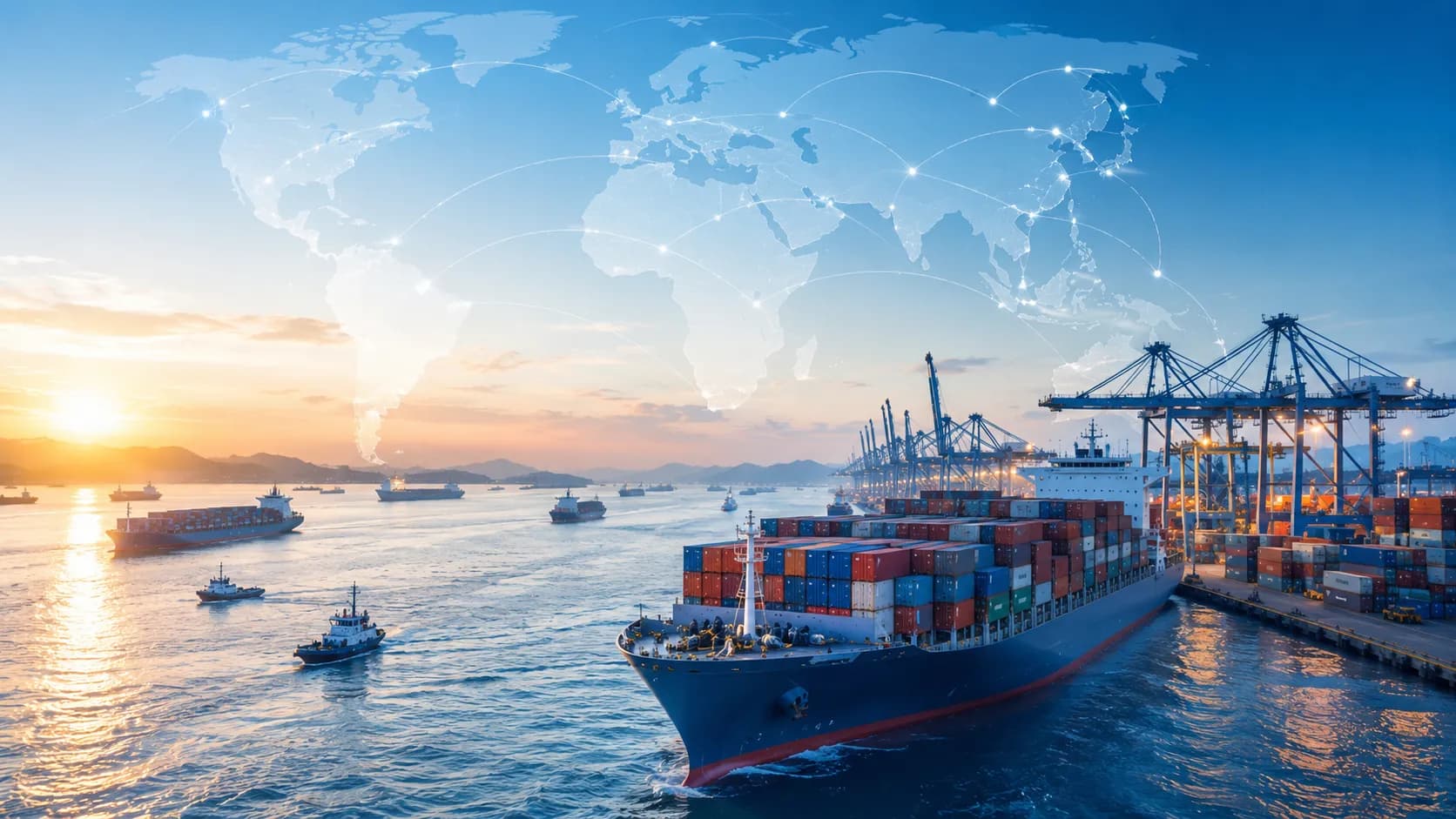
The South China Sea is usually discussed as one of Asia's most dangerous geopolitical flashpoints. For China, however, it is also something more fundamental: one of the maritime foundations of the Chinese economy.
The sea connects China's industrial centers and ports with Southeast Asia, the Indian Ocean, the Middle East, Africa and Europe. A major disruption would therefore affect not only Chinese naval strategy but also energy imports, manufacturing supply chains, exports and ultimately economic growth.
New analysis published in 2026 estimates that roughly one-third of global shipping passes through the South China Sea, while more than 60 percent of China's trade by value travels by sea.
That makes stability in these waters an economic necessity for Beijing.
China's Factories Depend on the Sea
China remains one of the world's largest manufacturing and trading economies, but its industrial power depends heavily on maritime transportation.
China's seaborne imports and exports increased 1.7 percent in 2025 and represented 61.5 percent of the country's total goods trade, according to Chinese government data released in June 2026. Foreign-trade cargo throughput at Chinese coastal ports also increased 4.7 percent.
UNCTAD data underline the scale of this dependence.
China discharged almost 3 billion metric tons of maritime cargo in 2024, equivalent to approximately one-quarter of the world's total unloaded maritime freight.
The South China Sea is therefore effectively an extension of China's industrial infrastructure.
Factories may be located in Guangdong, Zhejiang or elsewhere on the mainland, but their economic connections extend through ports and maritime corridors thousands of kilometers beyond China's coastline.
$6.4 Trillion Moves Through the Region
The scale of commerce passing through the region is enormous.
A new 2026 analysis by the CSIS ChinaPower project estimates that approximately $6.4 trillion in trade moved through the South China Sea's eight principal chokepoints in 2024, although this figure includes goods counted more than once when they passed through multiple straits.
The Malacca and Taiwan straits were particularly important. More than $2.4 trillion in goods passed through each of them.
For China, the Strait of Malacca is especially strategic.
It connects the South China Sea with the Indian Ocean, creating the maritime bridge between Chinese ports and major markets and suppliers in the Middle East, Africa and Europe.
Any serious disruption around Malacca or the South China Sea could force shipping companies onto longer and more expensive routes.
Energy Is China's Greatest Vulnerability
The South China Sea is particularly important because China's economy remains heavily dependent on imported energy.
China is the world's largest importer of oil and gas, and much of that energy arrives from the Middle East and other suppliers through the Indian Ocean before passing through the Strait of Malacca and the South China Sea.
Research published this year estimates that roughly 80 percent of China's crude-oil imports travel through the South China Sea, equivalent to almost 60 percent of China's total oil supply when domestic production is included.
U.S. Energy Information Administration data also show the global importance of the route: approximately 28 million barrels per day of petroleum and petroleum products passed through the South China Sea in 2023, representing around 37 percent of worldwide maritime petroleum shipments.
This explains why Beijing sees maritime security as directly connected to energy security.
China can manufacture enormous quantities of goods domestically, but much of the energy required to power that industrial system arrives through vulnerable international waterways.
Southeast Asia Is Becoming More Important
The South China Sea is also China's gateway to Southeast Asia.
As supply chains become more regional, Chinese companies increasingly trade with and invest in Vietnam, Malaysia, Indonesia, Thailand and other ASEAN economies.
Chinese ports are adapting accordingly.
Exports through Zhanjiang along the New International Land-Sea Trade Corridor increased 23.8 percent year-on-year during the first half of 2026, reaching 9.28 billion yuan. The port is expanding shipping connections with Malaysia, Thailand, Vietnam and Indonesia.
This demonstrates that the South China Sea is not simply a corridor connecting China with distant Western markets.
It is increasingly at the center of an integrated Asian production and logistics network.
Territorial Disputes Create Economic Risk
This economic importance makes the territorial disputes in the South China Sea particularly dangerous.
China claims sovereignty over most of the sea, while the Philippines, Vietnam, Malaysia, Brunei and Taiwan maintain overlapping claims.
Recent confrontations between China and the Philippines have again demonstrated how maritime disputes can create wider geopolitical risks. An AP assessment published this week highlighted the possibility that instability involving Taiwan or the South China Sea could disrupt international commerce and place Southeast Asian governments under increasing geopolitical pressure.
Beijing and ASEAN countries are simultaneously attempting to manage these risks diplomatically.
China and the ten ASEAN members met in Manila from August 19–21 to continue negotiations on a long-discussed Code of Conduct for the South China Sea.
For China, avoiding uncontrolled escalation has an obvious economic rationale.
A military crisis in waters carrying Chinese exports, imported energy and industrial inputs could damage the very economy Beijing is attempting to protect.
China Is Searching for Alternatives
Beijing is consequently attempting to reduce its dependence on vulnerable maritime chokepoints.
The Belt and Road Initiative, China-Europe rail connections, pipelines from Russia and Central Asia and new transport corridors across Eurasia all contribute to this diversification.
China is even exploring Arctic shipping more seriously. A Chinese shipping company recently announced plans for a regular container service through the Northern Sea Route, potentially shortening some journeys between China and Europe. But the Arctic remains a limited alternative because of seasonal, environmental and geopolitical constraints.
For the foreseeable future, no alternative can replace the scale and efficiency of China's southern maritime routes.
China's Economic Lifeline
The strategic importance of the South China Sea therefore extends far beyond territorial claims and naval competition.
It connects China's factories with foreign consumers.
It carries raw materials into Chinese ports.
It links China with Southeast Asian production networks.
And most importantly, it carries much of the imported energy required to keep the world's second-largest economy functioning.
This creates a paradox for Beijing.
China wants greater strategic control over its maritime environment, but its economic success also depends on keeping that same environment open, predictable and commercially stable.
For China, the South China Sea is therefore not simply disputed territory.
It is an economic lifeline.
Ahmet Balakan
Contributing writer at EUReflect.
Follow EUReflect
See more of our reporting on Google
Mark EUReflect as a preferred source and our stories are ranked higher for you in Top Stories, Discover and Google News — and carry a “preferred” badge when they are cited in AI results.
Add EUReflect as a preferred source