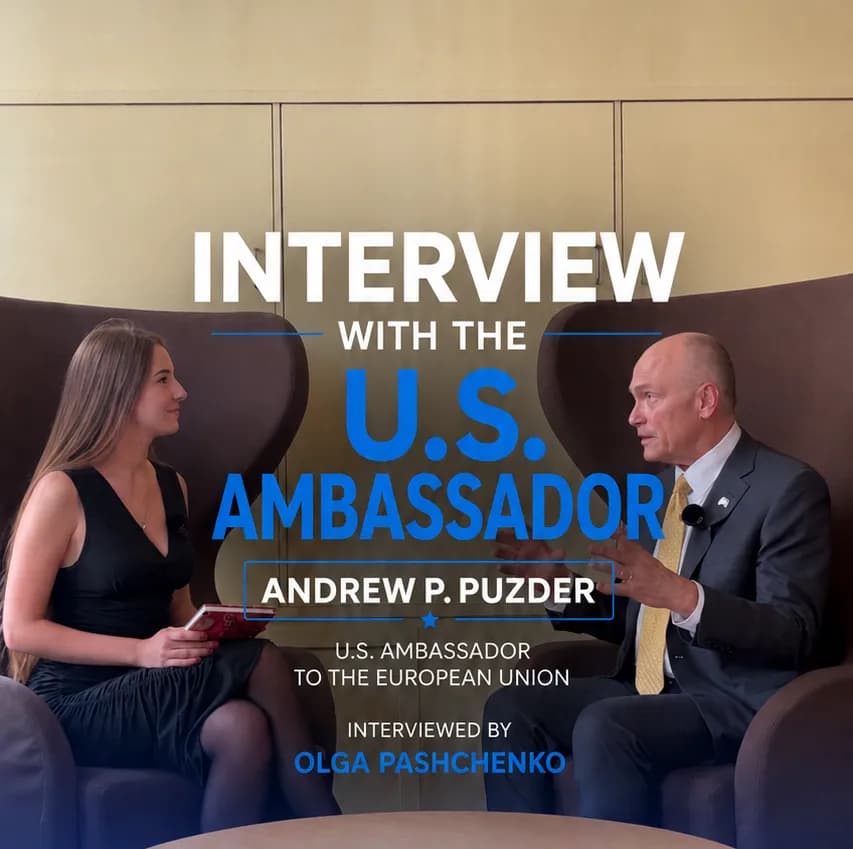
Exclusive Interview with U.S. Ambassador to the EU Andrew Puzder
Brussels, Belgium, by Olha Pashchenko — As the United States celebrates the 250th anniversary of its founding, the Brussels Liberty Network Summer Reception brought together policymakers, diplomats, academics, and business leaders to discuss the future of transatlantic cooperation. On the occasion of the event, EUReflect Media interviewed U.S. Ambassador to the European Union Andrew Puzder, who shared his perspective on the evolving U.S.–EU partnership and the strategic priorities shaping relations across the Atlantic.
The reception, organized by Brussels Report, Property Rights Alliance, and the Tholos Foundation, continues the tradition of the Brussels Liberty Network meetings, providing a platform for dialogue among supporters of free-market policies within the European institutions, think tanks, academia, NGOs, and industry.
When asked what message he would like to send to Europeans as the United States marks its 250th anniversary, Ambassador Puzder stressed that recent achievements demonstrate the strength and resilience of the transatlantic alliance.
"If you look at the last 30 or 60 days," he said, "the United States and the European Union have entered into the largest trade agreement in the history of the world to stabilize the largest trade relationship in the world."
According to the Ambassador, the agreement represents a significant milestone in reinforcing economic ties between Washington and Brussels while providing greater certainty for businesses and investors on both sides of the Atlantic.
Beyond trade, Ambassador Puzder highlighted the growing strategic cooperation on critical resources. He pointed to the recently concluded Memorandum of Understanding on critical minerals, which is intended to strengthen the resilience of both economies by securing access to essential raw materials and reducing dependence on external actors.
"We can ring-fence our economy on critical minerals and not be coerced by China, which currently has significant control over critical minerals," he explained.
The Ambassador also emphasized a new initiative known as XCeliga, describing it as a framework for cooperation between the United States, the European Union, and other like-minded partners. The initiative focuses on strengthening collaboration in strategic industries, including semiconductor manufacturing, resilient supply chains, critical minerals, and emerging artificial intelligence technologies.
Taken together, Ambassador Puzder said, these initiatives illustrate that the transatlantic partnership continues to deepen despite public narratives suggesting otherwise.
"While you hear a lot of press about this is happening or that's happening, the reality is we had a great G7 meeting, we had a great NATO meeting, and we entered into three very significant agreements that bring Europe and the United States closer together, not further apart," he stated.
His remarks reflect the growing importance of U.S.–EU cooperation in addressing today's geopolitical and economic challenges. As global competition intensifies and technological innovation reshapes international markets, both partners are increasingly investing in coordinated policies aimed at strengthening economic security, technological leadership, and resilient supply chains.
The celebration of America's 250th anniversary therefore served not only as a commemoration of the nation's history but also as an opportunity to reaffirm the enduring strategic partnership between the United States and Europe. Ambassador Puzder's message was clear: despite challenges, the relationship remains robust and continues to evolve through concrete agreements that advance shared prosperity and collective security.
Interview conducted by EUReflect Media during the Brussels Liberty Network Summer Reception in Brussels.
Olha Pashchenko
Contributing writer at EUReflect.
Follow EUReflect
See more of our reporting on Google
Mark EUReflect as a preferred source and our stories are ranked higher for you in Top Stories, Discover and Google News — and carry a “preferred” badge when they are cited in AI results.
Add EUReflect as a preferred source