US Presses Countries to Choose Sides in AI Race With China
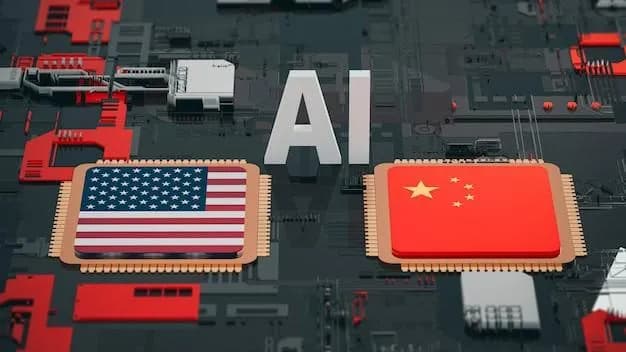
The United States is preparing to pressure dozens of countries to choose between competing AI frameworks led by Washington and Beijing. The move aims to limit China's access to critical minerals, AI technologies and semiconductor supply chains.
Washington Tightens Its AI Alliance
The United States is preparing to pressure dozens of countries to choose between Washington and Beijing in the global artificial intelligence race, according to a U.S. official and an internal draft reviewed by Reuters.
The draft letter warns countries that they could be excluded from a U.S.-led AI coalition if they also join China's competing framework. The move reflects Washington's growing effort to limit China's access to the critical resources and technologies needed to develop advanced AI systems.
Washington Tightens Its AI Alliance
The draft letter was prepared by the U.S. State Department and is addressed to the 35 countries that signed a U.S. “AI Opportunity Statement” in June.
Those countries include members of the non-binding Pax Silica framework as well as other states seeking closer cooperation with Washington on artificial intelligence.
The proposed message represents a significant escalation in the U.S. approach to international AI cooperation. Rather than simply encouraging countries to work with Washington, the United States is considering explicitly asking them to choose between competing technology frameworks.
Pax Silica Targets Critical Technology Supply Chains
Washington launched the Pax Silica initiative last year to strengthen supply chains for AI models, semiconductors and critical minerals.
Around two dozen countries have joined the initiative, including Japan, Australia and South Korea. Kazakhstan has also joined, despite becoming the only country currently known to participate in both the U.S.-led initiative and China's competing framework.
The dual membership has raised concerns in Washington because Kazakhstan could potentially provide access to critical minerals while simultaneously cooperating with China's AI framework.
The draft letter makes clear that Washington views participation in Pax Silica as more than a symbolic commitment.
Kazakhstan Highlights the Challenge
Kazakhstan has emerged as a central example of the dilemma facing countries caught between the United States and China.
The country is considered a potential source of critical minerals and has joined the U.S.-backed Pax Silica initiative. At the same time, it has also joined China's competing AI coalition.
The draft letter argues that countries cannot maintain commitments to initiatives whose expectations conflict with those of Washington.
The language reflects a broader American concern: countries that cooperate with both sides could potentially give China access to resources while still benefiting from U.S.-led technological partnerships.
China Builds a Competing AI Framework
The American pressure comes as Beijing expands its own international AI ambitions.
Chinese President Xi Jinping launched the World Artificial Intelligence Cooperation Organization in July, promoting China's open-weight AI technology as an alternative to the U.S.-dominated model.
The competing frameworks illustrate the growing division in global technology governance.
Washington is seeking to strengthen a network based on cooperation with U.S. allies and partners, while Beijing is promoting a model centered on broader access to Chinese AI technology.
The Race Extends Beyond AI Models
The competition is not limited to artificial intelligence software.
Pax Silica focuses on the broader supply chain supporting AI development, including semiconductor chips and critical minerals. These resources are essential to the production and operation of advanced computing systems.
The United States therefore sees control over these supply chains as an important component of technological competition with China.
By encouraging countries to coordinate with Washington on export controls and joint projects, Pax Silica aims to reduce reliance on adversaries for strategically important resources and technologies.
A Global Technology Divide Emerges
The growing rivalry between Washington and Beijing is creating difficult choices for countries that want to cooperate with both powers.
For many governments, maintaining balanced relationships with the world's two largest technological powers can offer economic and strategic advantages. The American draft, however, suggests that Washington increasingly wants those governments to make clearer choices.
This could transform AI cooperation into another arena of geopolitical alignment.
Countries may increasingly face pressure to determine which technological ecosystem they want to join, particularly as AI becomes more important to national security, economic competitiveness and industrial development.
AI Competition Moves Into Security
The stakes of the rivalry are also increasing because of the rapidly expanding capabilities of artificial intelligence.
Chinese open-weight AI models have made significant gains against proprietary systems developed by U.S. companies such as OpenAI and Anthropic.
The technology's rapidly expanding capabilities have also created concerns over its potential military applications. The ability of advanced AI systems to perform increasingly sophisticated tasks, including autonomous hacking, has intensified international debate over how the technology should be controlled.
This makes the competition between the United States and China more than a commercial contest.
Washington's Choice-and-Alliance Strategy
The proposed letter indicates that Washington wants to transform technological cooperation into a clearer strategic alliance.
The United States hopes that encouraging countries to choose its framework will restrict China's access to critical minerals, advanced AI resources and semiconductor-related supply chains.
However, the approach could also force countries to reconsider their relationships with both powers.
The draft does not specifically name China when warning against participation in competing initiatives, but its message is clear: Washington does not want countries to simultaneously participate in frameworks that it considers strategically incompatible.
A New Front in US-China Competition
The AI race is increasingly becoming part of the broader strategic competition between Washington and Beijing.
Semiconductors, critical minerals, AI models and export controls are now closely connected. The United States is attempting to build a technology network that limits dependence on China, while Beijing is developing alternative institutions and promoting its own AI technologies.
The pressure on dozens of countries demonstrates that the competition is no longer confined to the two powers themselves.
For countries such as Kazakhstan, Japan, Australia and South Korea, the choices made today could shape their technological partnerships for years to come.
The United States' proposed message marks a significant step in that process. Washington is no longer simply competing with China for technological leadership; it is increasingly asking other countries to decide which side of that competition they want to join.
Ipek Tuncer
M.A. in International Relations
Follow EUReflect
See more of our reporting on Google
Mark EUReflect as a preferred source and our stories are ranked higher for you in Top Stories, Discover and Google News — and carry a “preferred” badge when they are cited in AI results.
Add EUReflect as a preferred source