Where Chaos Meets Calm: Sri Lanka's Peaks, Valleys, and Seas
Introduction
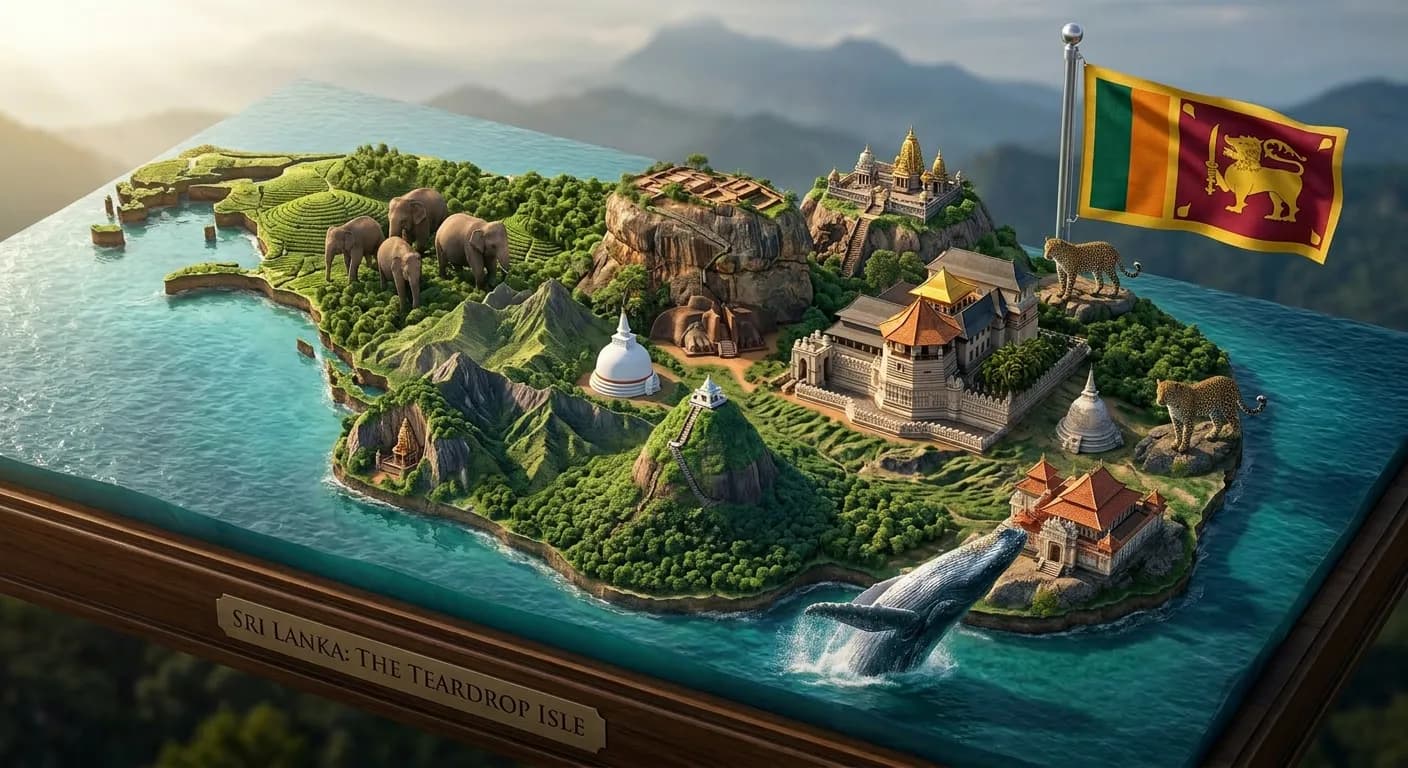
Off the Indian coast lies Sri Lanka, a 65,610-square-kilometer island filled with rainforests, beaches, and dramatic mountain peaks. With human presence dating back at least 125,000 years, the country combines deep history, cultural richness, and remarkable natural diversity in a way that makes it stand out as a travel destination.
Nature’s touch on Sri Lanka
Sri Lanka is far from an ordinary island. Its biodiverse rainforests are home to some of the world’s rarest species, supported by varied elevation, diverse soil types, and a warm, moist climate that creates ideal conditions for wildlife.
The country’s tea-covered highlands offer a lush alternative to the snow-capped mountains more commonly associated with dramatic landscapes. From the south-central highlands, where the terrain rises to 2,524 meters, travelers can reach the sea in roughly two hours, experiencing a temperature difference of around 10 degrees Celsius along the way.
This short journey also reveals the island’s rich wildlife. In the highlands, visitors may encounter sambar deer, purple-faced langurs, toque macaques, and a variety of rare birds, with occasional leopard sightings in the evening.
Further downhill, the tea country and rainforest zones are inhabited by wild boars, buffaloes, monkeys, and vividly colored birds. In the lowlands and coastal regions, herds of Asian elephants can be seen alongside spotted deer, crocodiles, wild pigs, peacocks, and water buffaloes.
What makes Sri Lanka especially distinctive is the way its compact geography brings together striking changes in terrain, climate, and wildlife over such a short distance. This combination gives the island a rare sense of diversity within a relatively small area.
Beyond Nature
Beyond its landscapes, Sri Lanka also offers a rich urban and cultural experience. In the capital, Colombo, Portuguese, Dutch, and British colonial influences blend with South Asian energy, producing a cityscape shaped by colonial architecture, modern skyscrapers, religious landmarks, markets, and public parks.
Colombo’s markets burst with color and a vibrant sense of organized chaos, offering everything from fabrics, spices, and fresh produce to street food, gold, and jewelry. The city’s street food culture mirrors this lively disorder, metal pans clatter, oils sizzle, and the air fills with a medley of spices and aromas that embody the restless pulse of the capital. Amid the narrow lanes, vendors shout and push their carts through the crowds, a scene that captures Colombo’s multicultural soul, where Muslim, Tamil, and Sinhalese traders each bring their own flavor to the streets.
Away from the markets, Colombo also offers spaces of calm and reflection. Near Beira Lake stands the Gangaramaya Temple and the Seema Malaka pavilion, connected by a bridge and set against the water, creating a peaceful contrast to the city’s fast pace. This pavilion symbolizes calm mind and balance, sitting like a “thought” floating quietly in the middle of this bustling city’s lake.
Sri Lanka also contains important Buddhist heritage sites beyond the capital. One of the most famous is Adam’s Peak, rising 2,243 meters above sea level, where a footprint-shaped rock is believed by many Buddhists to bear the footprint of Buddha.
Conclusion
Sri Lanka is an island where culture, chaos, calm, religion, and life all come together throughout its incredible scenery and diverse terrains, making this country a must-visit destination not only for travel lovers but for lovers of life in general, symbolizing that no matter the chaos, there will always be calm within. Its ability to move from cool highlands to coastal lowlands, and from crowded markets to peaceful sacred spaces, makes it a destination defined by both contrast and harmony.
Tamim Majdoub
Contributing writer at EUReflect.
Follow EUReflect
See more of our reporting on Google
Mark EUReflect as a preferred source and our stories are ranked higher for you in Top Stories, Discover and Google News — and carry a “preferred” badge when they are cited in AI results.
Add EUReflect as a preferred source