A New Model of Cognitive Flexibility
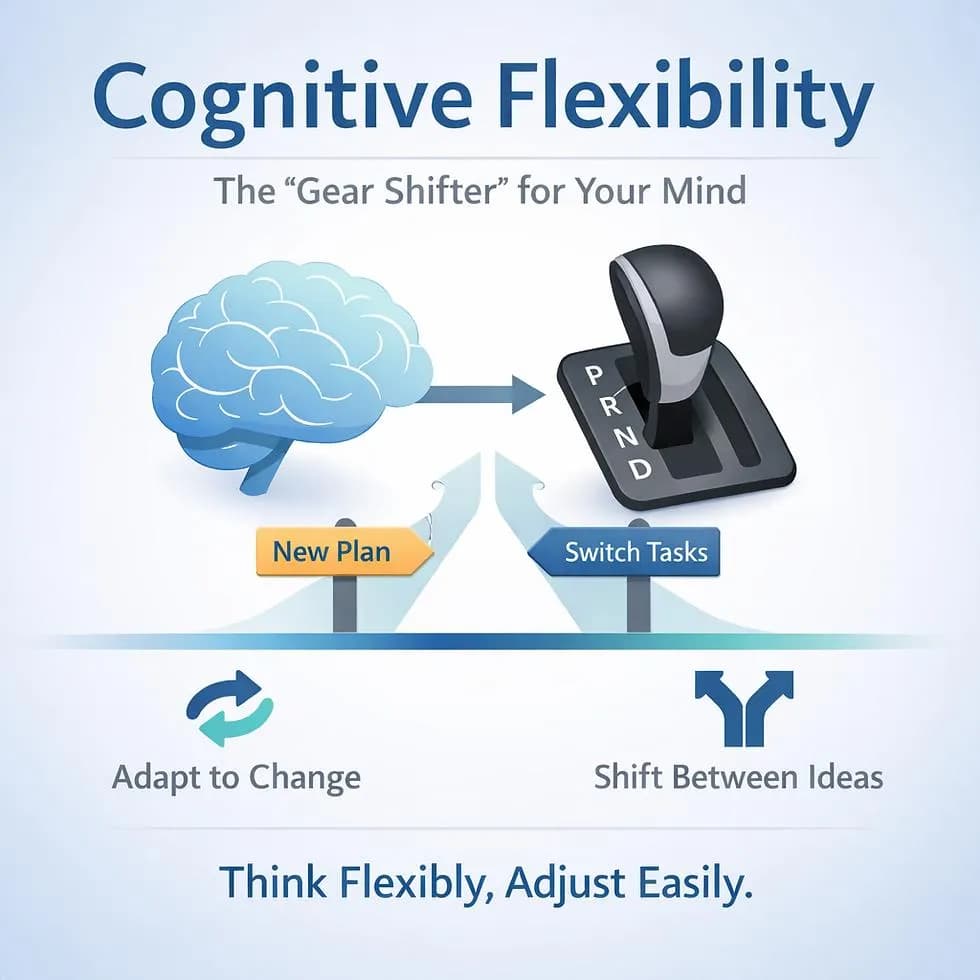
Cognitive flexibility is usually described as the ability to adapt thinking when circumstances change. A new theoretical model proposes that this ability may not be a single mental capacity, but a system composed of three interacting forms of flexibility.
What Is Cognitive Flexibility?
Cognitive flexibility refers to the ability to change mental strategies, update existing frameworks and adapt behaviour when circumstances change.
It plays an important role in everyday problem-solving. A person may need to abandon an ineffective strategy, consider new information or approach the same problem from a different perspective.
Although cognitive flexibility has been widely studied, researchers have not always agreed on whether it represents a single ability or a collection of related processes.
A new theoretical proposal offers a different answer.
A Three-Part Model
A 2026 paper published in New Ideas in Psychology proposes the Modular Model of Cognitive Flexibility. The model describes flexibility as a hybrid architecture combining three partially distinct but dynamically interacting components: Crystallized Flexibility, Semi-Fluid Flexibility and Fluid Flexibility.
The model therefore moves away from treating flexibility as a single point on a simple scale.
Instead, different forms of flexible thinking may depend on different psychological mechanisms.
Switching
The first component is Crystallized Flexibility, described through the function of the Adaptor.
This form involves switching between established rules or cognitive sets.
For example, a person may know several strategies for completing a task and select the appropriate one when the rules of the situation change.
The emphasis here is not on creating something completely new. It is on successfully moving between already established possibilities.
Searching
The second component is Semi-Fluid Flexibility, represented by the Explorer.
Here, flexibility involves searching through possibilities and adapting to contextual information.
Instead of simply switching between known strategies, the individual explores alternatives and determines which approach may be appropriate in a changing situation.
This intermediate form connects established knowledge with more open-ended adaptation.
Shaping
The third component is Fluid Flexibility, represented by the Generator.
This is the most generative form of flexibility.
Rather than selecting or searching among existing options, the individual can actively shape new strategies, interpretations or solutions.
This component is particularly relevant when familiar approaches are insufficient and a problem requires something genuinely different.
Why Three Forms Matter
The model suggests that two people can appear equally flexible while relying on different mechanisms.
One person may be highly effective at switching between established strategies but less comfortable generating new ones.
Another may be particularly capable of producing novel solutions but less efficient when required to follow established rules.
This distinction could help explain why cognitive flexibility sometimes appears inconsistent across different psychological tasks.
Beyond a Single Flexibility Score
Many psychological assessments attempt to summarize cognitive abilities using scores.
The new model raises the possibility that such approaches may overlook the internal structure of cognitive flexibility.
If flexibility consists of several interacting components, measuring only whether someone can change their response may not reveal how that change occurs.
The theoretical shift is therefore from asking:
“How flexible is this person?”
to asking:
“What kind of flexibility is this person using?”
Flexibility and Adaptation
The model also places cognitive flexibility within a broader understanding of adaptation.
Changing circumstances do not always require the same psychological response.
Sometimes an individual needs to switch between established rules. In other situations, they need to search for alternatives. Under more complex conditions, they may need to generate an entirely new strategy.
The three-component model attempts to capture these differences within one theoretical framework.
A More Dynamic View of Thinking
One of the most important implications of the model is that cognitive flexibility may be better understood as a dynamic system rather than a fixed personal characteristic.
The three components are described as partially dissociable but dynamically interacting.
This means that flexible thinking may emerge from the interaction between different psychological processes rather than from one general ability operating independently.
Such a perspective could eventually influence how researchers conceptualize problem-solving, learning and adaptation.
Rethinking Mental Flexibility
The emergence of the Modular Model of Cognitive Flexibility reflects a broader movement in psychology toward more detailed theoretical models.
Instead of assuming that a psychological ability is a single capacity, researchers are increasingly asking whether apparently unified abilities contain multiple interacting mechanisms.
For cognitive flexibility, the proposed answer is clear: switching, searching and shaping may represent different ways in which the mind adapts to change.
The theory therefore offers a new way to understand flexible thinking—not as one ability that people simply possess to a greater or lesser degree, but as a system of interacting capacities that can become relevant under different circumstances.
Ipek Tuncer
M.A. in International Relations
Follow EUReflect
See more of our reporting on Google
Mark EUReflect as a preferred source and our stories are ranked higher for you in Top Stories, Discover and Google News — and carry a “preferred” badge when they are cited in AI results.
Add EUReflect as a preferred source