Belgium and Türkiye: Trade Target Raised to 15 Billion Euros
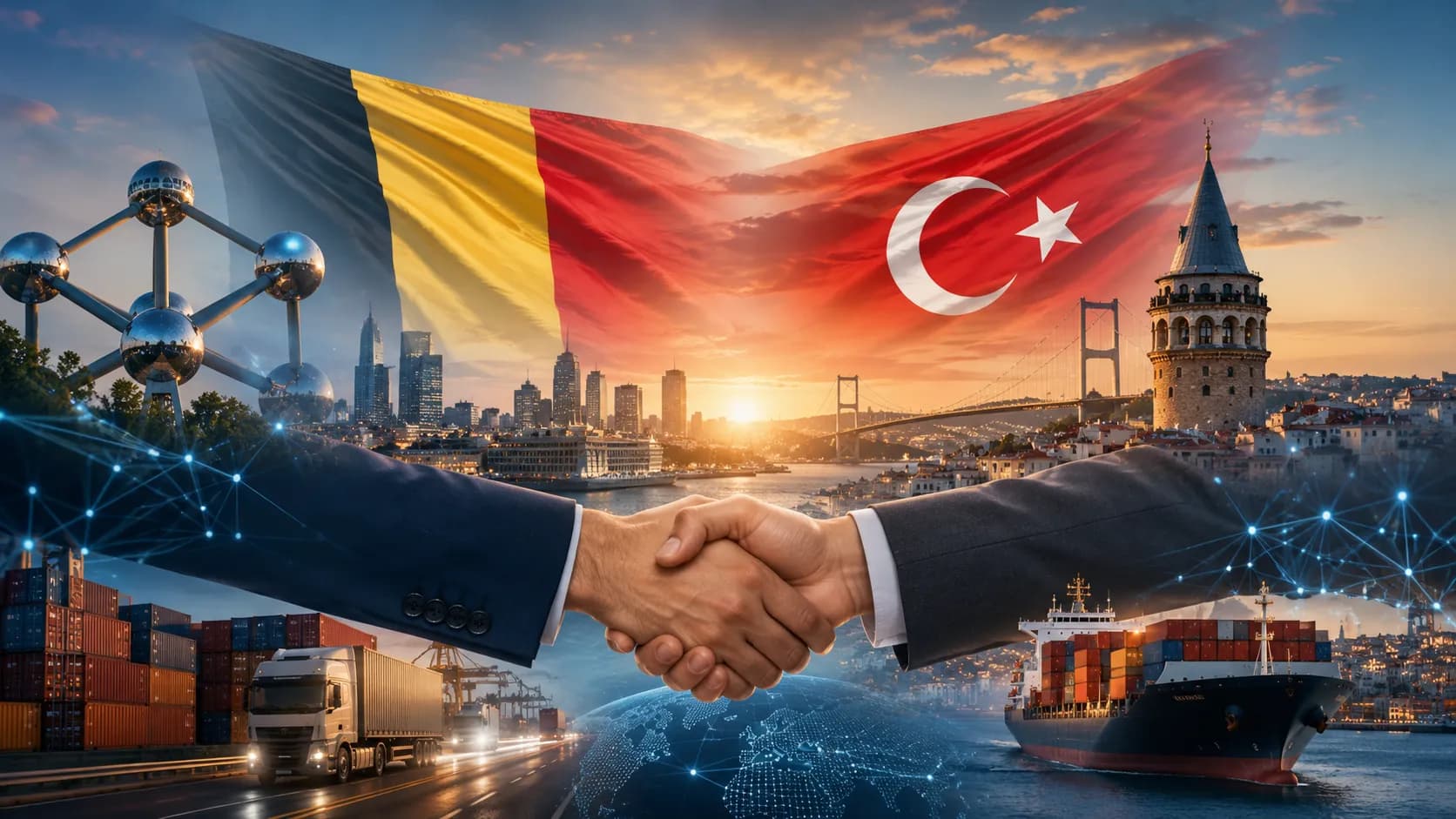
Belgium’s 2026 Economic Mission to Türkiye resulted in around 30 agreements in trade, investment, logistics, energy, and digital transformation. The two countries aim to increase their current 9 billion euro trade volume to 15 billion euros.
Introduction
Belgium’s decision to select Türkiye as one of the priority destinations for its 2026 Economic Mission demonstrates that bilateral economic relations are entering a new strategic phase. Led by the Belgian Royal Family and attended by a delegation of nearly 450 people, the mission aims to deepen cooperation in trade, investment, defense industry, logistics, digital transformation, and energy. In particular, Türkiye’s growing role as a regional production and logistics hub amid Europe’s changing economic and security environment has significantly increased Brussels’ interest in Ankara.
Trade Volume Target Increased to 15 Billion Euros
Trade volume between Türkiye and Belgium reached approximately 9 billion euros in 2025. The two countries are now aiming to increase this figure to 15 billion euros in the medium term. Belgium is also the eighth-largest foreign investor in Türkiye, with investments totaling nearly 8 billion dollars.
During the Economic Mission, discussions focused not only on increasing trade but also on transforming bilateral economic relations into a more integrated and sustainable structure. Around 30 agreements were signed between Turkish and Belgian companies operating in sectors such as food, technology, logistics, healthcare, education, and services.
Particular emphasis was placed on developing joint projects in:
- sustainable trade,
- digital transformation,
- healthcare technologies,
- supply chain management,
- e-commerce,
and international contracting.
Türkiye as Europe’s New Strategic Partner
Belgian Deputy Prime Minister and Foreign Minister Maxime Prevot stated that Türkiye has strategic priorities in energy, transportation, aviation, and industry, emphasizing that Belgian companies’ areas of expertise strongly align with Türkiye’s needs.
Flemish Minister-President Matthias Diependaele also described Türkiye not only as a major market but as a strategic partner for Europe’s future.
Europe’s recent efforts to diversify global supply chains and reduce dependency on China have increased Türkiye’s importance. Thanks to its geographical location, industrial infrastructure, and logistics capacity, Türkiye is increasingly viewed as an alternative production center for Europe.
As a result, Türkiye-Belgium relations are no longer based solely on bilateral trade, but are increasingly shaped through joint production, technology transfer, and collaborative investments in third countries.
Customs Union and EU Relations Return to the Agenda
One of Ankara’s main topics during meetings with the Belgian delegation was the modernization of the Customs Union with the European Union. During his meeting with Queen Mathilde, President Recep Tayyip Erdoğan emphasized that Türkiye-EU relations should be strengthened both economically and geopolitically.
The existing Customs Union, in force since 1996, helped increase annual trade between Türkiye and the EU to 220 billion euros. However, officials argue that the current framework is no longer sufficient to cover areas such as the digital economy, services, e-commerce, and new production models.
Belgian Defense and Foreign Trade Minister Theo Francken’s positive remarks regarding Türkiye’s calls for modernization attracted attention. This has fueled speculation that a new European approach toward strengthening economic integration with Türkiye may be emerging.
Conclusion
Belgium’s 2026 Economic Mission to Türkiye demonstrates that bilateral relations are evolving beyond trade into a broader strategic framework centered on production, technology, logistics, and investment. Europe’s changing geopolitical landscape and supply chain concerns are making Türkiye an increasingly critical partner for Belgium.
The wide range of cooperation areas, extending from defense industry to digital transformation, suggests that Türkiye-Belgium relations are likely to become deeper and more multidimensional in the coming years.
Alvara Merrick
Contributing writer at EUReflect.
Follow EUReflect
See more of our reporting on Google
Mark EUReflect as a preferred source and our stories are ranked higher for you in Top Stories, Discover and Google News — and carry a “preferred” badge when they are cited in AI results.
Add EUReflect as a preferred source