Brussels Budget at Risk Following Crisis Exit
After more than 600 days of institutional paralysis, the Brussels-Capital Region finally has a government. At its helm, Boris Dilliès (MR) has presented a concise Regional Policy Statement (DPR) — 24 pages — intended to close the country’s longest regional political crisis.
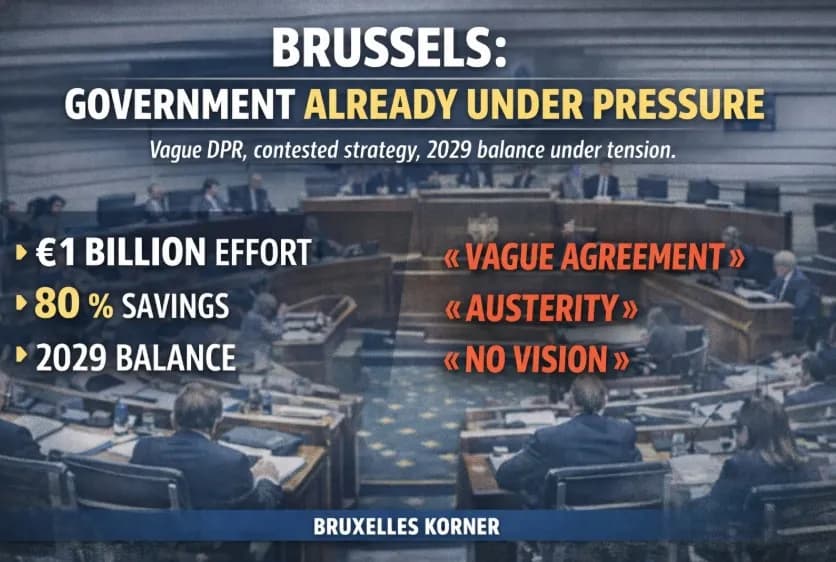
The central message is straightforward: restore Brussels’ financial credibility. The stated objective is a return to budget balance by 2029, through a €1 billion adjustment effort — 80% via structural spending cuts and 20% via new revenues. A hiring freeze across the regional administration, administrative streamlining, and targeted reforms in mobility and security: fiscal discipline is the backbone of the text.
But in Parliament, the reception was icy. For the opposition, the government is off to a poor start: a vague document, an unreadable strategy, an absent vision — a failed first exam.
A broad majority, coherence still to be proven
The coalition brings together MR, PS, Les Engagés, Groen, Vooruit, Anders and CD&V — a wide alliance forged out of necessity to end the deadlock.
Yet the more heterogeneous the majority, the more precise the strategic line must be. And it is precisely this precision that the opposition says is missing.
The overarching criticism is not ideological; it is methodological: the DPR sets out intentions, but provides neither an operational timeline, nor a detailed budget breakdown, nor a mechanism to absorb the social impact of the announced measures.
The opposition fires on all cylinders
PTB: “masked austerity”
Françoise De Smedt sums up the DPR in three words: austerity, expensive rents, immobility.
PTB argues that the announced savings could lead to the loss of 2,000 to 3,000 public-sector jobs and weaken regional public services — housing, mobility, water, and social support.
The core accusation: instead of addressing Brussels’ structural underfunding, the government is internalising the adjustment through service cuts.
Ecolo: discipline without a project
Zakia Khattabi denounces the lack of a mobilising vision linking budget, climate, housing and urban cohesion.
Two blind spots are highlighted:
-The impact of federal reforms on regional finances;
-The absence of a clear budget trajectory for the Joint Community Commission (COCOM), a key actor in health policy and social assistance.
The political message is blunt: management cannot replace a project.
Team Fouad Ahidar: a rushed agreement
Fouad Ahidar describes a text “negotiated in 48 hours,” lacking details on how savings will actually be implemented.
He challenges the request for parliamentary confidence without a precise perimeter of cuts or a clear timeline.
N-VA and DéFI: a façade, no structural reform
Gilles Verstraeten speaks of “facade chapters.”
Jonathan de Patoul regrets the absence of institutional reform — a single electoral college, bilingual lists — regularly presented as a way out of Brussels’ structural deadlocks.
The core question: can Brussels fix itself on its own?
The controversy goes beyond the DPR. It reaches the Region’s model itself.
Brussels carries:
-Capital-city costs (national and European);
-High social pressure;
-Demographic growth;
-A constrained tax base;
-Rising debt.
In this context, two readings collide:
-For the majority, restoring financial credibility is a prerequisite for any ambitious policy;
-For the opposition, budget balance without external refinancing risks translating into a contraction of public services.
Everything will depend on how granular — and how transparent — the actual arbitrations become.
The timeline: the real test starts now
The DPR sets the horizon of 2029. But the decisive test will come as early as autumn 2026, with the preparation of the 2027 budget.
That is when the following must materialise:
-A precise breakdown of the €1 billion adjustment effort;
-The detailed architecture of structural savings;
-Possible compensatory measures;
-A clear trajectory for COCOM.
Without a fine-grained budget translation, the DPR will remain a programmatic document.
Failed first exam?
Politically, the opposition has scored points: the government has not managed to impose a mobilising narrative beyond its own majority.
But an initial parliamentary setback is not a final verdict.
Three conditions will determine what happens next:
1. rapid publication of a costed operational plan with public deadlines;
2. clarity on the social impact of the announced savings;
3. visible results on a few structural dossiers — mobility, housing, neighbourhood-level security.
In Brussels, credibility is not proclaimed; it is demonstrated.
An exit from crisis — not yet a stabilisation
A liberal returning to the top post marks a political shift. But symbolism is not enough.
The government has closed the institutional crisis. It is now opening a high-risk budget sequence.
If it turns the DPR into a rigorous, executable roadmap, it can reverse the “vagueness” narrative.
If it delays, the label of a “fragile deal” may stick.
The first exam is over.
The real test begins with the budget.
Kadir Duran
Contributing writer at EUReflect.
Follow EUReflect
See more of our reporting on Google
Mark EUReflect as a preferred source and our stories are ranked higher for you in Top Stories, Discover and Google News — and carry a “preferred” badge when they are cited in AI results.
Add EUReflect as a preferred source