Central Asia – The Five Gates of Eurasia: From a Regional Idea to a Global Vision
Central Asia should no longer be seen only as a landlocked or transit region. The vision of “The Five Gates of Eurasia” presents Kazakhstan, Kyrgyzstan, Tajikistan, Turkmenistan and Uzbekistan as five sovereign gateways of peace, trust, connectivity and sustainable development at the heart of the continent.
By Maral Rahymova
In an earlier article, I introduced the idea of “Central Asia – The Five Gates of Eurasia” in the context of cooperation between Central Asia and the European Union. There, the focus was on why the region matters to Europe: connectivity, energy, critical resources, transport corridors, climate resilience, security dialogue and cultural cooperation.
But the concept should not remain limited to the EU context.
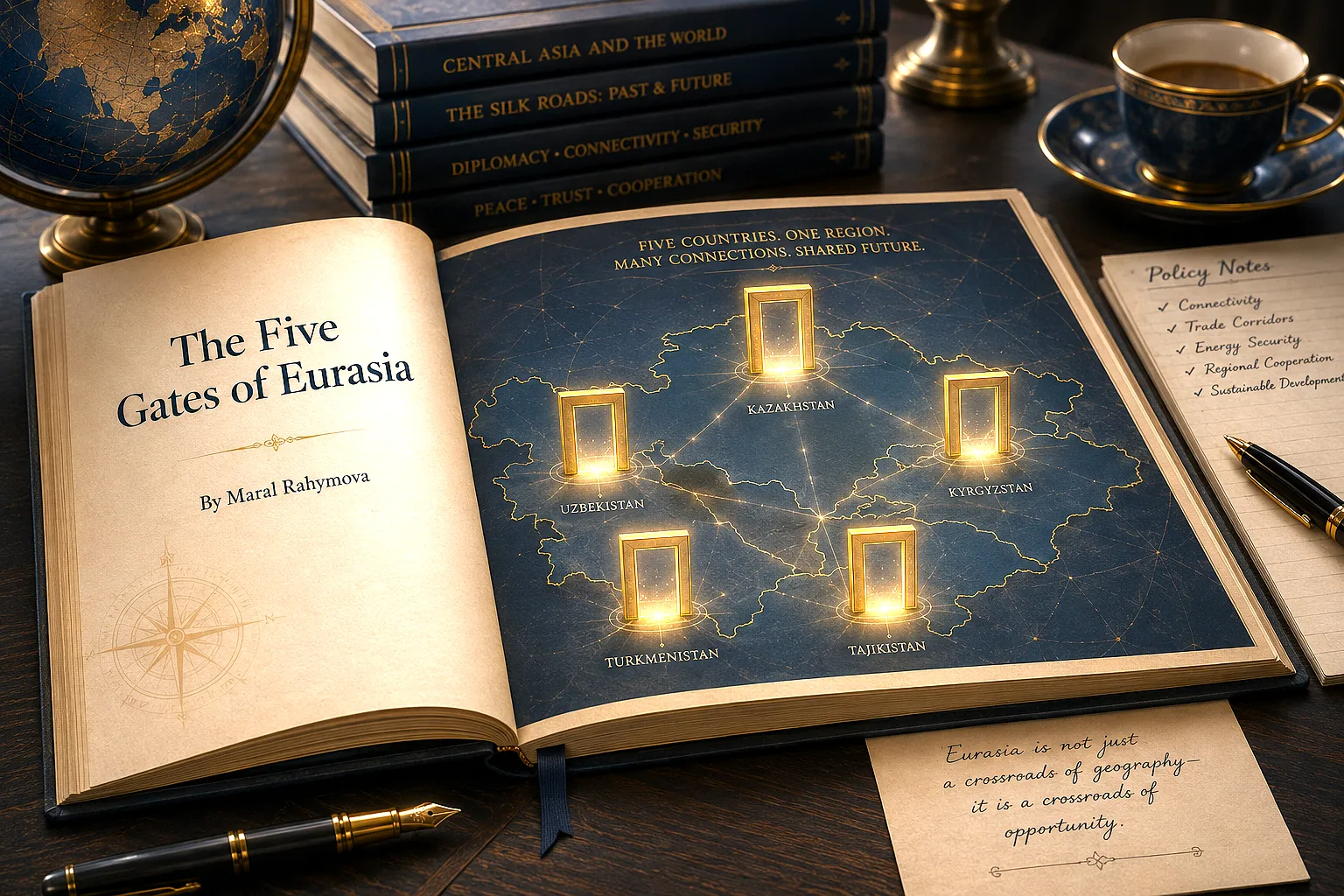
In this article, I propose looking at The Five Gates of Eurasia as a broader global framework – a new way of understanding Central Asia’s role in the 21st century. My argument is simple: Kazakhstan, Kyrgyzstan, Tajikistan, Turkmenistan and Uzbekistan should no longer be seen only as “landlocked” states, “post-Soviet” countries, a “transit region” or a space located between larger powers. They should be seen as five sovereign gates of Eurasia – a region of peace, trust, connectivity and sustainable development connecting continents, civilizations, markets, energy systems, cultures and people.
The term “Five Gates of Eurasia” is not intended to create a political bloc or replace the national identities of the five Central Asian states. On the contrary, it respects their sovereignty and individuality. Each country is a gate in its own right. Together, they form a regional gateway system at the heart of Eurasia.
This is not just a branding idea. It is a strategic narrative whose time has come.
Why Central Asia needs a new global language
International politics is shaped not only by power and geography, but also by language. The way a region is named affects how it is understood, studied, funded, visited and engaged.
International politics is shaped not only by power and geography, but also by language. The way a region is named affects how it is understood, studied, funded, visited and engaged.
Central Asia has often been described by limiting terms. It is called “landlocked,” which is technically correct but psychologically restrictive. It is called a “transit region,” which makes it sound like a place to pass through rather than a place with its own agency. It is sometimes described as a “buffer,” which reduces five sovereign countries to a space between others.
Yet the reality of Central Asia is much larger than these labels suggest. Together, Kazakhstan, Kyrgyzstan, Tajikistan, Turkmenistan and Uzbekistan cover almost 4 million square kilometres – a territory broadly comparable in size to the European Union, whose geographical size is also around 4 million square kilometres. The region’s population is now estimated at more than 83 million people in 2025 and nearly 85 million in 2026, making it not a marginal space, but a major human, geographic and strategic region in the heart of Eurasia.
Nor is Central Asia only becoming more visible to the outside world; it is also rediscovering itself from within. Mutual trade among Central Asian countries reached about $12.3 billion in 2025, nearly doubling compared with 2020. This is not just a statistical increase. It is evidence that our economies are beginning to rediscover each other after decades.
This regional awakening is also political. Since 2018, the Consultative Meetings of the Heads of State of Central Asia have developed into an increasingly important mechanism of dialogue and coordination. Their significance lies precisely in the fact that this format was created by the countries of the region themselves. It is not imposed from outside. It reflects our own understanding that Central Asia needs more dialogue, more coordination and more practical cooperation. The seventh Consultative Meeting, held in Tashkent in November 2025, confirmed this trend and marked another step in the institutionalization of regional dialogue.
The Tashkent meeting was especially important because Turkmenistan assumed the rotating chairmanship of the Central Asian consultative format for 2026. President Serdar Berdimuhamedov stated that Turkmenistan would work to strengthen unity, solidarity and economic partnership in Central Asia, increase the region’s attractiveness for major foreign investment, and advance large-scale international projects in energy, transport, communications and other sectors.
This is why the phrase The Five Gates of Eurasia is more than a metaphor. It reflects a region that is large enough to matter, young enough to grow, connected enough to transform, and increasingly conscious of its own collective role.
The Five Gates of Eurasia offers a different language.
It says that Central Asia is not isolated – it is land-linked.
It is not peripheral – it is central.
It is not merely between powers – it is a meeting point of regions.
It is not only a corridor – it is a civilizational and developmental space.
It is not only five separate national stories – it is an emerging regional conversation.
This shift matters. In a fragmented world, regions that connect rather than divide are becoming strategically important. Central Asia is one of them.
The first gate: peace and trust
The first gate is peace.
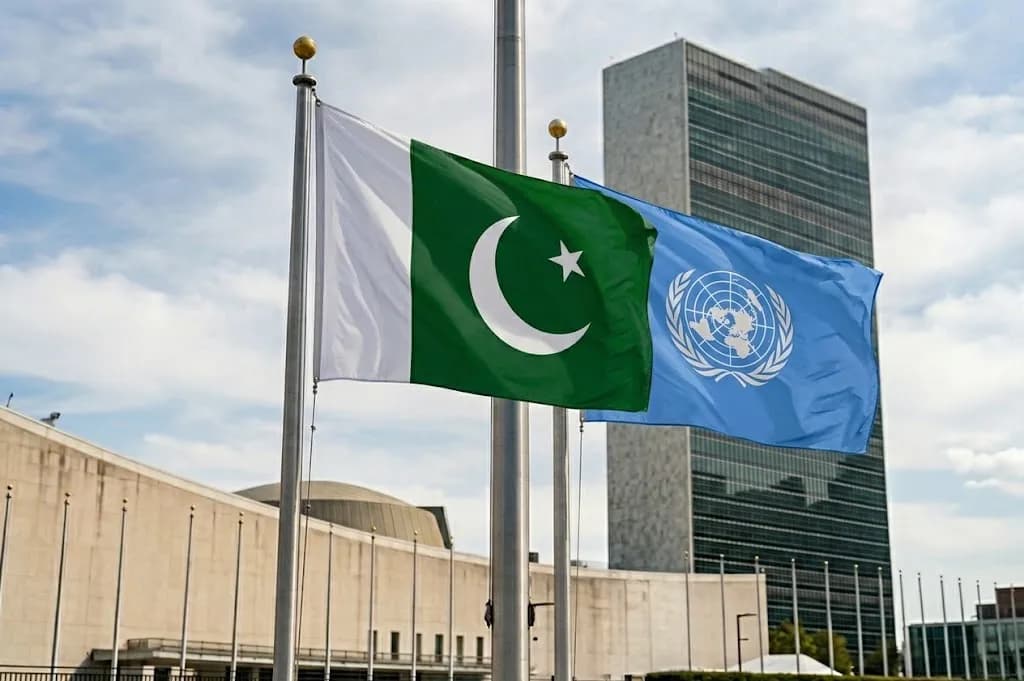
The world often discusses Central Asia in terms of resources, transport and geopolitics. But the region’s most important contribution may be its ability to serve as a space of dialogue. In 2024, the UN General Assembly adopted resolution A/RES/79/5, titled “Zone of peace, trust and cooperation of Central Asia,” without a vote. This followed the earlier 2022 resolution on the same theme, showing that the international community has already recognized Central Asia as a region associated with peace, trust and cooperation.
This is a powerful foundation for the Five Gates concept. The gates of Central Asia should not be imagined as military gates, geopolitical gates or gates of competition. They are gates of preventive diplomacy, confidence-building and peaceful cooperation.
The United Nations Regional Centre for Preventive Diplomacy for Central Asia, headquartered in Ashgabat, was established in 2007 to support the five countries – Kazakhstan, Kyrgyzstan, Tajikistan, Turkmenistan and Uzbekistan – in strengthening conflict prevention through dialogue, confidence-building measures and partnership.
That matters globally. At a time when many regions are defined by confrontation, Central Asia can be defined by the search for balance. The Five Gates of Eurasia can become a language for a region that does not want to be a battlefield of interests, but a bridge of cooperation.
The second gate: connectivity
The second gate is connectivity.
For centuries, Central Asia was part of the living geography of the Silk Roads. Today, that history is returning in modern form through transport corridors, energy infrastructure, digital routes, trade facilitation and logistics networks.
The Middle Corridor, linking China and Europe through Central Asia, the Caspian Sea and the South Caucasus, has become one of the most discussed routes in Eurasian connectivity. The World Bank has noted that, with the right policies and investments, the Middle Corridor could significantly increase freight volumes and reduce travel times by 2030.
But Central Asia should not be reduced to one corridor. A corridor is something others pass through. A gate is something that creates access, exchange and value.
The Five Gates of Eurasia should therefore be understood as a wider connectivity vision: railways, roads, ports, dry ports, digital infrastructure, customs modernization, air links, energy grids, educational networks and people-to-people contact. The real question is not only how fast goods can move across Central Asia. The real question is how much prosperity, technology, knowledge and opportunity can remain inside the region.
Connectivity must not only connect others through Central Asia. It must connect Central Asia to the world.
The third gate: energy and resources
The third gate is energy.
Central Asia is already important for global energy security. The region has gas, oil, uranium, hydropower potential, solar and wind opportunities, and increasing relevance for the green transition. But the future should not be built on extraction alone.
The global demand for critical minerals has grown sharply because these resources are needed for clean energy technologies, electric vehicles, batteries and digital infrastructure. The International Energy Agency has warned that critical minerals have moved high on the policy agenda due to demand growth, supply-chain risks and geopolitical concerns.
Central Asia can be part of this global transformation, but it should not become only a new resource frontier. The Five Gates of Eurasia should promote a more balanced approach: responsible extraction, local processing, green technologies, human capital, environmental standards and fair partnerships.
A gate should not only open outward for raw materials to leave. It should also open inward for investment, technology, skills and sustainable industrial development.
The fourth gate: water, climate and resilience
The fourth gate is water.
Central Asia’s future will be shaped not only by roads and railways, but by rivers, glaciers, deserts, mountains and fragile ecosystems. Water is one of the most sensitive and strategic issues in the region. It links agriculture, energy, food security, climate adaptation, public health and regional stability.
This is why the Five Gates concept must include ecological responsibility. Central Asia cannot be promoted only as a trade and transport space. It must also be understood as a climate-sensitive region whose water systems matter far beyond national borders.
The Aral Sea tragedy remains one of the world’s most painful environmental lessons. But it can also become the basis for a new generation of ecological diplomacy. Water cooperation, glacier protection, desertification control, sustainable agriculture and renewable energy should become part of the Five Gates vision.
If the 20th century treated Central Asia’s environment as an afterthought, the 21st century must treat it as a central question of regional security and global responsibility.
The fifth gate: culture, knowledge and civilization
The fifth gate is culture.
Central Asia is not only a geopolitical space. It is a civilizational region. The Silk Roads were never simply trade routes; they were routes of ideas, science, mathematics, astronomy, medicine, poetry, architecture, religion, craftsmanship and human imagination.
UNESCO’s work on Silk Roads heritage in Central Asia demonstrates the depth of this legacy. The Chang’an–Tianshan Silk Road Corridor includes sites in Kazakhstan and Kyrgyzstan, while the Zarafshan–Karakum Corridor, nominated by Tajikistan, Turkmenistan and Uzbekistan, was added to the World Heritage List in 2023 with 33 component sites.
This is why the Five Gates of Eurasia should not be presented only to diplomats, investors and transport specialists. It should also be presented to historians, students, artists, tourists, researchers and young people.
The region’s cultural power is one of its greatest assets. If Central Asia is remembered only as a route, it can be bypassed. If it is remembered as a civilization, it becomes indispensable.
Why the Five Gates matter for the United Nations
The Five Gates concept also fits the current international moment.
In 2024, UN Member States adopted the Pact for the Future, described by the United Nations as a landmark agreement intended to make the international system more effective, inclusive and fit for 21st-century challenges. It includes the Global Digital Compact and the Declaration on Future Generations.
Central Asia has something to contribute to this agenda. The region’s main challenges – peace, connectivity, climate, water, energy, youth, digitalization, landlocked development and sustainable growth – are not only regional issues. They are global issues.
The Five Gates of Eurasia can therefore become a useful framework for multilateral cooperation. It can link Central Asia to the UN agenda on sustainable transport, landlocked developing countries, preventive diplomacy, climate resilience, cultural heritage, future generations and inclusive development.
At the Third UN Conference on Landlocked Developing Countries, held in Awaza, Turkmenistan, in August 2025, UN Secretary-General António Guterres emphasized that geography should never define destiny and called for transforming geography “from a barrier to a bridge.”
That sentence captures the spirit of the Five Gates of Eurasia.
The concept turns geography into possibility.
From national diplomacy to regional identity
The Five Gates of Eurasia should not be owned by one country alone. It must be inclusive and respectful of all five states.
Kazakhstan brings vast geography, resources, industrial capacity and an important role in Eurasian transport.
Kyrgyzstan brings mountains, water, hydropower potential, mobility and human openness.
Tajikistan brings glaciers, water sources, Persianate heritage and strategic links with South Asia.
Turkmenistan brings neutrality, energy diplomacy, Caspian access and the Ashgabat-based UN preventive diplomacy platform.
Uzbekistan brings demographic weight, historic cities, regional diplomacy and an important position in Central Asian connectivity.
Each is different. Each is sovereign. Each is a gate.
The strength of the concept lies precisely in this balance. It does not erase national identities. It creates a regional umbrella under which all five countries can be seen more clearly.
How the concept can be used globally
If developed seriously, the Five Gates of Eurasia can become more than an article title. It can become a practical international framework.
It could inspire:
The Five Gates of Eurasia Forum – a platform for peace, connectivity and sustainable development.
The Five Gates Connectivity Index – measuring regional transport, digital and trade integration.
The Five Gates Cultural Route – promoting Silk Roads heritage across the five countries.
The Five Gates Youth Dialogue – connecting young professionals, students and innovators.
The Five Gates Green Corridor Initiative – linking water, climate, energy and sustainable transport.
The Five Gates Peace and Trust Platform – supporting preventive diplomacy and regional confidence-building.
The concept could be used in academic research, diplomatic speeches, policy papers, tourism campaigns, UN side events, investment forums and cultural projects. Its strength is that it is simple enough to remember, but broad enough to grow.
My personal proposal
As the author of this concept, I propose “Central Asia – The Five Gates of Eurasia” as a new positive international identity for the region.
It is not a replacement for existing diplomatic formats. It is not a political union. It is not a geopolitical slogan. It is a narrative framework – one that can help the world see Central Asia not through old categories, but through its emerging role.
The Five Gates of Eurasia should stand for:
peace instead of rivalry;
trust instead of suspicion;
connectivity instead of isolation;
sustainability instead of extraction;
civilization instead of stereotypes;
cooperation instead of fragmentation.
This is the global value of Central Asia.
The 21st century will not be shaped only by oceans, ports and maritime chokepoints. It will also be shaped by inland regions that connect continents, manage scarce resources, preserve civilizational memory, provide platforms for dialogue and help build new forms of sustainable development.
Central Asia is one of those regions.
In my earlier article, I argued that the Five Gates of Eurasia matter for the European Union. In this article, I argue that they matter for the world.
The world needs regions that connect rather than divide. It needs spaces of trust in an age of suspicion. It needs new routes of cooperation in an era of fragmentation. It needs names that reflect not only geography, but purpose.
That is why I propose calling Central Asia what it increasingly is:
The Five Gates of Eurasia
A zone of peace, trust, connectivity and sustainable development – opening from the heart of the continent to the wider world.
By Maral Rahymova
Diplomat at the Embassy of Turkmenistan in Belgium, Mission of Turkmenistan to the European Union
Related Topics

Maral Rahymova
Maral Rahymova is a Turkmen diplomat and policy writer based in Brussels. Her work and research focus on diplomacy, international cooperation, peace, emerging technologies, and global affairs.
Follow EUReflect
See more of our reporting on Google
Mark EUReflect as a preferred source and our stories are ranked higher for you in Top Stories, Discover and Google News — and carry a “preferred” badge when they are cited in AI results.
Add EUReflect as a preferred source