Did Javier Milei Save Argentina’s Economy — or Just Stabilize It?
By Dmytro Melnyk, 11 April 2026 Javier Milei’s economic strategy in Argentina has delivered a verifiable reduction in inflation, transforming a hyperinflationary crisis into a manageable disinflationary trajectory, though this success hinges on a libertarian austerity model that imposes steep short-term costs and faces enduring unc
Overview
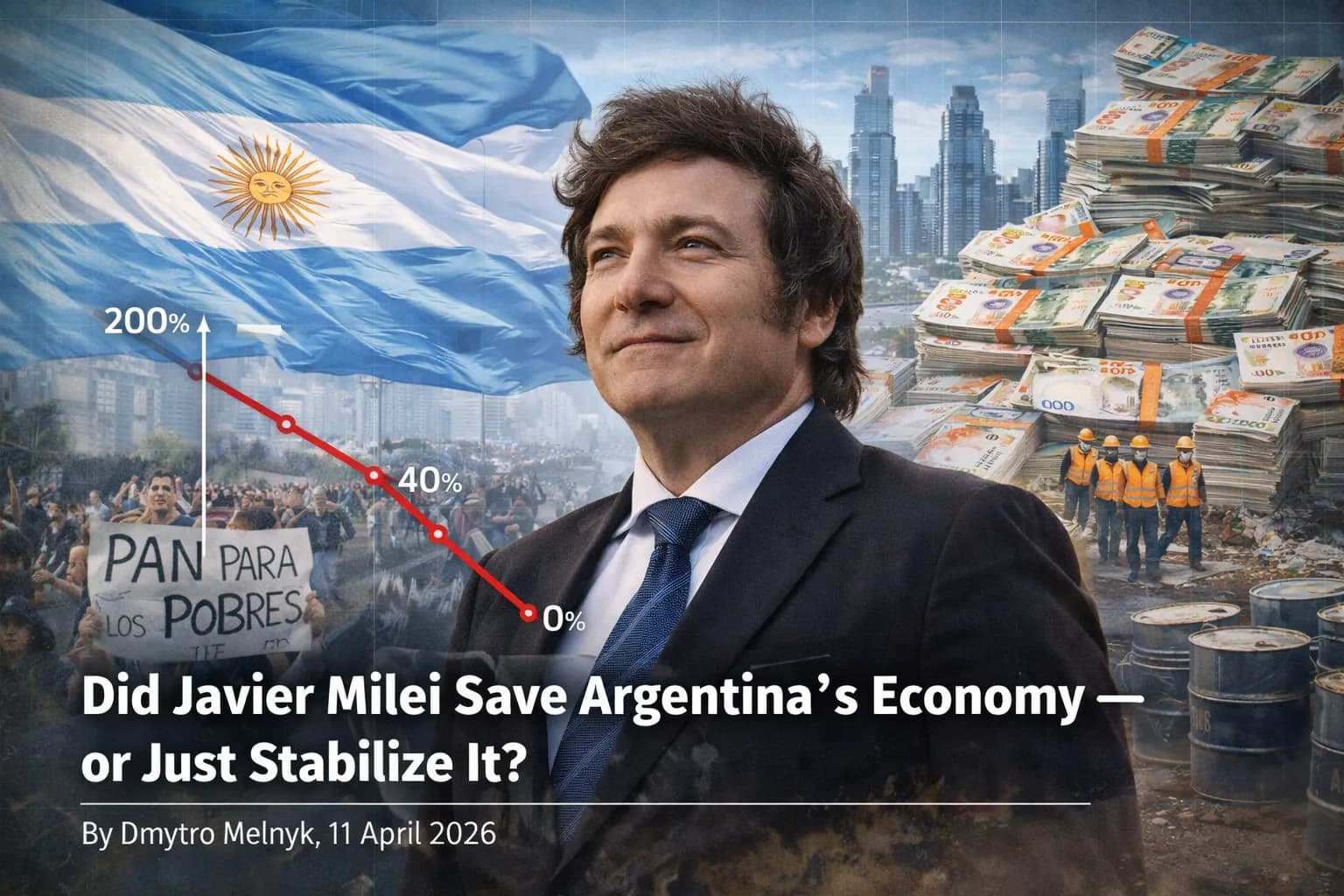
When Javier Milei was sworn in as Argentina's president in December 2023, the country was in the state of one of the most severe inflation crises in the world. Annual inflation stood at 211.4% The central bank had been financing deficits through monetary emission for years, the fiscal deficit was running at roughly 5 percent of GDP, and foreign currency reserves had been drained to deeply negative levels. The diagnosis was terrible. The cure Milei prescribed was even more radical (Iglesia, 2026).
Milei’s Libertarian Philosophy
Milei's worldview is built on anarcho-capitalist foundations, shaped by thinkers like Murray Rothbard and Friedrich Hayek, filtered through a confrontational political style that frames Argentina's failures as the direct product of an entrenched political caste and an overreaching state. He campaigned with a literal chainsaw — a theatrical prop that proved to be an accurate preview of his governing philosophy. On entering office, he cut the number of government ministries by more than half, launched sweeping subsidy eliminations, immediately devalued the peso by roughly 54 percent, and pledged to end monetary financing of the deficit entirely.
The flagship legislative vehicle for these reforms, the Ley Bases, dismantled regulatory barriers designed to attract investment and spur market efficiency. A companion 2 emergency decree enacted sweeping deregulation across the economy. The reforms were uncompromising, divisive, and in many ways unprecedented in modern Latin American policy.
The Inflation Achievement
The results on inflation are real and substantial. Prices in Argentina increased 31.5% over 2025 — the lowest annual inflation rate since 2017, more than 86 percentage points lower than 2024's 117.8%, and 180 percentage points below 2023's 211.4% (Iglesia, 2026).
Annual inflation peaked at 211% in 2023 and closed 2025 at 31.5% , a reduction of nearly 180 percentage points achieved in roughly two years. Monthly inflation, which was running near 25% when Milei was elected, fell to approximately 2.1% in October 2025. By January 2026, it had ticked back to 2.9% month-on-month, the second-highest monthly reading since September 2024 (Mann, 2026).
The disinflationary mechanism is genuine rather than cosmetic. Cessation of monetary emission to fund deficits removed the principal fuel driving price growth. The combination of fiscal consolidation, a managed exchange rate anchor, and demand compression created conditions in which inflation, while still elevated by international standards, has been durably reduced. Severe fiscal retrenchment eliminated a national government budget deficit that had been running at about 5 percent of GDP, and Argentina recorded its first fiscal surplus in over a decade (Obstfeld, 2026). However, the trajectory is not without complications.
Starting in February 2026, Argentina's national statistics bureau INDEC began using a new basket of goods to calculate inflation, giving greater weight to services and transportation, analysts calculated that if this methodology had been used since Milei took office, inflation would have been measured approximately 11% higher overall. The methodological shift is a legitimate concern, when assessing the headline figures. The central bank's market survey (REM) raised the 2026 inflation forecast to 29.1%, driven in part by the Iran war's global oil price shock, which feeds through to Argentina's domestic fuel and transport costs.
The Economic Recovery is Stronger Than Expected
One of the most significant corrections to the narrative concerns economic growth. The article's original suggestion of "lingering recessionary conditions" and a "modest 0.3 percent quarterly expansion in late 2025" is not consistent with current data. Argentina's GDP expanded 4.4% in 2025, the highest growth rate in years, outside of a pandemic-era bounceback, which confirms President Milei's success in turning around the economy. Economy Minister Luis Caputo noted that the sectors driving this improvement were capital-intensive ones generating fewer jobs, such as agriculture, finance, and mining, which is an important qualifier, but the macro picture is one of genuine recovery, not stagnation (Semafor, 2026)
The fiscal accounts have been brought back into balance. Public debt and inflation are both on a downward trajectory, and real wages are beginning to recover, though unevenly. International capital has flowed back in. The IMF approved a $20 billion program. Financial markets have rewarded the adjustment with sharply reduced sovereign risk premiums.
The Social Toll: Real, Severe, and Partially Reversed
The human cost of this adjustment was substantial and doesn’t have to be minimized. When Javier Milei became a president in November 2023, poverty affected 41.7% of the population. The indicator soared to 52.9% in the first half of 2024 following the steep devaluation and subsidy removals. This wasn’t an abstraction, it actually represented millions of Argentine families unable to afford a basic food basket in the immediate aftermath of the shock (Buenos Aires Times, 2026).
Driven by job losses in the public sector, unemployment spiked from 7.3% in late 2023 to 9.1% in early 2025. Between November 2023 and November 2025, 22,000 companies have closed, while unemployment is at its highest level in six years.
Yet the social indicators have since reversed meaningfully. Argentina's poverty rate fell to 31.6% in the first half of 2025, a drop of 6.5 points from the second half of 2024 and 4 the lowest poverty rate since 2018. Extreme poverty stood at 6.9 percent. The recovery was principally driven by the sharp deceleration of inflation allowing household incomes to outpace rising basic-goods costs. Child poverty remains acute, however, at 41.3% for those under 14, a figure that receives less attention in the macroeconomic commentary but reflects the unequal distribution of the adjustment's costs.
Political Durability and Ongoing Risks
Milei's political standing has been reinforced by economic results. The October 2025 midterm elections proved pivotal, with Milei's La Libertad Avanza party securing 41% of the vote and doubling its congressional representation, giving him a broader legislative mandate to continue reforms.
Nevertheless, the experiment's durability faces structural challenges. The exchange rate regime remains a point of vulnerability. A significant run on the currency in September– October 2025 was only staved off by a rare U.S. intervention in the FX market, hardly a sustainable solution to depreciatory pressure. Argentina's chronic reliance on the US dollar as the preferred unit of account and store of value reflects deep distrust in the peso after repeated devaluations, defaults, and deposit freezes, a structural feature of the economy that fiscal discipline alone cannot rapidly resolve.
Externally, the Iran war's energy shock presents a new threat. Argentina's disinflation had been Milei's most bankable achievement, attracting investor confidence and underpinning the peso's relative stability, but the Iran conflict feeds through to domestic fuel costs, transport prices, and food logistics, the same transmission mechanism hitting Chile, Colombia, and Brazil simultaneously.
Conclusion
Milei's economic program has delivered on its headline promise: inflation has been brought from a crisis-level 211% annual rate in 2023 to approximately 31.5% by the close of 2025. GDP grew 4.4% in 2025. Poverty, after surging to nearly 53% in the shock phase, has fallen back to its lowest level in seven years. These outcomes are real.
But they were forged in recessionary fire during 2024, at the cost of a poverty spike, an unemployment jump from 7.3% to 9.1%, the closure of 22,000 businesses, and a suppression of real wages from which recovery is only now gradually emerging. The disinflation was achieved partly through demand compression, which means the full inflationary pressure has not been structurally eliminated so much as suppressed by austerity and an exchange rate anchor that remains fragile.
The verdict on the "Milei experiment" is not yet written. The macroeconomic numbers are impressive. The social balance sheet is still being tallied. And Argentina's history offers ample warning that gains made in a single political cycle can unravel in the next. True vindication lies not in taming prices alone, but in converting stabilization into broad-based, durable prosperity, something no Argentine government before has managed to sustain in the modern era.
References
Iglesia, F. (2026, January 13). Argentina’s inflation in 2025 fell to 31.5%, the lowest in 8 years. Buenos Aires Herald. https://buenosairesherald.com/economics/argentinas-inflation-in-2025-fell-to-31-5- the-lowest-in-8-years Obstfeld, M. (2026, February 11). Argentina's fragile monetary framework risks renewed volatility. Peterson Institute for International Economics. https://www.piie.com/blogs/realtime-economics/2026/argentinas-fragile-monetaryframework-risks-renewed-volatility Mann, R. (2026, April 8). Argentina Economy 2026: Complete investor guide. The Rio Times. https://www.riotimesonline.com/argentina-economy-2026-complete-guide/ 6 Semafor. (2026, March 23). Argentina’s 2025 GDP growth signals economic recovery. Semafor. https://www.semafor.com/article/03/23/2026/argentinas-2025-gdp-growth-signalseconomic-recovery Buenos Aires Times. (2026). Sharp drop in Argentina’s poverty rate delivers boost for Milei. Buenos Aires Times. https://batimes.com.ar/news/amp/argentina/sharp-drop-in-argentinas-poverty-ratedelivers-boost-for-milei.phtml Casanovas, M. (2025, December 2). Argentina economy under Milei. FocusEconomics. https://www.focus-economics.com/blog/argentina-economy-under-milei/ Theia Consulting Group. (2026). Argentina’s economy keeps surpassing expectations. Theia Consulting Group. https://www.theiacg.com/insights/argentinas-economy-keeps-surpassingexpectations-s7m8t
Dmytro Melnyk
Contributing writer at EUReflect.
Follow EUReflect
See more of our reporting on Google
Mark EUReflect as a preferred source and our stories are ranked higher for you in Top Stories, Discover and Google News — and carry a “preferred” badge when they are cited in AI results.
Add EUReflect as a preferred source