Russia’s Ground War Is Changing
Moscow has created at least 10 new divisions since December 2022, but many are understrength, highlighting the strain on personnel and equipment.
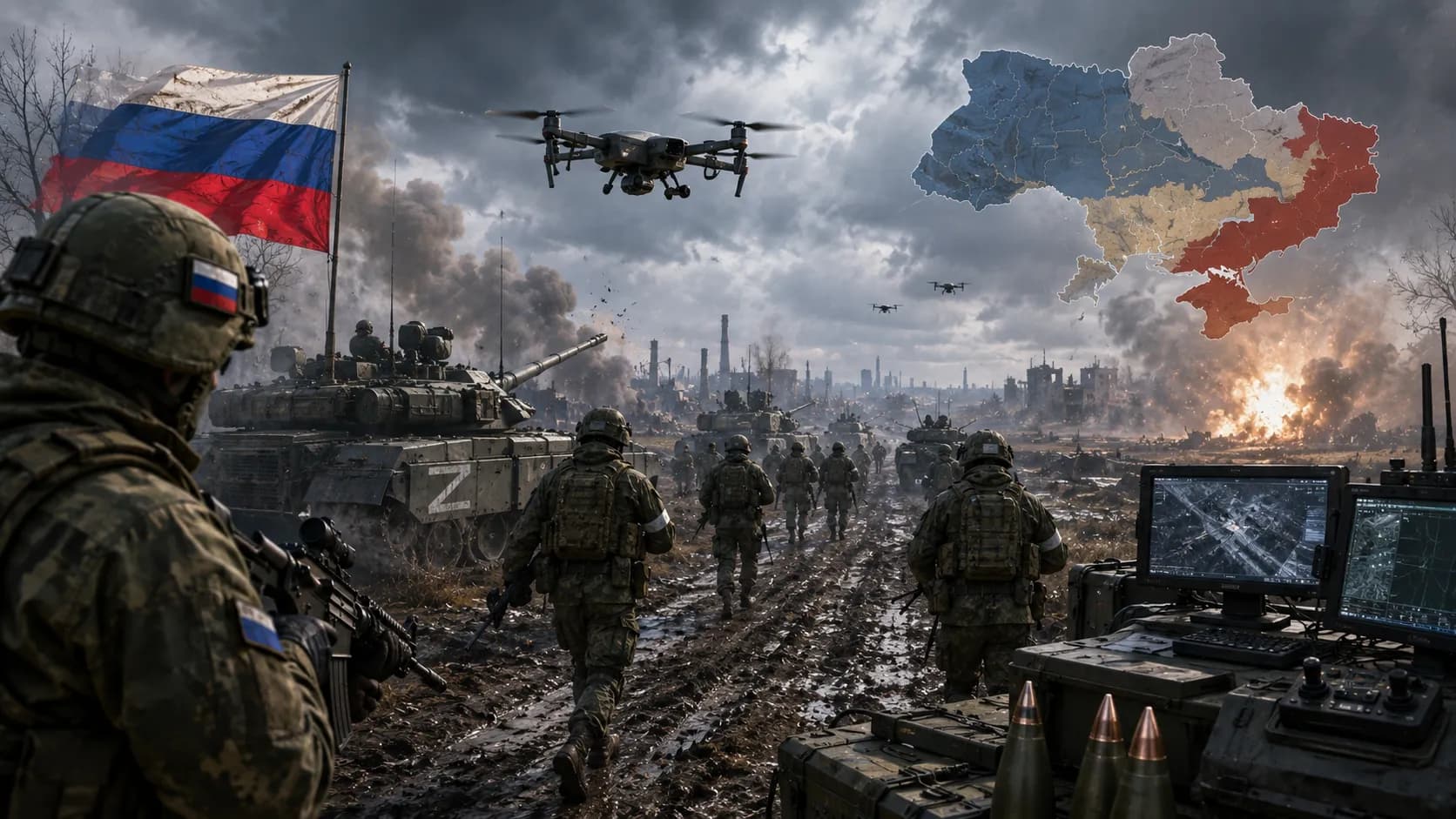
Russia's intervention in Ukraine has transformed its ground forces more profoundly than any conflict since the collapse of the Soviet Union. More than four years of high-intensity warfare have forced Moscow to expand formations, modify assault tactics, accelerate drone integration and reorganize command structures while simultaneously replacing heavy battlefield losses.
The result in 2026 is a Russian land force that is larger and more experienced in prolonged warfare, but also increasingly shaped by attrition.
Recent operations illustrate this contradiction. Russian forces continue to exert pressure across eastern Ukraine and have recently advanced east of Slovyansk, while maintaining operations around Pokrovsk, Dobropillya, Kupyansk, Sumy and Zaporizhzhia. Yet many advances remain slow and geographically limited.
Ukraine Changed the Russian Army
Russia entered Ukraine in February 2022 expecting comparatively rapid combined-arms operations involving armored formations, artillery, airborne troops and air power.
The war developed differently.
Dense defenses, anti-tank weapons, artillery, mines and eventually enormous numbers of drones made large mechanized movements increasingly dangerous.
Russia consequently adapted.
Its ground forces increasingly rely on smaller infantry assault groups, reconnaissance drones, electronic warfare, artillery and highly localized infiltration. Successful penetrations are frequently reinforced rapidly rather than immediately followed by large armored formations.
Recent fighting east of Slovyansk illustrates this method. Ukrainian military analysis cited by ISW indicates that Russian commanders are reinforcing assault infantry immediately after successful infiltrations to consolidate newly captured positions.
The Russian army has therefore increasingly shifted from seeking dramatic breakthroughs toward continuous pressure and incremental territorial gains.
Russia Is Still Expanding Its Army
Moscow is simultaneously attempting to enlarge its permanent ground-force structure.
Since 2022, Russia has recreated the Moscow and Leningrad military districts and formed or reorganized numerous motorized-rifle, airborne and naval-infantry formations.
ISW assessed in June that Russia had formed and deployed at least 10 new divisions since December 2022, although many were not operating at their intended doctrinal strength. Russia also continues plans for additional divisions and brigades.
This expansion has implications beyond Ukraine.
The restoration of military districts facing Europe indicates that Moscow is constructing a force structure intended not simply for the current war but for a potentially prolonged confrontation with NATO.
The problem is personnel.
Creating a division organizationally is considerably easier than providing it with enough trained soldiers, officers, vehicles and equipment to operate at full strength.
Manpower Is Becoming the Critical Question
Russia's greatest advantage over Ukraine has been its ability to draw from a much larger population and continuously replace battlefield losses.
But maintaining that advantage is becoming increasingly expensive.
The Financial Times reported this month that Western estimates put Russian losses at more than 30,000 personnel per month, while recruitment officials are facing growing difficulty attracting enough new contract soldiers. Moscow continues to avoid another large public mobilization and instead relies heavily on financial incentives and increasingly aggressive recruitment.
Russian officials say approximately 200,000 personnel were recruited during the first half of 2026, but high attrition means many new soldiers are needed simply to replenish existing formations rather than create strategic reserves.
This is crucial.
A large army can continue attacking while replacing losses.
But a powerful offensive army also needs reserves capable of exploiting a breakthrough once one occurs.
Russia's manpower system currently appears better suited to sustaining pressure than generating a decisive operational maneuver.
Territorial Gains Remain Expensive
July demonstrated the problem particularly clearly.
ISW assessed that Russian forces achieved only about 37.85 square kilometers of net territorial gains during July 2026, although infiltration temporarily extended into a substantially larger area.
The same assessment, citing Ukrainian General Staff figures, reported 42,860 Russian casualties during July. Those casualty numbers are Ukrainian claims and cannot be independently treated as exact Russian losses, but the broader evidence points to an extremely high level of attrition.
Russia's offensive therefore operates through an unusual equation:
manpower + artillery + drones + time = gradual territorial pressure.
This can work strategically if Moscow believes Ukraine will eventually suffer greater shortages of soldiers, ammunition or political support.
But it is extremely costly.
Drones Have Become Part of Ground Warfare
Perhaps the most important technological transformation concerns unmanned systems.
Drones are no longer simply reconnaissance equipment supporting Russian ground forces.
They have become part of the battlefield architecture itself.
Small UAVs identify Ukrainian positions, track vehicles, guide artillery and conduct direct attacks. Longer-range systems strike logistics and command infrastructure behind the front.
Russia has consequently been institutionalizing unmanned warfare. Command reforms announced in August included instructions to complete the formation of specialized unmanned-systems forces, explicitly drawing on lessons from Ukraine.
But Ukraine is adapting simultaneously.
Ukrainian tactical drones have created increasingly dangerous zones behind the immediate front line, making it harder for Russian vehicles, supplies and reinforcements to move safely.
ISW assesses that Ukrainian tactical drone superiority in some sectors, combined with intermediate-range strikes against Russian logistics, is slowing Russia's operational tempo.
This means the battlefield increasingly extends dozens or even hundreds of kilometers behind the trench line.
Tanks Are No Longer Enough
Russia still possesses large armored forces, but Ukraine has demonstrated the limitations of traditional armored warfare.
A tank approaching the front can now potentially be detected by reconnaissance drones, attacked by FPV drones, targeted by artillery or stopped by mines before reaching Ukrainian defensive positions.
Armor consequently remains valuable, but it increasingly operates as one element inside a broader network rather than as the principal instrument for achieving breakthroughs.
The central lesson is not that tanks have become obsolete.
It is that armor without electronic warfare, drone protection, reconnaissance and infantry coordination has become extraordinarily vulnerable.
Russia's evolving tactics increasingly reflect this reality.
Ukraine Is Now Attacking Russia’s Rear
Another important transformation is occurring far behind Russian ground formations.
Ukraine is intensifying strikes against Russian logistics, command facilities, air defenses, airfields and infrastructure in occupied territory and inside Russia itself.
On August 23–24, Ukrainian forces reportedly struck Russian aircraft, helicopters, surveillance radars and other military infrastructure, while separate operations have targeted warehouses, electrical substations and logistics facilities supporting Russian forces.
This creates a new challenge for Russia's land forces.
An army no longer needs to protect only its frontline units.
It must protect the entire logistical system behind them.
Fuel depots, railway connections, repair facilities, command centers and ammunition storage sites increasingly exist within Ukraine's strike envelope.
Russia Has Learned — But So Has Ukraine
The Russian army of 2026 is significantly different from the force that crossed into Ukraine in February 2022.
It has accumulated enormous combat experience.
It has expanded drone warfare.
It has modified infantry tactics.
It has reorganized formations and command structures.
And it has demonstrated an ability to sustain a prolonged industrial war despite sanctions and severe losses.
But adaptation does not automatically equal superiority.
Ukraine has simultaneously developed one of the world's most sophisticated drone ecosystems, expanded long-range strikes and learned how to make Russian movement increasingly dangerous.
Recent operations around Kupyansk, Borova and Zaporizhzhia show that Russian attacks can continue without necessarily producing territorial advances.
The central question surrounding Russia's ground forces is therefore changing.
It is no longer whether Russia possesses enough military power to continue the war.
It clearly does.
The more important question is whether Russia can convert its enormous expenditure of manpower, equipment and ammunition into operational breakthroughs rather than incremental advances.
Ukraine has transformed Russia's army into a force optimized for attritional warfare.
That makes the Russian ground forces extremely dangerous in a prolonged conflict — but it also reveals their principal weakness: Moscow has so far proved considerably better at sustaining pressure than turning that pressure into rapid strategic victory.
I can monitor major changes in Russia’s ground-force structure and Ukraine front lines and flag significant developments.
Ahmet Balakan
Contributing writer at EUReflect.
Follow EUReflect
See more of our reporting on Google
Mark EUReflect as a preferred source and our stories are ranked higher for you in Top Stories, Discover and Google News — and carry a “preferred” badge when they are cited in AI results.
Add EUReflect as a preferred source