Elon Musk’s Historic Milestone
Elon Musk became the first person in history to surpass a net worth of $1 trillion after SpaceX’s highly anticipated Nasdaq debut. Strong investor demand pushed the company’s valuation above $2 trillion, making it one of the world’s most valuable corporations and reinforcing Musk’s control.
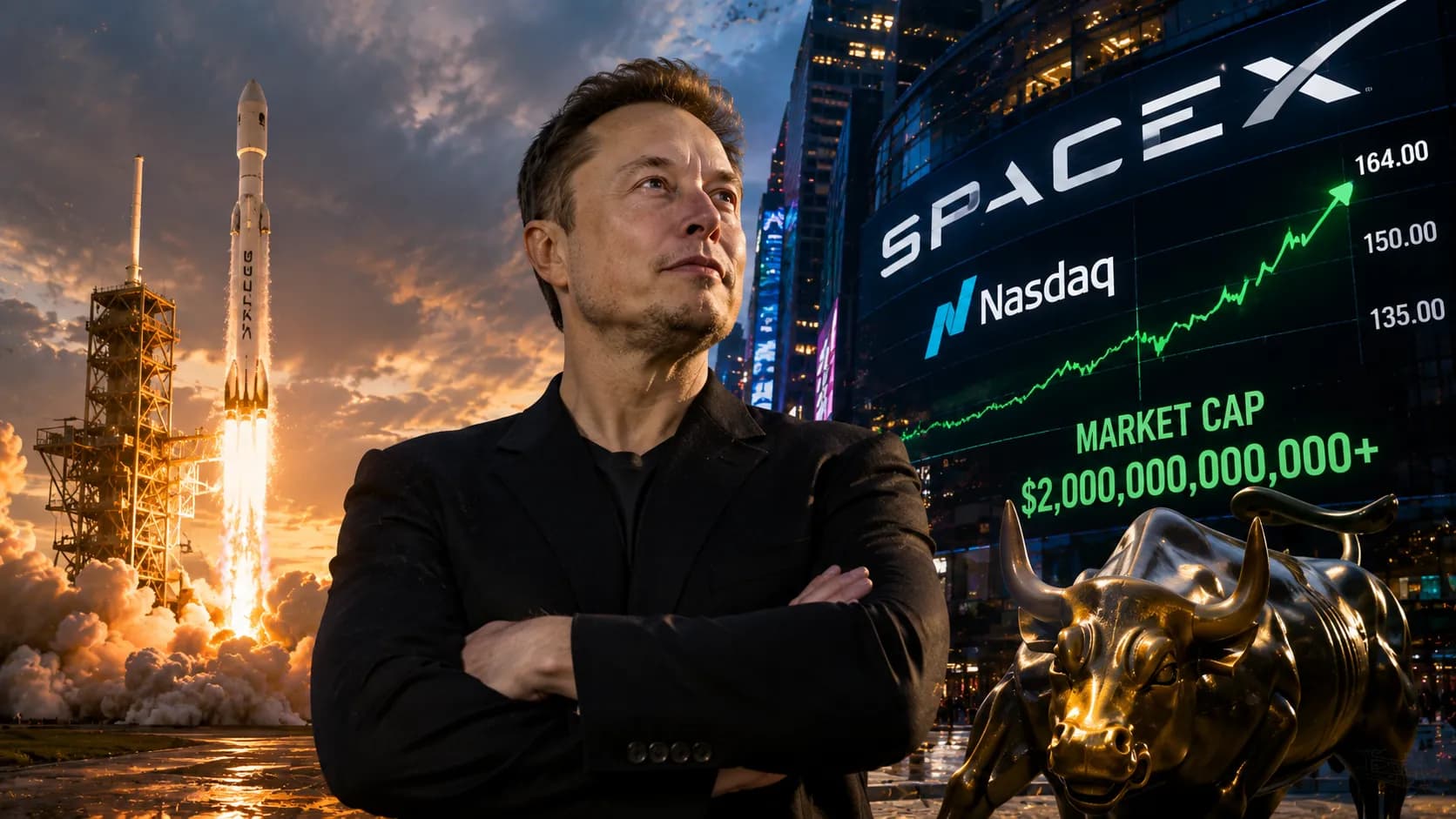
A historic milestone has been reached in the global business and technology sector. Elon Musk, already recognized as the world’s richest individual, has become the first person in history whose net worth has exceeded $1 trillion. The achievement follows the long-awaited public listing of SpaceX on the Nasdaq stock exchange, where overwhelming investor demand pushed the company’s valuation beyond $2 trillion within minutes of trading.
The event marks not only a personal triumph for Musk but also a defining moment for the global space industry, financial markets, and the future of private technological innovation.
SPACEX IPO DRIVES RECORD-BREAKING VALUATION
SpaceX offered a portion of its shares to public investors at an initial price of $135 per share. However, extraordinary market demand immediately drove the stock price significantly higher. Trading opened around $150 per share before rapidly climbing to approximately $164.
Investor enthusiasm had been anticipated. Reports indicated that pre-market demand for SpaceX shares exceeded available stock by nearly four times. As a result, the company instantly entered the ranks of the world’s most valuable corporations.
At the initial offering price, SpaceX was valued at approximately $1.77 trillion. Following the surge in trading, the company’s market capitalization surpassed the symbolic $2 trillion threshold, placing it among the most influential corporate entities in history.
The listing demonstrates the growing confidence investors place in the commercial space sector and advanced technology businesses. SpaceX’s success is widely viewed as evidence that private companies can transform industries once dominated by governments and state agencies.
FROM ROCKET FAILURES TO A GLOBAL TECHNOLOGY EMPIRE
The rise of SpaceX represents one of the most remarkable corporate success stories of the modern era. Founded in 2002, the company initially faced repeated technical failures and financial uncertainty. Early rocket launches ended in explosions, and many industry observers questioned whether the company would survive.
Tom Mueller, one of SpaceX’s earliest employees and the company’s first official hire, reflected on the extraordinary journey. He recalled the challenges of developing the company’s first rocket engines, the setbacks caused by launch failures, and the breakthrough moment in 2008 when SpaceX successfully placed a rocket into orbit.
Over the years, SpaceX expanded far beyond launch services. Today, the company operates a vast portfolio of businesses and technologies, including reusable rocket systems, satellite networks, artificial intelligence ventures, and social media assets.
The organization now incorporates xAI, Musk’s artificial intelligence company, while also maintaining connections with the social platform X, formerly known as Twitter. Together, these ventures have created an interconnected technology ecosystem spanning aerospace, communications, artificial intelligence, and digital media.
MUSK RETAINS UNPRECEDENTED CONTROL OVER SPACEX
Despite becoming a publicly traded company, SpaceX will remain firmly under Elon Musk’s control. Through a dual-class share structure, Musk is expected to hold approximately 40% of the company’s equity while controlling more than 84% of shareholder voting power.
Such a governance structure is uncommon even among major technology firms. While companies like Meta Platforms have similar arrangements, the level of voting influence retained by Musk significantly exceeds that of many other corporate founders.
This concentration of power allows Musk to maintain decisive authority over major strategic decisions, acquisitions, executive compensation, and long-term corporate direction. Analysts note that even if Musk sells portions of his ordinary shares in the future, his special voting shares would likely enable him to retain effective control of the company.
Supporters argue that founder-led control promotes innovation and long-term planning. Critics, however, warn that such structures may reduce shareholder influence and create governance risks, particularly regarding transactions involving Musk’s other businesses.
The issue has attracted increasing attention from investors and legal scholars, who emphasize the importance of balancing entrepreneurial leadership with corporate accountability.
Conclusion
The public debut of SpaceX represents a landmark event in global economic history. The company’s rise from a startup struggling with failed rocket launches to a $2 trillion enterprise illustrates the transformative power of technological innovation and entrepreneurial ambition.
For Elon Musk, the listing has resulted in an unprecedented achievement: becoming the first individual to surpass a net worth of $1 trillion. For financial markets, the success of SpaceX may pave the way for other highly valued private technology firms, including OpenAI and Anthropic, to pursue public offerings in the near future.
Whether SpaceX’s valuation continues to rise or faces future market challenges, its stock market debut has already secured its place as one of the most significant corporate events of the twenty-first century.
Botakoz Unbayeva
Contributing writer at EUReflect.
Follow EUReflect
See more of our reporting on Google
Mark EUReflect as a preferred source and our stories are ranked higher for you in Top Stories, Discover and Google News — and carry a “preferred” badge when they are cited in AI results.
Add EUReflect as a preferred source