EU Enlargement Returns to the Forefront as Security Concerns Reshape Europe
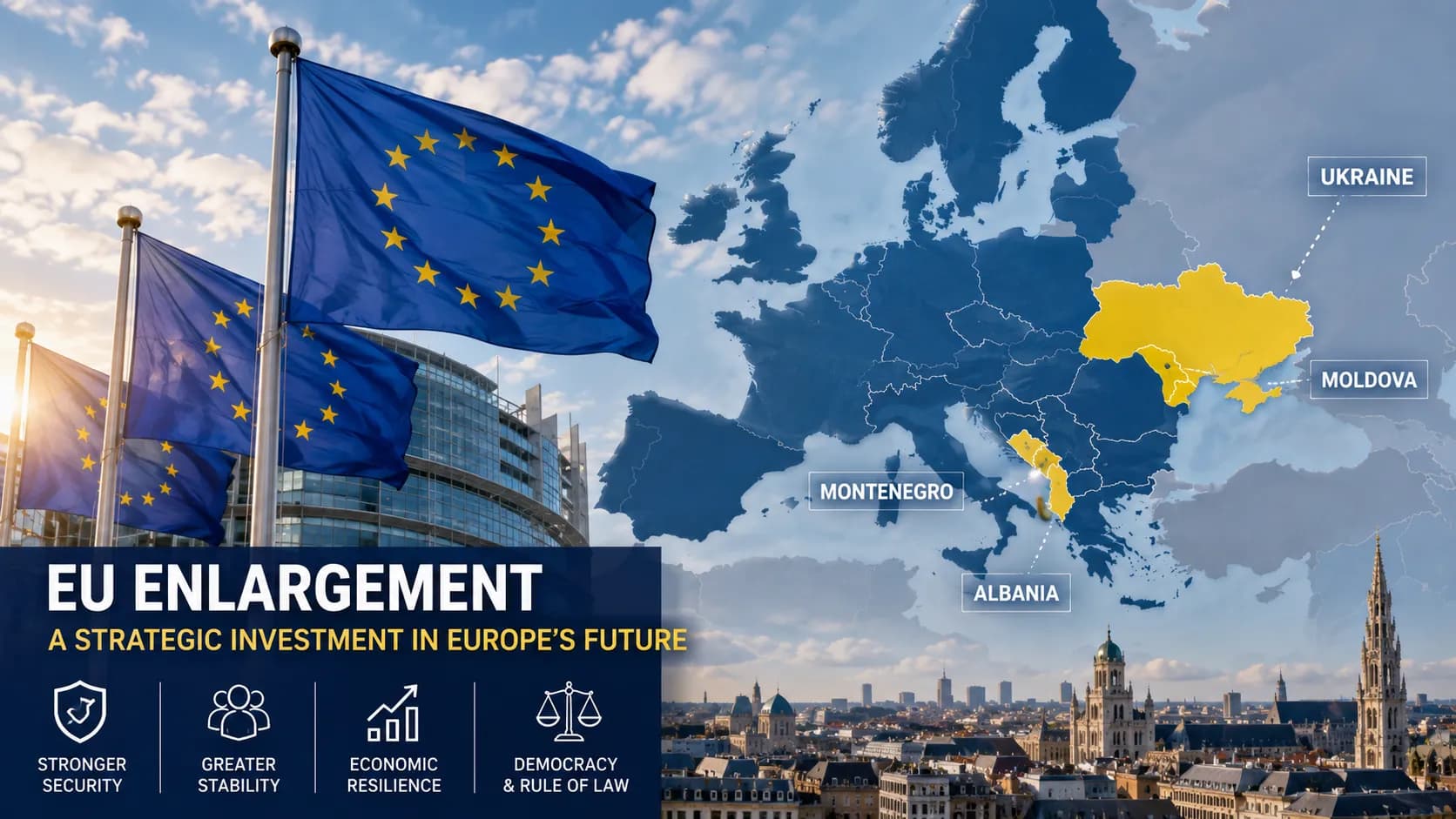
The European Union is accelerating discussions on enlargement as security concerns reshape its strategic priorities. Candidate countries including Ukraine, Moldova, Albania and Montenegro are viewed as essential to strengthening Europe's long-term stability.
EU Enlargement Returns to the Forefront as Security Concerns Reshape Europe
The European Union is once again placing enlargement at the center of its long-term strategic agenda as geopolitical instability and security concerns redefine the bloc's priorities. Once viewed primarily as an economic and political project, EU enlargement has increasingly become a cornerstone of Europe's security strategy in response to Russia's war in Ukraine and broader regional instability.
EU leaders have intensified discussions on accelerating accession negotiations with several candidate countries, including Ukraine, Moldova, Albania and Montenegro. Officials argue that integrating these nations into the European project would strengthen political stability, democratic governance and economic resilience across the continent.
While enlargement has historically progressed slowly due to complex accession requirements and differing political views among member states, recent geopolitical developments have shifted the conversation. Many European policymakers now consider expansion not merely an institutional objective but a strategic investment in the continent's long-term security.
The renewed momentum reflects growing recognition that prolonged uncertainty in Europe's eastern neighborhood could undermine regional stability. By offering a clearer membership perspective, Brussels hopes to encourage reforms while reducing external influence in candidate countries.
Balancing Opportunity and Reform
Despite broad political support for enlargement, significant challenges remain. Candidate countries are expected to implement comprehensive reforms related to the rule of law, judicial independence, anti-corruption measures and democratic governance before joining the Union.
At the same time, the EU itself faces institutional questions. Several member states argue that internal reforms including decision-making procedures, budget mechanisms and voting rules—must accompany any future enlargement to ensure the Union remains effective with additional members.
European Commission officials have repeatedly emphasized that enlargement will continue to be based on merit rather than political timelines, maintaining that every candidate must fulfill the established accession criteria.
Security as the Driving Force
Security has emerged as the defining element of the enlargement debate. Russia's continued military pressure on Ukraine has reinforced the perception that political integration can contribute to greater regional resilience and collective stability.
Analysts argue that admitting new members from Eastern Europe and the Western Balkans would reduce geopolitical vulnerabilities while strengthening the EU's capacity to respond to future crises.
The discussion also reflects Europe's broader ambition to assume greater responsibility for its own security, complementing NATO while reinforcing the Union's political influence across neighboring regions.
Looking Ahead
Although full membership for many candidate countries may still require several years of negotiations, the renewed political commitment signals a significant shift in European priorities. Enlargement is no longer viewed solely as an administrative process but increasingly as a strategic tool for safeguarding peace, stability and democratic values across the continent.
As global geopolitical competition intensifies, the success of the EU's enlargement strategy will likely shape the future architecture of European security for decades to come.
Ipek Tuncer
M.A. in International Relations
Follow EUReflect
See more of our reporting on Google
Mark EUReflect as a preferred source and our stories are ranked higher for you in Top Stories, Discover and Google News — and carry a “preferred” badge when they are cited in AI results.
Add EUReflect as a preferred source