France and Germany's Joint Push: Europe's Quest for AI Sovereignty
The €200 billion InvestAI initiative includes plans for AI gigafactories and exascale supercomputers, with a facility in Grenoble set to house over 100,000 next-gen accelerators.
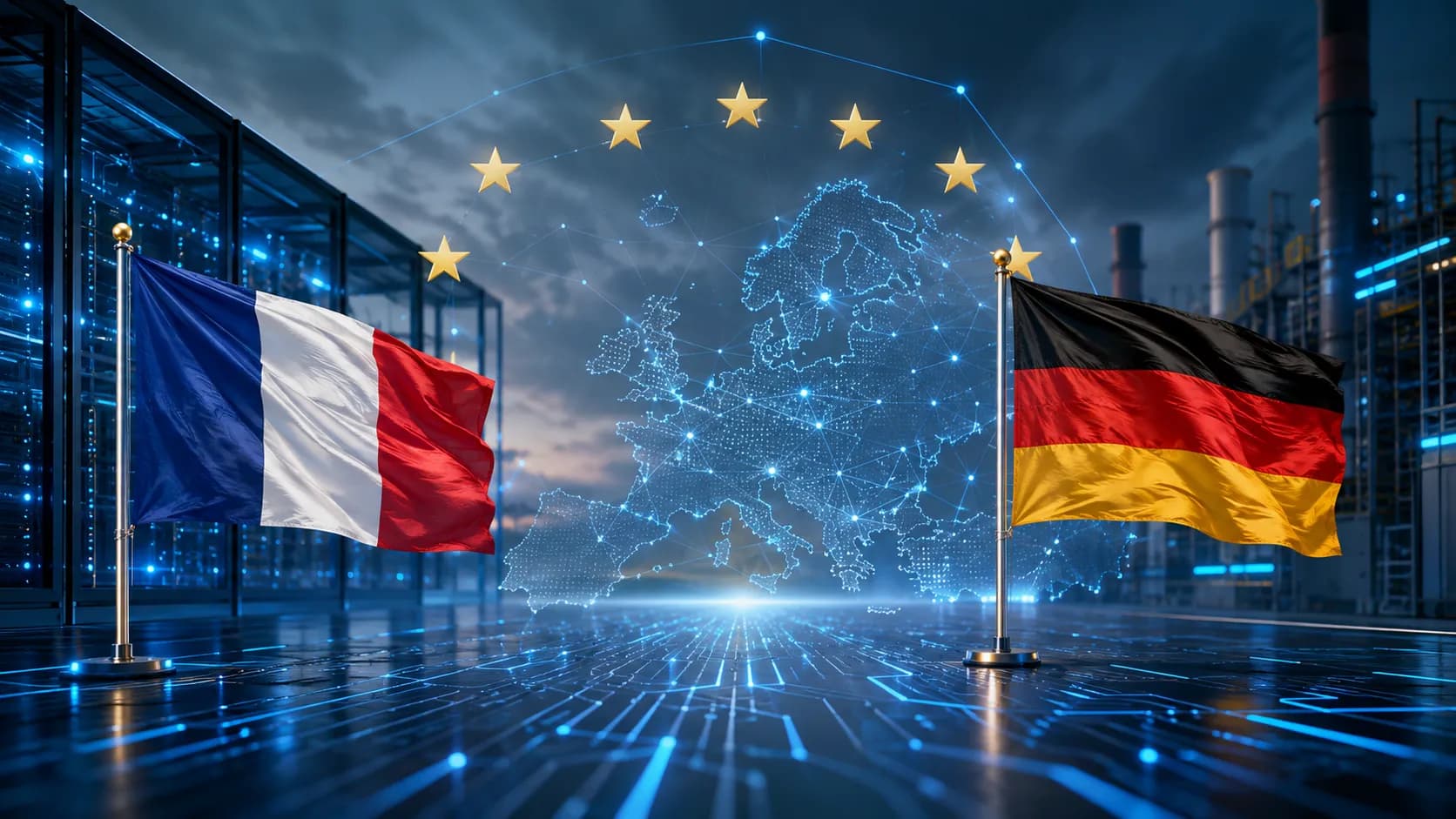
Europe's two largest economies, France and Germany, are moving toward increasingly close cooperation as concern grows that the continent is falling behind in the global AI race. Rather than relying solely on separate national strategies, the two countries are working to build a "Made in Europe" AI infrastructure spanning everything from data centers to defense software. Here's a look at the steps Paris and Berlin are taking.
France: Gigafactories and Exascale Computing
France sits at the center of the €200 billion InvestAI initiative launched after the 2025 Paris AI Summit. According to TechPlusTrends, the strategy is built largely around "AI gigafactories," sovereign compute infrastructure, and exascale supercomputers aimed at reducing dependence on US-based cloud giants. The gigafactory in Grenoble is being built as one of the first operational "exascale nodes" among facilities designed to house more than 100,000 next-generation accelerators each.
France's approach isn't limited to large language models; a significant portion of the funding is earmarked for the GenAI4EU program, which supports applied AI in sectors where Europe holds a strong global position, from protein-folding research to smart manufacturing.
Germany: A Push to Quadruple Data Center Capacity
Germany, meanwhile, is channeling its industrial strength into AI infrastructure. According to Euronews, Germany is implementing a national data center strategy aimed at quadrupling its AI capacity by 2030. At the opening of the VivaTech conference in Paris, the French and German digital ministers issued a joint call to action, arguing that Europe must move quickly to build genuine technological sovereignty or risk being left as a mere spectator in the decade's defining technological shift.
Germany's efforts are also taking concrete shape through the Franco-German AI Industry Executives' Dialogue, led by Fraunhofer-Gesellschaft and France's Inria. According to Fraunhofer, a report submitted to both governments in April 2026 laid out shared challenges ranging from simplifying the regulatory framework to strengthening AI infrastructure and computing capacity across Europe.
A Joint Sovereignty Push: A Rival to Palantir and a Franco-German "Digital Backbone"
The two countries are also advancing concrete joint projects. According to TheNextWeb, following talks between Emmanuel Macron and Friedrich Merz, France and Germany signed a joint declaration committing to develop a European alternative to Palantir's military AI software; the declaration also calls for examining a "European sovereign digital backbone" covering data security, AI, and cloud solutions.
In public administration, France and Germany have partnered with Mistral AI and SAP to build sovereign AI infrastructure. According to Geopriskindex, the initiative, announced at the Summit on European Digital Sovereignty in Berlin, is set to be formalized through a binding framework agreement by mid-2026. Speaking at the summit, Macron argued that if Europe lets the Americans and the Chinese take all the champions, it may end up with the best regulation in the world while regulating nothing at all.
Conclusion
Having recognized the limits of separate national strategies, France and Germany are increasingly aligning their approach to AI. France's focus on infrastructure and compute power is combining with Germany's industrial-scale data center expansion, alongside joint sovereignty projects in critical areas like defense and public administration. But as both countries acknowledge, the real test of this cooperation lies in whether Europe can clear its bureaucratic hurdles quickly enough to keep pace with the US and China.
Zhansaya Nurlanovna
Contributing writer at EUReflect.
Follow EUReflect
See more of our reporting on Google
Mark EUReflect as a preferred source and our stories are ranked higher for you in Top Stories, Discover and Google News — and carry a “preferred” badge when they are cited in AI results.
Add EUReflect as a preferred source