How Algorithmic Manipulation Is Degrading Human Intelligence?
Social media algorithms and AI tools are weakening human attention, memory, and critical thinking. Research from 2025 shows rising short-form video addiction, cognitive decline, IQ reduction, and the spread of “cognitive debt” on a global scale.
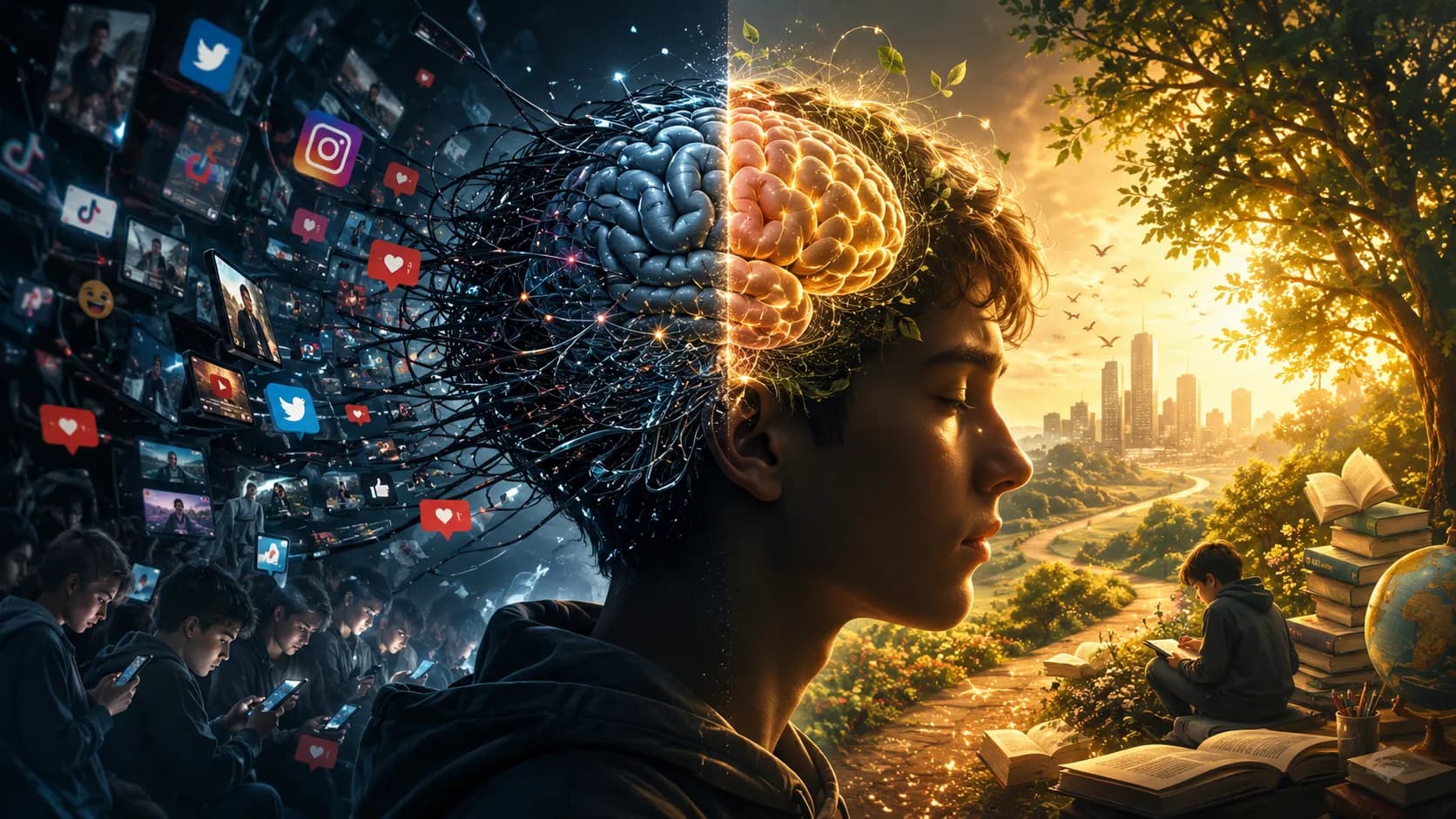
For most of human history, the brain was shaped by slow, deliberate cognition: deep reading, logical reasoning, and the effortful construction of knowledge. Over the past decade, however, a silent and profound transformation has taken place. The algorithms that power social media feeds, short form video platforms, and generative artificial intelligence are not merely capturing our attention; they are systematically rewiring our neural circuits, fragmenting our capacity for sustained focus, dulling our critical faculties, and replacing intellectual rigor with passive, compulsive consumption. As a growing body of neuroscientific and behavioral research from 2025 demonstrates, our collective cognitive capacity is not just under strain; it is measurably declining, with consequences that threaten the very foundations of informed democratic society.
At the biological core of this manipulation lies the brain's dopamine reward pathway. Social media platforms are engineered to exploit this system by delivering unpredictable, high frequency bursts of stimulation that mirror the mechanics of substance addiction. Functional magnetic resonance imaging studies have confirmed that each swipe, notification, and algorithmic recommendation provides a small neurochemical reward, gradually raising the brain's threshold for stimulation. This "dopamine addiction model" fosters dependency analogous to that seen with drugs or gambling. A 2025 international study across Singapore and Australia, surveying 583 young people aged 13 to 25, found that 68 percent of youth participants reported significant difficulty focusing, with many describing an inability to complete schoolwork or engage with any content lasting more than a minute.
One teenager's testimony captured the scale of the problem: "TikTok has made my attention span so low that I cannot even watch a one minute video." Short form video platforms, including TikTok, Instagram Reels, and YouTube Shorts, represent the apex of this dopamine engineering. A large 2025 meta analysis of nearly one hundred studies confirmed that heavy short form video use is linked to weaker attention, reduced inhibitory control, and greater difficulty staying on task, with the strongest associations found for attentional performance and impulse regulation. Clinicians now report a sharp increase in patients presenting with short video addiction: attention deficits, memory impairment, emotional volatility, and degraded sleep quality.
The erosion of sustained attention is not anecdotal; it is quantifiable and pervasive across generations. A 2025 survey of 2,000 UK adults found that the average Briton can now focus on reading for only fourteen minutes before losing concentration, roughly one chapter of a book, with 43 percent of respondents blaming social media notifications and 26 percent citing compulsive "doom scrolling." Most alarmingly, 80 percent of those surveyed admitted to being easily distracted, losing focus an average of eight times per day.
Among children, a four year longitudinal study tracking social media usage found that average daily time on these platforms rose from just thirty minutes among nine year olds to two and a half hours by age thirteen, with a clear, causal link between heavy use and a gradual decline in concentration over time, an effect uniquely attributable to social media, distinct from television or video games. The neural cost of this constant multitasking is stark. A 2025 study calculated that every additional hour of daily screen use increased reaction time by 8.32 milliseconds and measurably reduced attention accuracy. Across multiple peer reviewed studies, high levels of screen use are now consistently linked to slower processing speed, weakened memory, and reduced cognitive flexibility.
Perhaps the most insidious form of algorithm driven intellectual degradation, however, comes not from social media but from generative AI tools that promise efficiency while quietly atrophying our cognitive muscles. In June 2025, the Massachusetts Institute of Technology Media Lab released the world's first neuroscientific study assessing the impact of large language models on human cognition. Fifty four university students were connected to electroencephalogram headsets while writing essays under three conditions: using ChatGPT, using a search engine, or using no external tools. The results were staggering. Participants who used ChatGPT showed 55 percent less brain activity compared to those who wrote independently, with significantly fewer neural connections between brain regions. Memory retention was even more telling. Eighty three percent of participants who wrote with ChatGPT could not recall a single sentence from their essay just minutes after completing it, compared to only 11 percent of those who wrote without any tools.
The researchers termed this phenomenon "cognitive debt," a loan taken from future cognitive abilities in exchange for immediate convenience. Most disturbingly, when participants who had previously used ChatGPT were later asked to write without any tools, their brains still showed reduced coordination and effort, as if the neural pathways for independent reasoning had been rendered "lazy" by prior AI assistance. A separate study confirmed that while AI assisted essays received high marks for linguistic accuracy, they lacked depth and originality, their structure was less diverse, and their content was more homogeneous, resembling standard ChatGPT output rather than genuine human thought.
The cumulative effect of these changes is now visible in global intelligence trends. For most of the twentieth century, IQ scores rose steadily, a phenomenon known as the Flynn Effect, with global scores climbing approximately three points per decade due to improved nutrition, education, and cognitive demands. But that trend has reversed. A growing body of research documents a Reverse Flynn Effect: measurable declines in intelligence test scores across multiple developed nations, beginning around 2010, precisely when smartphones became ubiquitous. A landmark study from Northwestern University analyzed nearly 400,000 IQ tests taken between 2006 and 2018, revealing consistent declines in fluid intelligence, the ability to solve novel problems, think logically, and recognize patterns.
The steepest drops occurred among 18 to 22 year olds, the demographic cohort with the highest smartphone usage. The study's authors described the phenomenon as a "crowdsourced lobotomy," driven by social media compressing complex information into memes and nonsense, creating a feedback loop of low quality information that degrades human cognition just as "model collapse" degrades AI trained on its own output. Norwegian longitudinal data corroborates these findings, showing each successive generation appears to lose approximately seven IQ points.
Finally, algorithms systematically narrow the range of ideas to which we are exposed, fostering intellectual homogeneity and eroding critical thinking. A 2025 systematic review of 30 peer reviewed studies found that algorithmic systems structurally amplify ideological homogeneity, reinforcing selective exposure and limiting viewpoint diversity. Individuals with low critical thinking skills are significantly more vulnerable to AI generated fake news, including deepfakes and auto generated texts. A 2025 Eurobarometer survey of over 26,000 Europeans found that while 66 percent believe they have been exposed to disinformation in the past week, and a similar proportion express high confidence in their ability to recognize fake news, a significant gap exists between confidence and actual ability.
Across multiple modalities, humans now fail to reliably distinguish AI generated content from genuine human created media, with detection accuracy for AI generated images below 50 percent, essentially guessing. The term "brain rot" may have originated as internet slang, but the neuroscience now confirms it as a clinical reality. Algorithms have manipulated not just our behavior but our very biology. The question for the coming decade is not whether we can reverse this trajectory, but whether we have the collective will to reclaim our minds before the cognitive debt becomes insurmountable.
Uroosa Khan
Contributing writer at EUReflect.
Follow EUReflect
See more of our reporting on Google
Mark EUReflect as a preferred source and our stories are ranked higher for you in Top Stories, Discover and Google News — and carry a “preferred” badge when they are cited in AI results.
Add EUReflect as a preferred source