Iraq gains a modest Hormuz bypass as Kirkuk–Ceyhan federal line restarts
Baghdad began pumping Kirkuk crude for export through its federal pipeline to Türkiye on 17 November, at 120,000 barrels a day, the first such flows since 2014. The volume is small, but the oil travels in Baghdad-owned pipe as far as the Turkish border and reaches the Mediterranean without going near the Strait of Hormuz.
Iraq has a second way to get northern crude onto tankers in the Mediterranean, and this one runs through Baghdad-owned pipe all the way to the Turkish border. On Tuesday 17 November Iraq's oil minister, Basim Mohammed Khudair, said export pumping had restarted on the federal Iraq–Türkiye line from Kirkuk at 120,000 barrels a day (b/d). Flows are to rise gradually to 500,000 b/d, he said in a statement issued through the state Iraqi News Agency (INA) and carried by Daily Sabah. He set no date for the higher figure.
Hours later Prime Minister Ali Falih al-Zaidi's cabinet, holding its 28th regular session in Najaf, approved a recommendation from the Ministerial Council for the Economy to rehabilitate the Iraqi–Turkish pipeline, the prime minister's media office said. The statement gave no cost, scope or timetable. The day before, the same council had reviewed the ministry's export plan, including Kirkuk crude to Ceyhan, Anadolu reported.
For refiners and traders in Europe and the eastern Mediterranean, the restart puts a second pipe behind Iraqi loadings at Ceyhan, on Türkiye's southern coast, though whether it adds barrels is not yet clear. For Baghdad, it is a hedge against Hormuz rather than a replacement for it.
Two lines into one port
The federal pipeline takes crude from Kirkuk to Fishkhabur, the crossing point in Duhok province, where it joins the Turkish network running to Ceyhan, according to 964media. It has carried no exports since 2014, when Islamic State attacks put it out of service. Its design capacity is about 1.5m b/d, but the minister said sabotage had always kept it below that level, 964media reported.
Beside it runs a line the Kurdistan Regional Government (KRG) built and the Kurdistan Pipeline Company operates. Since 18 March, a Baghdad–Erbil arrangement has also routed Kirkuk crude through it. In a post on X on 31 October, Baz Karim Barzanji, whose KAR Group owns a stake in the operator, said KRG-line exports had climbed from 250,000 to 500,000 b/d, 964media reported.
That leaves one question unanswered: is the new 120,000 b/d extra oil, or Kirkuk crude switched from the Kurdish line to the federal one? The ministry has not said. At the start of November, three North Oil Company sources told Shafaq News that Kirkuk fields supplied about 125,000 b/d of northern exports, close to the federal line's opening rate. Daily Sabah noted that the net gain will depend on available supply.
Shipments to Ceyhan are governed by a one-year deal Baghdad and Ankara signed in August, with capacity of 750,000 b/d, The National reported. It replaced a decades-old treaty that lapsed at the end of July. Turkish officials had not commented on the restart when Al-Monitor reported it.
The revenue problem
Baghdad's hunt for routes outside the Gulf is about the budget. Oil dollars fund more than 90 per cent of state spending, according to The National, which reported that exports collapsed from 3.36m b/d in February to 131,000 b/d in April after the Iran war disrupted Hormuz traffic. October exports were back above 3.4m b/d, the minister said, according to 964media. With about 500,000 b/d of that moving north, the great majority still relies on southern terminals and the strait.
The minister also argued that northern barrels can be marketed without price discounts, which he said would bring in extra revenue. ICE Brent crude for January delivery stood at $92.23 a barrel at 10:46 GMT on 18 November, about 1 per cent below Tuesday's settlement, according to delayed CNBC market data.
Bigger projects are further off. Work has begun on a Basra–Haditha pipeline, in Anbar province, designed for 2.5m b/d, The National reported. On 5 November al-Zaidi pledged to remove obstacles to a planned line to ports on the Mediterranean and the Red Sea, which the minister has described as branching towards Syria's Baniyas port and north to Fishkhabur, 964media reported. No cost, financing or construction schedule has been published.
In March, under the previous minister, Hayan Abdul Ghani, Baghdad outlined a plan to send up to 250,000 b/d from Kirkuk to Türkiye while bypassing the Kurdish network, EUReflect reported. Tuesday's rate is about half of that.
What could interrupt the flow
The northern system has physical weak points. Days before the restart, oil leaking from the Iraq–Türkiye pipeline near Zummar, north-west of Mosul, reached the Tigris, and on Friday 13 November the Nineveh water directorate shut its plants across the province, 964media reported. The minister's statement did not refer to the leak.
Politics has closed the route before. In March 2023 Türkiye stopped Iraqi flows to Ceyhan after an International Chamber of Commerce arbitration in Paris ruled that Ankara had broken the earlier treaty by allowing Kurdish exports Baghdad had not approved. Flows on the KRG line restarted only on 27 September 2025. Keeping two lines running will require Baghdad, Erbil and Ankara to stay in step.
Scale matters too. Saudi Arabia's East-West pipeline to the Red Sea has a capacity of about 7m b/d, CBS News noted. Even at 500,000 b/d, Iraq's federal line would carry roughly a seventh of October's export volume.
The next signals to watch: a ministry figure for total northern loadings at Ceyhan, which would show whether the new flows are additional, and whether the cabinet attaches money and a deadline to the rehabilitation it approved.
Related on EUReflect: Iraq bypasses northern-controlled pipelines with new Kirkuk–Turkey oil plan · Redrawing the Gulf: energy new routes beyond Hormuz · Iraq's energy vulnerability: the impact of Iranian gas supply disruptions
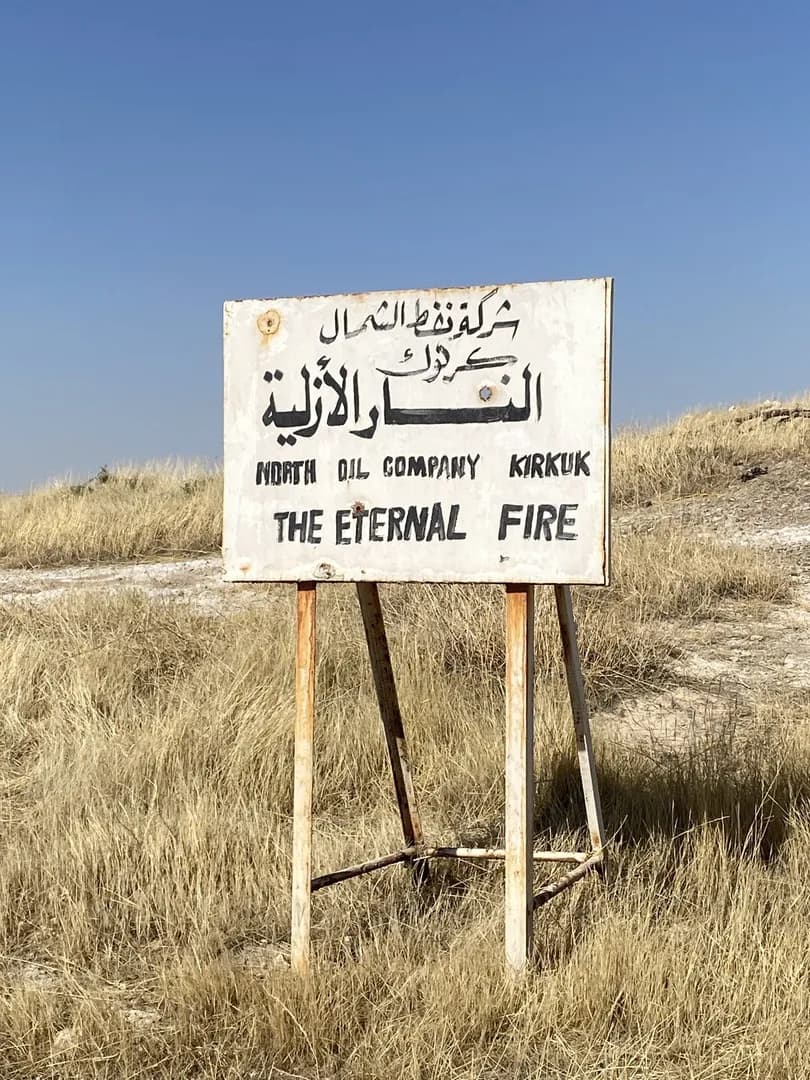
Main image: A North Oil Company sign at Baba Gurgur, the Kirkuk oil field whose crude is again flowing north to Ceyhan through the federal pipeline. (The photo shows the field, not the pipeline; taken July 2024.) Photo: NICTON t / Wikimedia Commons, CC0.
Related Topics
EUReflect News
Site Administrator
Follow EUReflect
See more of our reporting on Google
Mark EUReflect as a preferred source and our stories are ranked higher for you in Top Stories, Discover and Google News — and carry a “preferred” badge when they are cited in AI results.
Add EUReflect as a preferred source