Militarization of Space: The Next Battlefield Beyond Earth
The militarization of space presents unprecedented risks for global security. If countries continue to develop space-based weapons, the likelihood of conflicts extending beyond Earth becomes increasingly plausible.
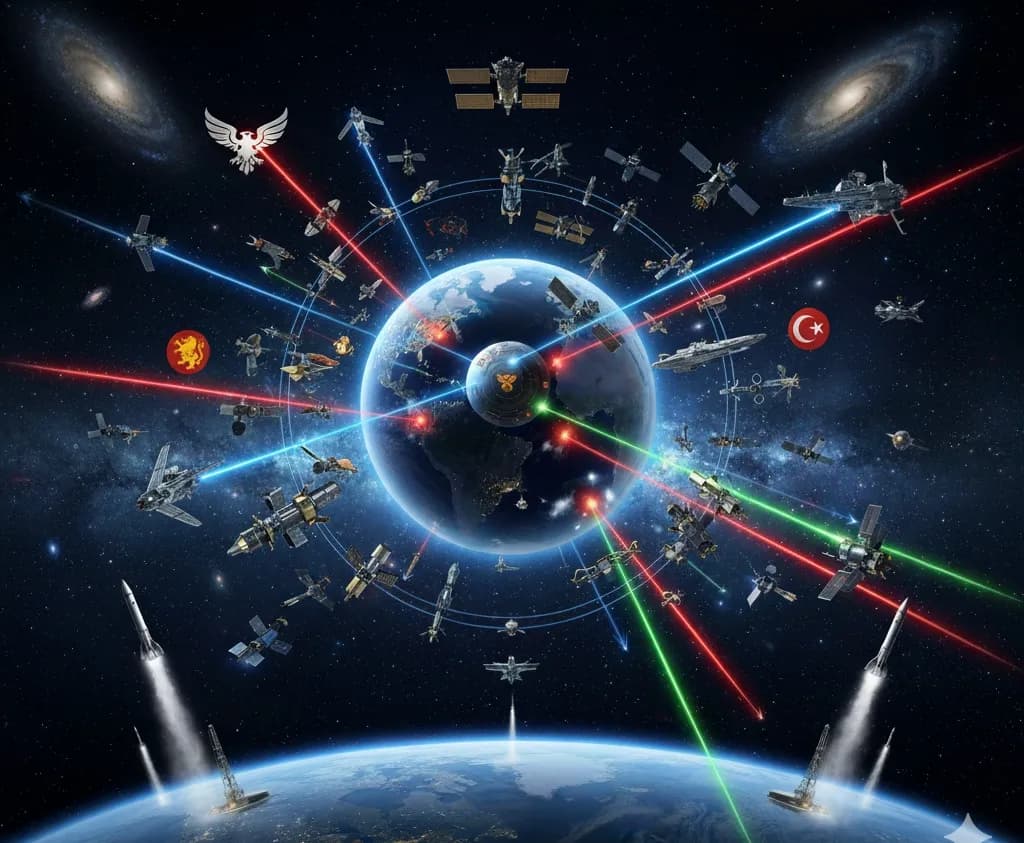
According to Realist school of Thought, major powers have always engaged in wars to pursue national interests and seek maximum power in the world. Historically, individuals have witnessed devastating wars and causalities in every epoch of the society. For instance, the Hundred Years’ War, Seven Years war, and the two World Wars affected the social fabric of societies.
Similarly, countries engaged in battles and the cold war to maximize security and dominate other states. There was a time when people fought with conventional weapons, engaging in direct and proxy wars. The 21st century is witnessing a major shift in the battlefield, as countries are now militarizing space to have enough capabilities against rival nations.
While space is undoubtedly the area for scientific exploration, some see it as a field in which political and military powers are now plainly competing for influence.
These great powers, the U.S.A. and the USSR, became interested in space exploration and were the first to be able to land on a moon. On October 4, 1957, the Soviet Union launched the first artificial satellite, Sputnik 1. The event was worldwide shock, a major symbolic victory for the USSR in the Cold War. The success of Sputnik showcased Soviet technology and really got the space race started.
Gagarin’s flight shocked the U.S. hugely and gave impetus to ramp up human spaceflight efforts. U.S. President John F. Kennedy had the audacious vision of sending a man to the Moon before the end of the 1960s. The USSR sent Luna 2 in 1959, the first-ever spacecraft to impact the Moon. In 1966, they also succeeded in the landing of Luna 9 that returned pictures from the surface of the Moon.
The crowning achievement of U.S. space flight came in 1969, with Apollo 11. On July 20, 1969, Neil Armstrong became the first human to set foot on the Moon, shortly followed by Buzz Aldrin.
However, in the inauguration ceremony of President Trump, the richest man in the world, Elon Musk said that the United States Flag on Mars will be proud moment for the country. The colonization of Mars by the company SpaceX and the collaboration of the US government will create balance of power disequilibrium, with other major countries such as China, Russia and others becoming the next players to colonize Mars.
Individual’s instinct for power now dominates space exploration and the colonization of other celestial bodies. China is heavily investing in space mission programs, similar to other major countries.
This move towards Mars colonization also raises geopolitical concerns. In 2019, it became the first country to land a probe, CHnag’e-4, on the far side of the Moon. Furthermore, China’s Tiangong space station is expected to be a long-term orbital presence, rivaling the International space station ISIS.
The European space agency and India’s ISRO have also announced plans for lunar bases and long term space missions, further escalating the race for space supremacy.
The US has established a US Military Space Force to deter the aggression posed by countries in the future in space. Countries are engaged in developing satellites to detect enemies and launch drone strikes anywhere in the world. The drone strikes in Syria, Afghanistan and in other countries caused collateral damage and killed many innocent civilians, all facilitated by military satellites.
Nations are working on building intercontinental ballistic missiles and other weapons that could attack the enemy by passing through space. In 2020, Russia tested an anti-missile, demonstrating its ability to destroy orbiting objects. China has also developed direct-ascent anti-satellite weapons capable of neutralizing adversary satellites, generating thousands of pieces of space debris, a major concern for global space safety. According to the Secure World Foundation, as of 2023, over 60,000 pieces of space debris pose a growing risk to satellites and space missions
There is growing concern that countries could deploy conventional weapons in space, such as kinetic kill vehicles or space-based missile interceptors.
If this happens, it would have a devastating impact on the peace and prosperity of individuals. Similarly, Russia and china have established military space divisions focusing on defense capabilities. Major countries are engaged in an arms race, and other middle power countries may follow suit to maximize their securities.
If countries are militarizing space and aiming to deploy conventional weapons, it will mark a new era where nations are welcoming the possibility of the third world war based on space.
However, the Outer Space Treaty was signed to protect space from an arms race, countries should abide by the treaty and avoid creating another war zone in space.
Another aspect driving competition in space is the pursuit of natural resources. The depletion of natural resources on Earth is diverting the policies of countries to explore minerals in other celestial bodies. India sent a mission such as Chandrayaan-2 sought to explore water ice on the Moon’s surface. China’s Chang’s missions aim to extract rare minerals from the Moon’s surface.
Additionally, asteroid mining is emerging as a future industry, with private companies like Planetary Resources and government agencies exploring ways to extract valuable metals.
The militarization of space presents unprecedented risks for global security. If countries continue to develop space-based weapons, the likelihood of conflicts extending beyond Earth becomes increasingly plausible. A potential third World War fought in space would have devastating consequences.
Undeniably, space warfare will be more threatening and devastating than direct and conventional wars. The international society should work to avoid a space arms race by taking decisive actions. World leaders must come to an agreement of treaty to create a space no war zone area. Space should be used for the benefit to humanity, not for the annihilation of mankind. Diplomacy and cooperation must take precedence over competition and conflict.
Uroosa Khan
Contributing writer at EUReflect.
Follow EUReflect
See more of our reporting on Google
Mark EUReflect as a preferred source and our stories are ranked higher for you in Top Stories, Discover and Google News — and carry a “preferred” badge when they are cited in AI results.
Add EUReflect as a preferred source