NATO’s Ankara Agenda Moves Into Action
NATO leaders pledged €70 billion in military aid for Ukraine in 2026, with European allies and Canada now funding the majority of security assistance.
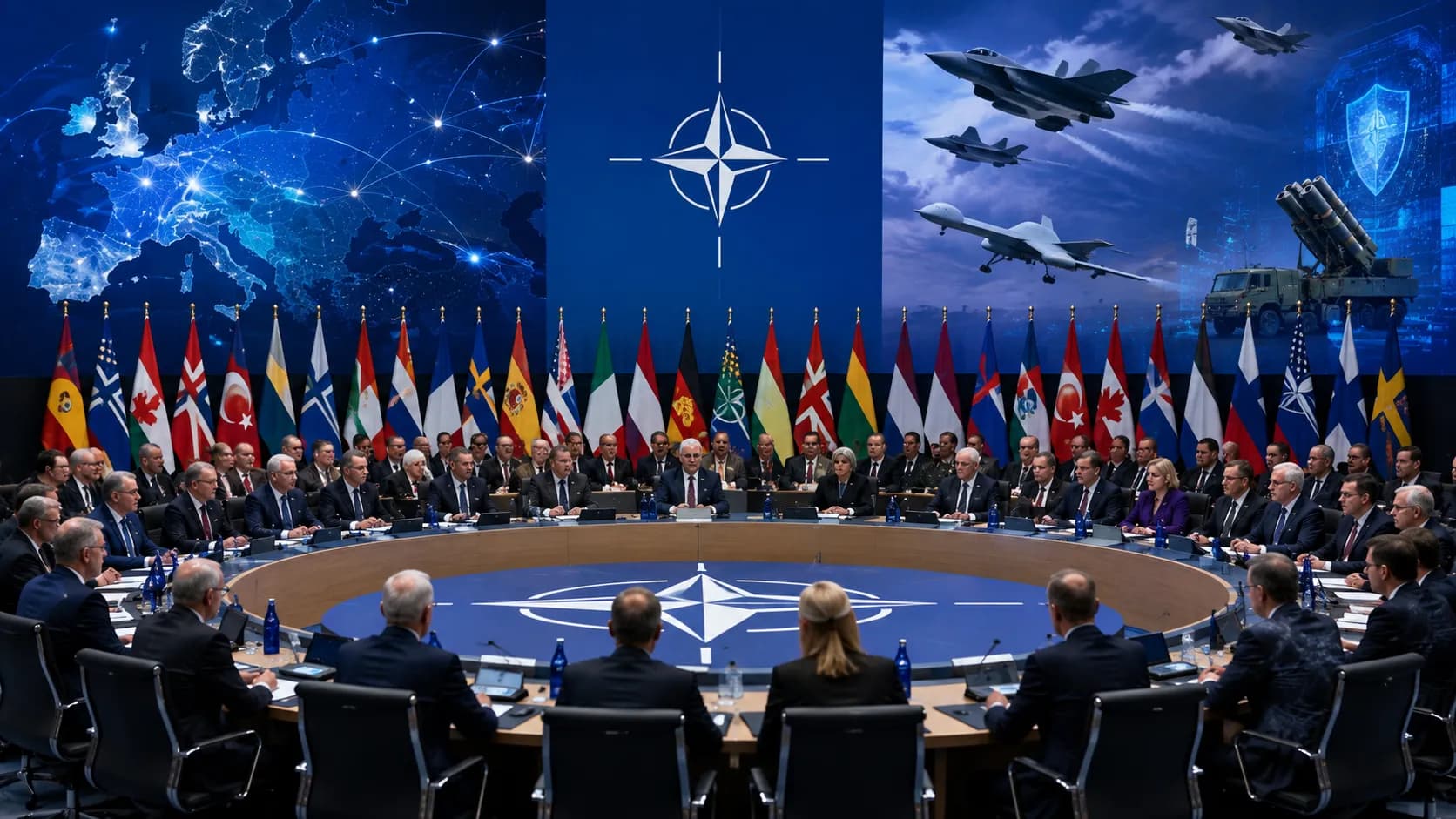
The NATO Summit held in Ankara on July 7–8 has ended, but the issues agreed in the Turkish capital are increasingly shaping the Alliance’s agenda in August 2026. The focus has shifted from political commitments to implementation, with defence spending, Russia, Ukraine, drones, air defence and military production emerging as the most immediate priorities.
Russia and the Eastern Flank
Russia remains NATO’s central long-term security concern.
That issue has become even more prominent following recent airspace violations involving Poland and Romania and a series of drone incidents. NATO’s North Atlantic Council met on August 12 and described the violations as dangerous and unacceptable, while emphasizing stronger air and missile defence from the Baltic region to the Black Sea.
This directly reinforces one of the central messages of Ankara: NATO must be capable not only of deterring conventional military attacks but also of responding rapidly to drones, missiles, hybrid operations and other threats against Allied territory.
Ukraine Remains a Strategic Priority
Support for Ukraine continues to be one of the most consequential elements of the Ankara agenda.
NATO members pledged €70 billion in military equipment, assistance and training for Ukraine in 2026, while committing to maintain at least an equivalent level of support in 2027. European Allies and Canada are now financing the majority of security assistance to Kyiv.
Air defence has become particularly urgent. NATO officials have emphasized Ukraine’s need for interceptors and other systems capable of defending cities and infrastructure while strengthening Kyiv’s position against Russia.
The debate is therefore moving beyond whether Ukraine should be supported toward how that assistance can be made predictable, sustainable and connected to NATO’s own defence-industrial expansion.
The 5 Percent Target Moves Toward Implementation
Another major issue is defence spending.
NATO members agreed at the 2025 Hague Summit to move toward spending 5 percent of GDP on defence and security-related requirements by 2035. Ankara was largely about demonstrating how that money will be converted into military capabilities.
European Allies and Canada increased core defence investment by more than $139 billion in 2025, while NATO says their combined defence and security spending is already around 4 percent of GDP.
This represents a significant change in NATO’s internal balance. European members and Canada are expected to assume greater responsibility while maintaining the transatlantic military relationship with the United States.
Drones Become a NATO-Wide Priority
The war in Ukraine has demonstrated that relatively inexpensive drones can fundamentally change modern warfare.
NATO responded in Ankara by launching Drone Edge, which foresees more than $40 billion in investment over five years in counter-uncrewed systems.
Artificial intelligence, autonomous systems, intelligence capabilities, deep precision strike and integrated air and missile defence are also becoming central components of NATO modernization.
The Alliance is additionally developing an interoperable transatlantic warfighting cloud and moving toward greater adoption of advanced AI models.
Defence Industry Becomes Part of Deterrence
Perhaps the most economically significant outcome of Ankara was the emphasis placed on industrial capacity.
More than €50 billion in new defence procurement agreements were announced around the summit, covering areas including precision strike, air and missile defence, unmanned systems and intelligence capabilities.
NATO also introduced mechanisms designed to connect governments more closely with defence companies and expand production across Allied countries.
This reflects an important strategic change. NATO increasingly views factory capacity, ammunition production, technology companies and secure supply chains as components of military deterrence themselves.
Türkiye is positioned to benefit from this transformation because of its rapidly expanding defence industry and experience in drones, missiles, ammunition, electronic warfare and other military technologies.
Energy Security Enters Defence Planning
Ankara also expanded NATO’s understanding of military infrastructure.
Allies announced a €27 billion investment in NATO’s fuel supply chain, including modernization of storage and distribution infrastructure and new facilities and pipelines extending toward the eastern part of the Alliance.
The objective is straightforward: NATO forces cannot sustain large-scale operations without reliable fuel, logistics and transportation networks.
Energy infrastructure is consequently becoming part of NATO’s broader deterrence architecture.
Ankara’s Agenda Is Bigger Than Ukraine
The Ankara Declaration also addressed instability beyond NATO’s eastern frontier.
Allies reiterated that Iran must not acquire a nuclear weapon and specifically called for freedom of navigation through the Strait of Hormuz. NATO also identified terrorism, hybrid threats, strategic competition and recurrent geopolitical shocks as continuing security challenges.
This is particularly relevant for Türkiye because Ankara sits at the intersection of NATO’s major security theatres: Russia and the Black Sea to the north, the Middle East to the south, the Caucasus to the east and the Mediterranean to the west.
The Ankara Summit therefore represents more than another NATO leaders’ meeting.
Its real significance is becoming clearer after the summit: NATO is attempting to transform increased defence spending into factories, weapons, drones, air-defence systems, infrastructure and long-term military readiness.
The central question for the coming months will be whether the Alliance can implement these commitments quickly enough to match the rapidly changing security environment around Europe and its neighboring regions.
Ahmet Balakan
Contributing writer at EUReflect.
Follow EUReflect
See more of our reporting on Google
Mark EUReflect as a preferred source and our stories are ranked higher for you in Top Stories, Discover and Google News — and carry a “preferred” badge when they are cited in AI results.
Add EUReflect as a preferred source