Nuclear Arms Race Raises Global Risks
With New START expired, no limits bind US and Russian strategic arsenals for the first time in 50 years, while China's stockpile grows to 620.
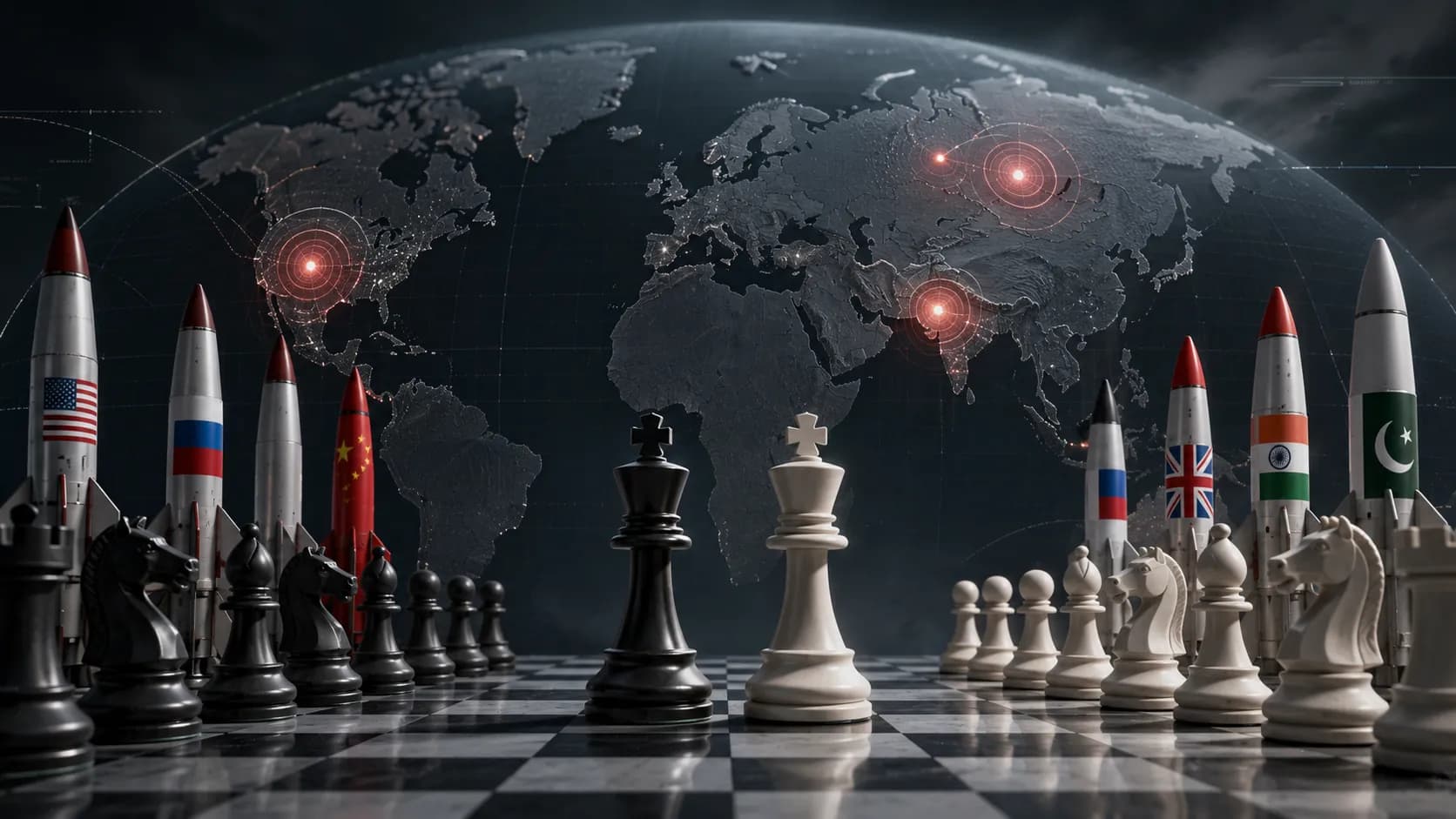
The world is entering a more dangerous phase of nuclear competition as major powers modernize their arsenals, arms-control mechanisms weaken and new technologies create additional possibilities for miscalculation.
The latest data from the Stockholm International Peace Research Institute show that nine countries possessed approximately 12,187 nuclear weapons at the beginning of 2026. Around 9,745 were in military stockpiles and potentially available for use, while approximately 4,012 were deployed with operational forces. More than 2,100 warheads were estimated to be maintained on ballistic missiles at high operational alert.
The concern is no longer simply how many nuclear weapons exist.
The greater danger is that nuclear modernization, geopolitical confrontation, weakened treaties and emerging technologies are developing simultaneously.
Nine Nuclear Powers Continue Modernizing
The United States, Russia, China, France, the United Kingdom, India, Pakistan, North Korea, and Israel possess nuclear weapons, according to SIPRI estimates.
All nine continued strengthening their nuclear arsenals during 2025, either through modernization, expansion or deployment of new nuclear-capable systems.
Russia and the United States still dominate the nuclear balance, together possessing almost 86 percent of the world's nuclear warheads.
China, however, is rapidly emerging as a third major factor. SIPRI estimates that Beijing's arsenal increased from approximately 600 to as many as 620 warheads during 2025.
This creates a strategic environment fundamentally different from the Cold War.
Washington increasingly has to consider both Moscow and Beijing, while other nuclear rivalries — particularly India-Pakistan and the Korean Peninsula — operate simultaneously.
The World Has Lost a Major Nuclear Treaty
One of the most important developments of 2026 occurred on February 5 when the New START Treaty between Russia and the United States expired.
For the first time in more than half a century, there are no binding treaty limits on the strategic nuclear arsenals of the world's two largest nuclear powers.
UN Secretary-General António Guterres described the expiration as a “grave moment for international peace and security” and warned that the risk of nuclear weapons being used is at its highest level in decades.
New START had limited each country to 1,550 deployed strategic nuclear warheads and also provided mechanisms that increased transparency and predictability.
Without a successor framework, Washington and Moscow have greater freedom to expand their strategic forces.
The danger is not only additional weapons.
Less transparency means each side may know less about what the other is doing — increasing the possibility of worst-case assumptions and miscalculation.
China Changes the Nuclear Balance
China's expansion makes future arms-control negotiations considerably more complicated.
During the Cold War and much of the post-Cold War period, strategic nuclear stability was primarily managed through agreements between Washington and Moscow.
That model is becoming outdated.
SIPRI notes that the deterioration of relations between the United States, Russia and China has prevented meaningful progress toward a trilateral nuclear-arms-control framework.
This creates the possibility of a three-way strategic competition in which each country responds to developments by the other two.
If one expands missile defenses, another may increase warheads. If one deploys new long-range missiles, competitors may develop additional delivery systems.
Such dynamics can produce an arms race even when none of the participants initially intends to start one.
North Korea Continues Expanding
North Korea represents another source of instability.
Kim Jong Un visited a newly commissioned uranium-enrichment facility in June and called for further increases in weapons-grade nuclear-material production.
North Korean state media said the country's production capacity for weapons-grade nuclear materials had more than doubled during the previous five years.
A March 2026 estimate from the Federation of American Scientists placed North Korea's arsenal at approximately 60 nuclear warheads.
The military pressure has continued.
On August 20, North Korea launched around ten short-range ballistic missiles toward its eastern waters following tensions surrounding U.S.-South Korean military exercises.
The Korean Peninsula therefore combines nuclear weapons, ballistic missiles and conventional military confrontation within a relatively small geographical area.
India and Pakistan Remain a Critical Flashpoint
South Asia presents a different danger.
SIPRI estimates that India possessed approximately 190 nuclear warheads at the beginning of 2026, compared with around 170 for Pakistan.
Unlike the United States and Russia, the two countries share a disputed border and periodically experience direct military crises.
The Kashmir dispute, terrorism allegations and the growing controversy surrounding the Indus Waters Treaty demonstrate how non-nuclear disputes can interact with nuclear deterrence.
The principal danger is therefore not necessarily a planned nuclear war.
It is escalation: a terrorist attack or border confrontation could trigger conventional retaliation, followed by counter-retaliation and eventually pressure to consider nuclear options.
AI Creates a New Nuclear Risk
Technology is adding another dimension.
Artificial intelligence can potentially improve intelligence analysis, early-warning systems and military decision-making. But its integration into nuclear-related systems also creates new vulnerabilities.
AI systems can make mistakes, misinterpret information or operate at speeds that reduce the amount of time available for political leaders to make decisions.
Cyber operations, attacks on satellites, electronic warfare and conventional strikes against command-and-control infrastructure can further complicate the situation.
SIPRI warned this year that interactions between nuclear and non-nuclear capabilities across cyber, space, information, air, sea and land domains are creating new pathways toward nuclear escalation.
The problem becomes particularly dangerous during a crisis.
A cyberattack against an early-warning network could potentially be interpreted as preparation for a larger military attack. A strike against a satellite could affect both conventional and nuclear communications.
Future nuclear crises may therefore develop faster and with less certainty than those of the Cold War.
The Non-Proliferation System Is Weakening
Diplomatic institutions are also struggling.
The 2026 Review Conference of the Nuclear Non-Proliferation Treaty ended in May without agreement on a final consensus document.
It was the third consecutive NPT Review Conference to fail to reach consensus. Disagreements included nuclear disarmament, extended deterrence and the controversy surrounding Iran's nuclear program.
This matters because the NPT remains the central international framework designed to prevent additional states from obtaining nuclear weapons while encouraging disarmament.
If existing nuclear powers expand their arsenals while arms-control agreements disappear, non-nuclear states may increasingly question whether remaining outside the nuclear club still guarantees their security.
That could become one of the most serious long-term proliferation risks.
The Greatest Threat Is Miscalculation
A deliberate global nuclear war remains an extreme scenario.
But modern nuclear risk does not require governments to intentionally choose global destruction.
A regional conflict, false warning, cyberattack, technical malfunction, misunderstanding or rapidly escalating conventional war could create a chain of decisions that becomes increasingly difficult to stop.
That is why the current nuclear environment is particularly dangerous.
The world is moving from a relatively structured nuclear order dominated by Washington and Moscow toward a multipolar nuclear system involving several rivalries, advanced technologies and fewer binding restrictions.
The nuclear threat of the coming decade may therefore not come from one country suddenly deciding to start a nuclear war.
It may come from a world in which more states possess increasingly sophisticated nuclear forces while the mechanisms designed to prevent escalation become progressively weaker.
Ahmet Balakan
Contributing writer at EUReflect.
Follow EUReflect
See more of our reporting on Google
Mark EUReflect as a preferred source and our stories are ranked higher for you in Top Stories, Discover and Google News — and carry a “preferred” badge when they are cited in AI results.
Add EUReflect as a preferred source