Regional Powers Rethink Libya
Ankara's new 'One Libya' policy includes direct talks with Haftar's camp, while Cairo reopens channels with Tripoli, signaling a shift from proxy rivalry to pragmatic engagement.
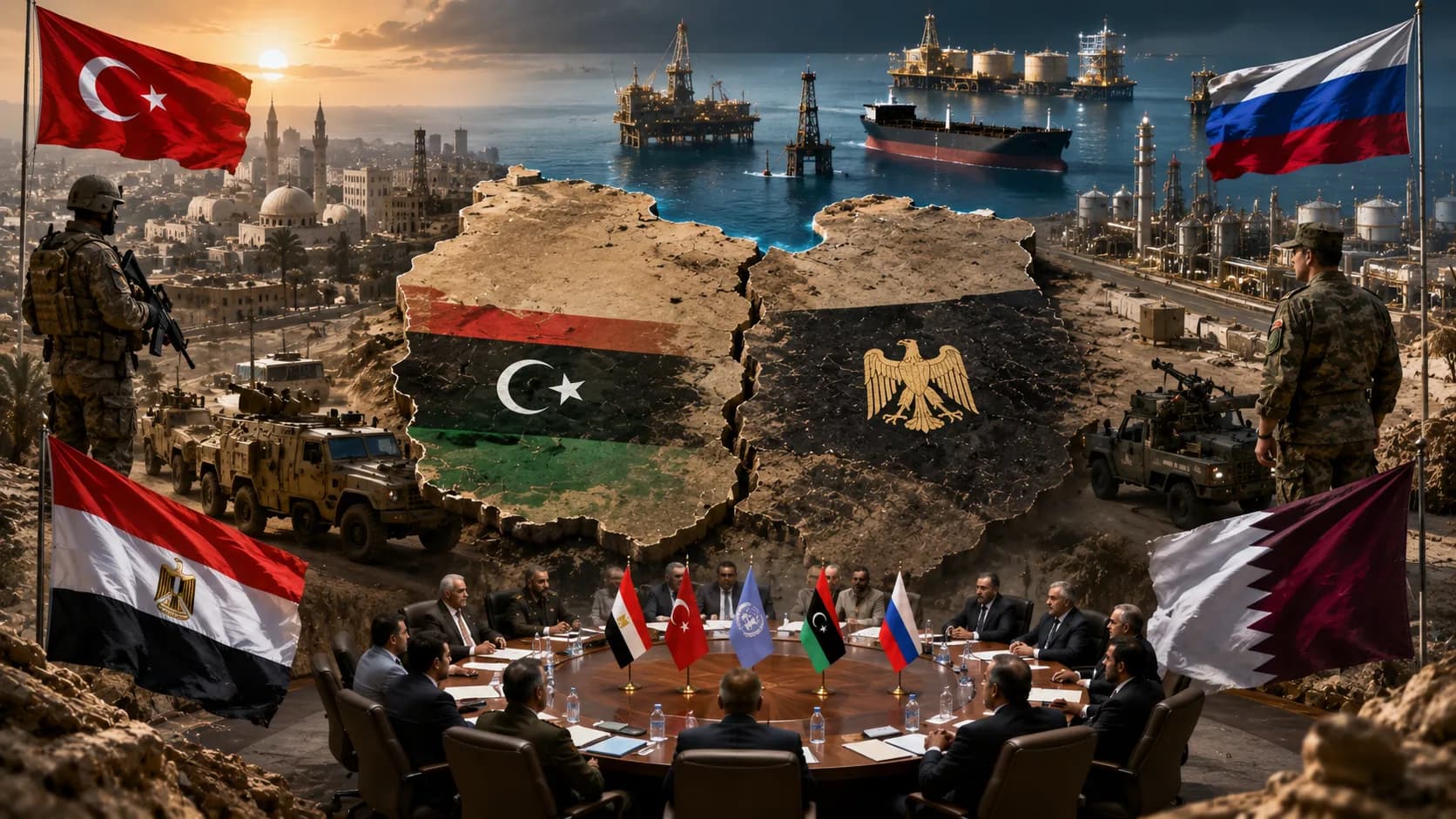
Libya’s conflict is entering a different phase in 2026. The country remains divided between the UN-recognized Government of National Unity in Tripoli and the eastern administration backed by Khalifa Haftar’s forces, while armed groups continue to compete for influence. Recent drone attacks around Zawiya, including strikes affecting oil and electricity infrastructure, demonstrate that the risk of renewed escalation remains real.
Yet the regional environment surrounding Libya is changing. Türkiye, Egypt, Qatar and other outside actors that once backed opposing camps are increasingly supporting dialogue, elections and institutional reunification. Russia, meanwhile, continues to view eastern and southern Libya as strategically important for its wider African and Mediterranean presence.
The Libyan conflict is therefore gradually shifting from a rigid proxy confrontation toward a more complicated system of cross-cutting partnerships.
Türkiye Moves From Tripoli to “One Libya”
Türkiye was the decisive foreign supporter of the Tripoli government during Haftar’s 2019–2020 offensive. Turkish military assistance helped prevent Haftar’s forces from capturing the capital.
Ankara is now significantly broadening its strategy.
Foreign Minister Hakan Fidan visited Tripoli this month for talks with Prime Minister Abdulhamid Dbeibeh and other western Libyan leaders, while Türkiye has simultaneously intensified contacts with the Haftar camp in Benghazi.
Turkish intelligence chief İbrahim Kalın met Saddam Haftar in June, and Fidan subsequently received him in Ankara in July. Ankara describes the new approach as a “One Libya” policy, supporting political and military unification while maintaining relations with western, eastern and southern actors.
The objective is strategic. Türkiye wants to protect its military, commercial and energy interests regardless of which political arrangement eventually emerges.
The controversial 2019 Türkiye-Libya maritime agreement in the Eastern Mediterranean remains particularly important, while Turkish energy companies are expanding exploration interests in Libya.
Egypt Still Backs Haftar — But Its Strategy Is Changing
Egypt traditionally regarded eastern Libya as a strategic buffer protecting its long western border.
That made Cairo one of Haftar’s most important regional supporters.
President Abdel Fattah el-Sisi met Khalifa Haftar again on August 19, emphasizing Libya’s territorial integrity, institutional unification and the need for presidential and parliamentary elections.
Egyptian military officials have also held talks with Saddam and Khaled Haftar covering military cooperation, border security and irregular migration.
But Cairo is simultaneously reopening channels with Tripoli.
Dbeibeh recently visited Cairo, while Egyptian intelligence chief Hassan Rashad travelled to Tripoli.
This represents an important transformation. Egypt no longer appears to view Libya exclusively through the question of which side controls Tripoli.
Its priorities increasingly center on border stability, limiting militant activity, controlling migration and preventing Libya from returning to large-scale war.
Türkiye and Egypt Are No Longer Fighting a Proxy Competition
Perhaps the most important regional development is the improvement in Turkish-Egyptian relations.
Only several years ago, Ankara and Cairo represented opposing geopolitical camps inside Libya.
That rivalry is weakening.
Recent reporting indicates growing Turkish-Egyptian coordination over Libya, even as Türkiye develops military relations with Haftar’s eastern forces. The emerging arrangement suggests that Ankara’s engagement with Benghazi does not necessarily threaten Cairo in the way it would have several years ago.
This could fundamentally change the Libyan conflict.
If two of the most influential regional actors stop treating eastern and western Libya as mutually exclusive spheres of influence, external incentives for another major east-west confrontation could diminish.
Russia Wants to Preserve Its Strategic Position
Russia approaches Libya from a different perspective.
Moscow has long supported Haftar and maintains a military presence through forces associated with the Africa Corps, particularly in central and southern Libya.
Libya is strategically valuable because of its geography.
Russian access can connect Moscow’s Mediterranean interests with its expanding military and political networks across the Sahel and Sub-Saharan Africa.
This makes Libya more than a local political issue for the Kremlin.
Following the transformation of Russia’s position in Syria, Libya has become even more important as Moscow seeks alternative logistical infrastructure supporting its African operations.
Russia therefore benefits from strong relations with eastern Libya but also has an interest in avoiding a political settlement that completely removes its military access.
The UAE Remains an Important Eastern Partner
The United Arab Emirates has historically been another major supporter of Haftar.
Abu Dhabi’s approach has been driven partly by opposition to Islamist political movements and partly by its broader competition for influence across the Middle East and North Africa.
The UAE previously supplied significant military and political support to Haftar, including drones and other capabilities, according to assessments of foreign involvement in the conflict.
But the regional environment has changed.
As Türkiye develops its own relationship with eastern Libya and Egypt increasingly coordinates with Ankara, Haftar has more opportunities to diversify his foreign partnerships.
That could reduce his dependence on any single external sponsor.
Qatar Supports the UN Track
Qatar occupies another position.
Doha maintains good relations with the Tripoli authorities but increasingly emphasizes the UN political process, elections and a Libyan-led settlement.
Qatar joined Egypt, France, Germany and other governments earlier this year in supporting Libya’s first unified national budget in more than a decade and calling for progress toward unified governance and national elections.
This illustrates how the regional divide has softened.
Countries that previously supported competing Libyan factions can increasingly agree on at least one objective: Libya’s political division cannot continue indefinitely.
Oil Is Driving International Interest
Behind the diplomacy lies Libya’s most important strategic asset: oil.
Eastern forces control much of the territory containing Libya’s major oil fields and terminals, while financial and administrative institutions remain divided between competing centers of power.
The United States is also increasing its involvement.
Washington is reportedly exploring a political arrangement connecting institutional reunification with greater opportunities for American investment in Libya’s energy sector.
For Türkiye, Egypt, Russia, European governments and the Gulf states, political stability therefore has an economic dimension.
A unified Libya could become a significant Mediterranean energy producer, reconstruction market and transportation hub connecting Europe with Africa.
Elections Offer a New Opening
There has been some political progress.
On August 25, Libyan negotiators announced a preliminary agreement covering electoral laws and restructuring of the national election commission.
UN envoy Hanna Tetteh told the Security Council on August 18 that progress had been made on the political roadmap, while warning that security incidents, economic problems and institutional fragmentation continue to threaten stability.
The fundamental problem therefore remains unresolved.
Libya possesses rival governments, competing armed forces and powerful local militias, while foreign governments continue to maintain their own strategic relationships.
Libya’s Proxy War Is Becoming a Diplomatic Competition
The most significant change in 2026 may be that regional powers increasingly recognize that complete victory by either Libyan camp is unrealistic.
Türkiye is talking to both Tripoli and Benghazi.
Egypt is maintaining Haftar while reopening channels with Tripoli.
Qatar is emphasizing UN-led reconciliation.
Russia is protecting its strategic military position.
The UAE remains influential in the east, while Washington is becoming more active around political reunification and energy.
This does not mean Libya’s conflict is over.
Rather, the competition is changing form.
For much of the previous decade, foreign powers competed by supporting rival armies and governments. Today, they increasingly compete by establishing relationships with both sides of a potentially reunified Libya.
If that trend continues, Libya could gradually move from being a battlefield for regional proxy competition toward becoming a diplomatic and economic arena where Türkiye, Egypt, Russia, the Gulf states and Western powers compete for influence after reunification.
The question is no longer simply which foreign power can help its Libyan ally win.
It is increasingly which powers will have influence if Libya finally becomes one state again.
Ahmet Balakan
Contributing writer at EUReflect.
Follow EUReflect
See more of our reporting on Google
Mark EUReflect as a preferred source and our stories are ranked higher for you in Top Stories, Discover and Google News — and carry a “preferred” badge when they are cited in AI results.
Add EUReflect as a preferred source