Türkiye Strengthens Its Agricultural Bridge to Europe
EU agri-food imports hit €188.6bn in 2025, and Türkiye's proximity offers a logistical edge over distant suppliers.
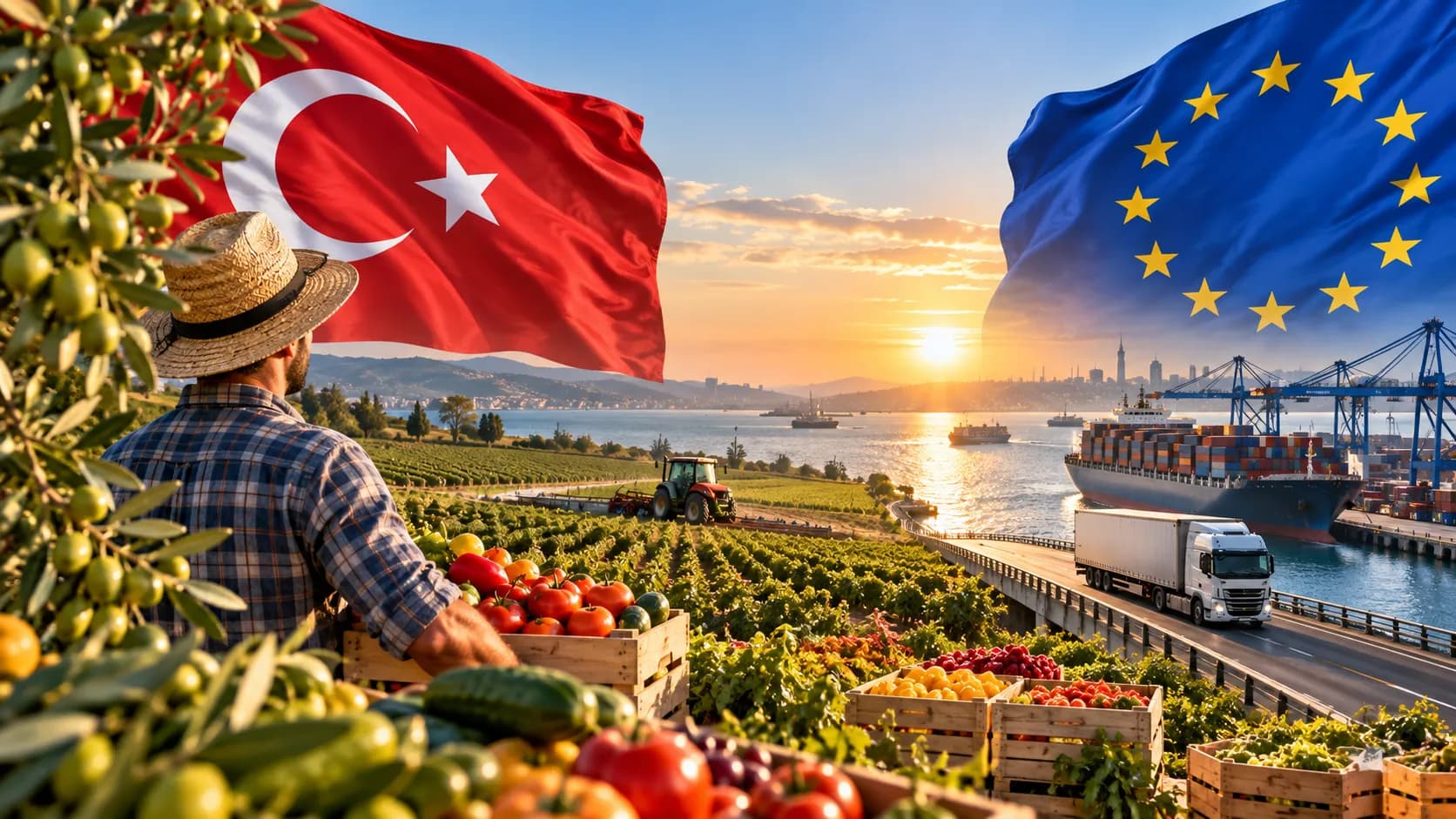
Türkiye is reinforcing its position as one of Europe’s most important agricultural production and supply partners, supported by rising agricultural output, a diversified export base and growing investment in technology-driven farming.
According to Türkiye’s Ministry of Agriculture and Forestry, the country’s agricultural output reached $83.2 billion in 2025, placing Türkiye seventh globally and first in Europe in terms of agricultural output. The government is increasingly emphasizing technology, production planning and higher productivity per unit of land as central elements of its agricultural strategy. (Tarım ve Orman Bakanlığı)
Agricultural exports are also becoming an increasingly important component of Türkiye’s external trade. Türkiye exported 2,226 different agricultural and food products to 185 countries, generating approximately $32.6 billionaccording to figures announced by the Agriculture Ministry in September 2026. (Tarım ve Orman Bakanlığı)
Europe remains particularly important for Turkish producers. The scale of the wider economic relationship provides a strong foundation: bilateral goods trade between Türkiye and the European Union exceeded €217.6 billion in 2025, with Türkiye remaining the EU’s fifth-largest trading partner. The relationship continues to operate within the framework established by the EU–Türkiye Customs Union, although agricultural products are subject to a more specific trade regime than industrial goods. (Trade and Economic Security)
For Türkiye, the next stage may increasingly depend on agricultural technology. Precision irrigation, smart greenhouses, artificial intelligence, agricultural drones, sensors and automated production systems could help producers increase yields while responding to water scarcity, climate risks and European requirements concerning quality, traceability and sustainability.
The European market itself offers substantial opportunities. EU agri-food imports reached €188.6 billion in 2025, highlighting the enormous scale of European demand for agricultural and food products. (Agriculture and rural development) Türkiye’s geographical proximity gives its exporters an additional logistical advantage compared with suppliers located much farther from European markets.
In this context, Türkiye’s competitive advantage may increasingly be defined not simply by how much it produces, but by how efficiently, sustainably and technologically it produces. Combining Türkiye’s agricultural capacity with technologies already being developed across Europe could strengthen the country’s role as a strategic agricultural production and supply hub connecting European markets with the Mediterranean, Black Sea and wider Eurasian region.
Zhansaya Nurlanovna
Contributing writer at EUReflect.
Follow EUReflect
See more of our reporting on Google
Mark EUReflect as a preferred source and our stories are ranked higher for you in Top Stories, Discover and Google News — and carry a “preferred” badge when they are cited in AI results.
Add EUReflect as a preferred source