Türkiye: The Strategic Bridge Between Asia and Europe
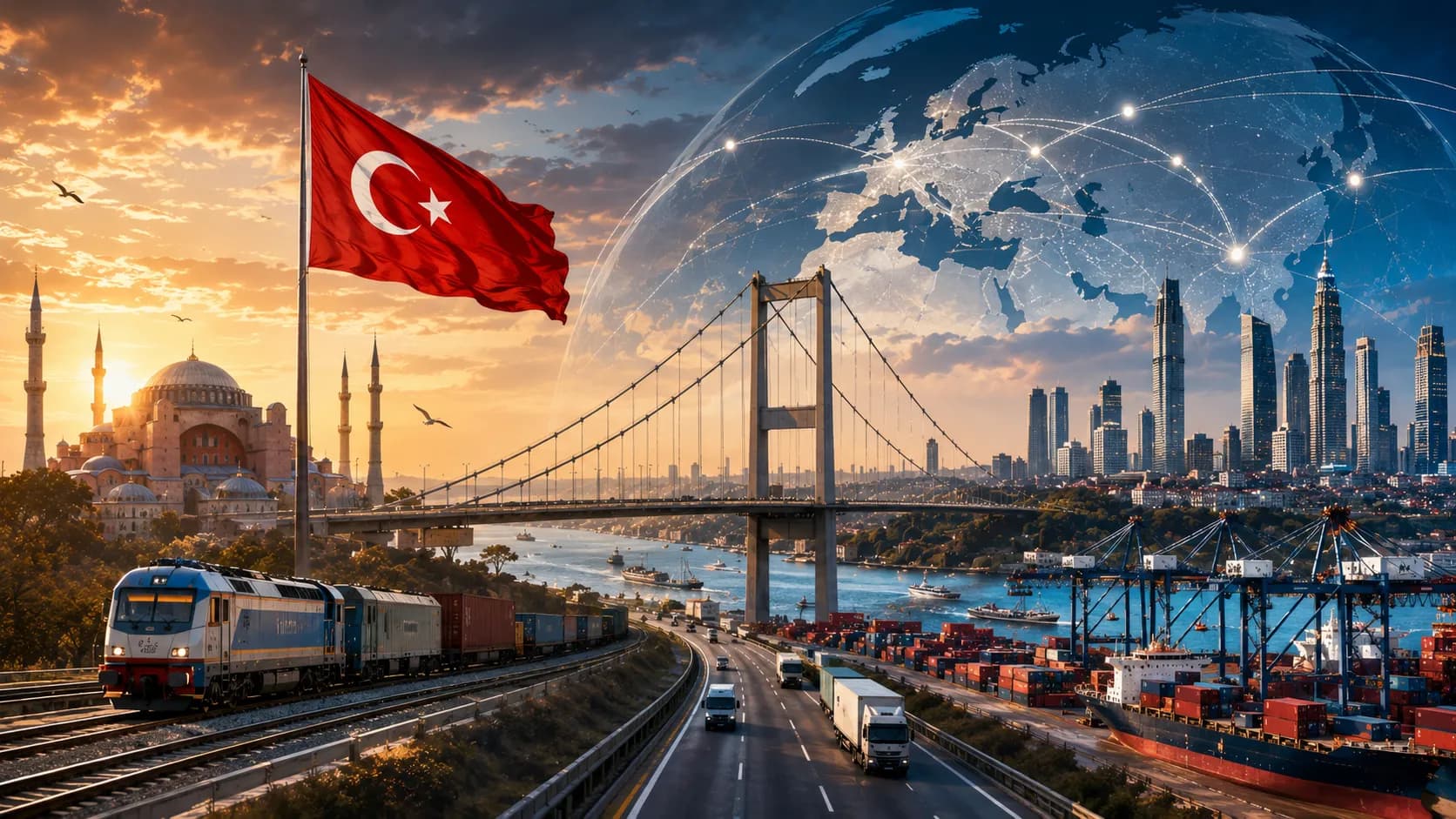
Türkiye is enhancing its strategic position as a bridge between Asia and Europe by expanding cooperation in trade, energy corridors, and diplomacy. Initiatives like the Middle Corridor and growing ties with Asian partners highlight its role as a multidimensional actor in the global system.
Introduction
Türkiye occupies one of the most strategically significant geographic positions on earth — a land where two continents meet, where civilisations have traded and collided for millennia, and where the modern world's great axes of commerce, energy, and diplomacy continue to converge. Straddling both Europe and Asia, Türkiye is not merely a transit point on a map; it is an active and deliberate architect of cross-continental connectivity.
This bridge role is embedded deep in Türkiye's identity. Istanbul, the country's cultural and economic capital, is the only major city in the world to span two continents. The Bosphorus Strait, which divides and connects Asia and Europe within the city's own borders, serves as a daily reminder of this extraordinary duality. Yet Türkiye's bridging function today extends far beyond geography — it manifests in the country's trade partnerships, energy infrastructure, diplomatic posture, and growing engagement with the Global South.
A compelling recent example came in June 2026, when Turkish Foreign Minister Hakan Fidan undertook a high-profile diplomatic tour of Southeast Asia, visiting Singapore and Indonesia. In Jakarta, Fidan held extensive talks with Indonesian President Prabowo Subianto, covering defence cooperation, energy projects, transportation links, and the halal food industry. The visit underscored Türkiye's strategic intent to deepen its presence across Asia while preserving its institutional anchors in the West. (Al Jazeera, June 3, 2026)
1. A Trade Bridge: Partnerships Stretching from East to West
Türkiye's economic geography places it at the intersection of some of the world's most dynamic trade corridors. To its west lie the consumer markets of Europe, with which Türkiye has had a Customs Union since 1996. To its east stretch the resource-rich economies of the Caucasus, Central Asia, and the broader Indo-Pacific — regions experiencing some of the fastest economic growth in the world.
Türkiye has been systematically expanding its trade footprint across Asia. The bilateral trade volume target of $10 billion between Türkiye and Indonesia — agreed by the two countries' leaders in April 2025 — exemplifies this strategy. Both nations are G20 members, majority-Muslim countries, and emerging powers in their respective regions. Their deepening economic relationship reflects not only commercial complementarity but also a shared vision for South-South cooperation.
Beyond Indonesia, Türkiye has pursued free trade agreements and strategic economic partnerships with countries across Asia, Africa, and Latin America. The country is also a key player in the Organisation of Islamic Cooperation (OIC) and uses these multilateral frameworks to build commercial bridges across the Muslim world. Türkiye's export profile has also diversified significantly — from textiles and construction to defence technology, unmanned aerial vehicles (UAVs), and pharmaceuticals — making it a more competitive and attractive partner for Asian economies. For more information, visit the official website of the Ministry of Trade of Türkiye.
2. Energy and Transportation: Infrastructure Connecting Continents
Few countries in the world can claim to sit at the crossroads of as many critical energy and logistics corridors as Türkiye. The country's infrastructure is, in many respects, the physical embodiment of its bridge role — pipelines, railways, ports, and highways that literally connect continents.
On the energy front, Türkiye hosts the Baku-Tbilisi-Ceyhan (BTC) pipeline, which carries Caspian oil to the Mediterranean for global distribution, and the Trans-Anatolian Natural Gas Pipeline (TANAP), which brings Azerbaijani gas westward into Europe. The TürkStream pipeline, running under the Black Sea, further cements Türkiye's role as a major energy transit hub between Russia and Southern Europe. As European countries continue seeking to diversify their energy supplies, Türkiye's position as an intermediary becomes ever more indispensable.
On the logistics side, the Middle Corridor — also known as the Trans-Caspian International Transport Route — is reshaping Eurasian connectivity. This multimodal route links China through Central Asia, the Caspian Sea, the Caucasus, and Türkiye all the way to European markets. As geopolitical shifts have made northern overland routes more complicated, the Middle Corridor has gained fresh strategic importance, and Türkiye is investing heavily in rail, port, and border infrastructure to consolidate its position as the corridor's western gateway.
The inclusion of transportation as a key agenda item during Fidan's Jakarta meetings signals that Türkiye is also exploring how to extend these logistical networks southward — potentially linking Southeast Asian trade flows into the broader Eurasian connectivity grid. Detailed information about the Middle Corridor and related projects is available on the Ministry of Transport and Infrastructure website.
3. Diplomatic Balance: Building Bridges with the Global South
Perhaps the most nuanced dimension of Türkiye's bridge role lies in its diplomacy. The country has long navigated a delicate balance — maintaining its Western institutional commitments through NATO membership and EU candidacy, while simultaneously pursuing an independent and multidirectional foreign policy that engages deeply with the East, the South, and the Islamic world.
Under the foreign policy doctrine often described as "strategic autonomy," Türkiye has positioned itself as a country that refuses to be confined to a single geopolitical bloc. This approach has allowed Ankara to serve as a mediator in several international crises — most notably brokering grain export agreements during the Ukraine conflict — and to maintain working relationships with actors that are often at odds with one another.
The Türkiye-Indonesia talks in Jakarta illustrate this dimension vividly. The joint statement from Indonesia's presidency noted that both countries believe "regional stability should be maintained through dialogue, diplomacy, and the peaceful resolution of disputes." This shared language reflects a broader alignment between Türkiye and many Global South nations — a preference for multipolarity, non-interference, and constructive engagement over confrontation.
Türkiye's active engagement with the Middle East, its support for Palestinian rights, its growing ties with African nations, and its deepening partnerships across Southeast Asia all point to a foreign policy that consciously cultivates Türkiye's identity as a bridge-builder and consensus-seeker on the world stage. For in-depth academic analysis of Turkish foreign policy, see the SETA Foundation and the Council on Foreign Relations.
Conclusion
Türkiye's role as a bridge between Asia and Europe is not a passive geographic accident — it is an actively pursued strategic identity that shapes the country's trade policy, energy infrastructure, and diplomatic conduct. From the pipelines running beneath its soil to the ministerial meetings conducted in distant capitals, Türkiye consistently leverages its unique position to build connections, open markets, and facilitate dialogue between worlds that might otherwise remain apart.
The $10 billion trade target with Indonesia, the investments in Middle Corridor logistics, and the diplomatic outreach across the Global South are not isolated initiatives — they are pieces of a coherent strategic vision. As the 21st century's centre of gravity increasingly shifts toward Asia, and as multipolarity reshapes the international order, Türkiye's bridge role is set to grow in both importance and complexity.
For a country that has always stood at the meeting point of civilisations, this is not a new role — it is, in many ways, a return to historical form. And in a fractured world searching for connectors, Türkiye's position as a bridge between East and West may prove to be one of its greatest strategic assets in the decades ahead.
Sources:
Botakoz Unbayeva
Contributing writer at EUReflect.
Follow EUReflect
See more of our reporting on Google
Mark EUReflect as a preferred source and our stories are ranked higher for you in Top Stories, Discover and Google News — and carry a “preferred” badge when they are cited in AI results.
Add EUReflect as a preferred source