Uzbekistan–China: 35 Years of Partnership
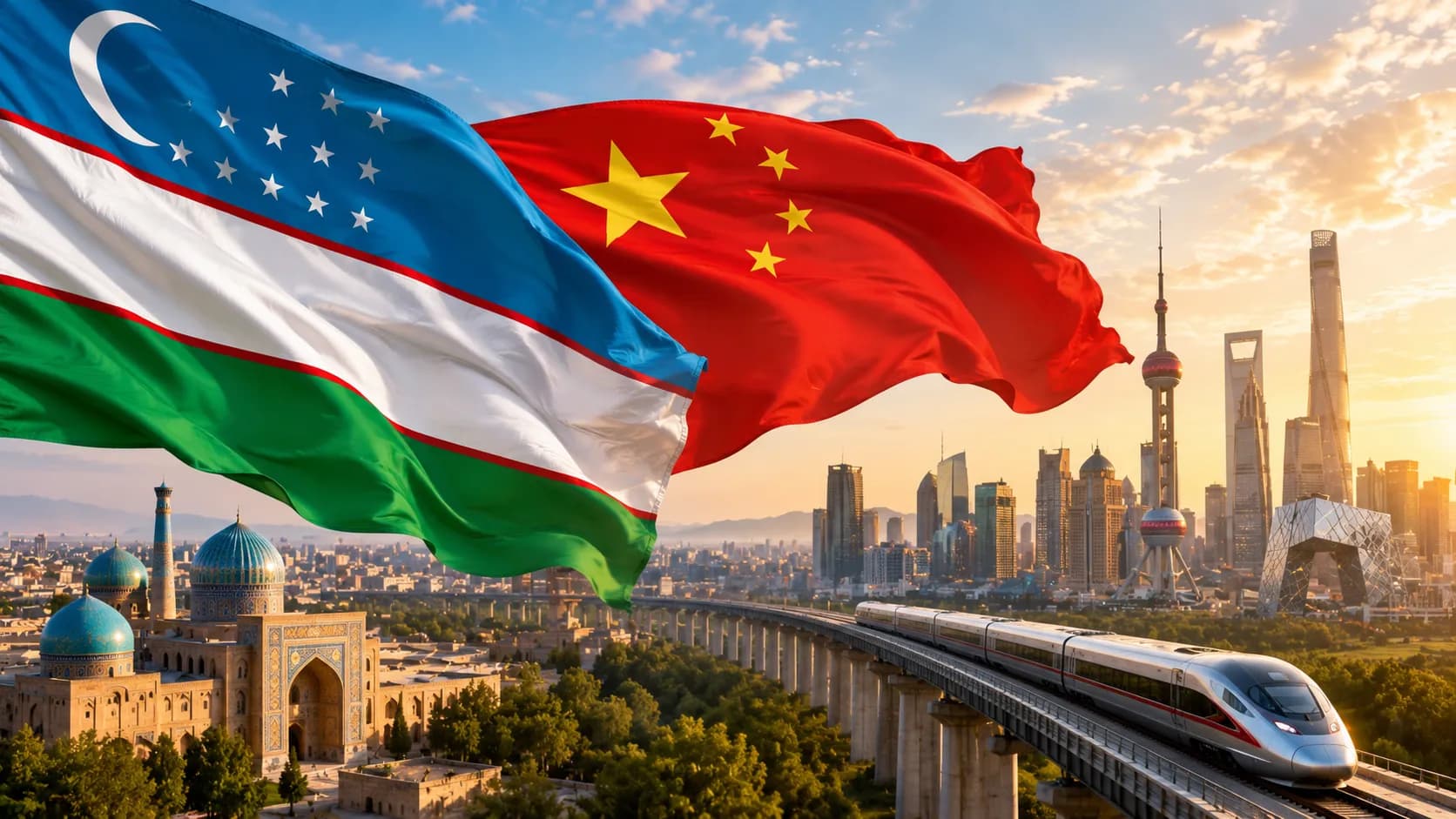
Since 1991, bilateral trade has expanded dramatically, with China now Uzbekistan's largest trading partner and a key investor in infrastructure and industrial projects.
Independence and its evolving meaning
In 2026, Uzbekistan marks the thirty-fifth anniversary of its state independence. This date represents not only the historical memory of the events of August 31, 1991, but also the long journey of a state that gained the right to determine its own development, build relations with the world, and assume responsibility for its future.
Independence is often understood as liberation from an external political center. Over time, however, its meaning becomes broader. In today’s interconnected world, sovereignty is measured not by a country’s distance from other states, but by its ability to choose its partners independently, define the terms of cooperation, and transform external opportunities into internal strength. From this perspective, the development of relations between Uzbekistan and the People’s Republic of China is particularly instructive.
Over the past three and a half decades, China has evolved from one of the first states to recognize Uzbekistan’s independence into the country’s largest trade and economic partner, a major investor, and a participant in large-scale infrastructure, industrial, and technological projects. Yet the central question concerns more than the number of agreements signed or the volume of trade. It is far more important to understand the new quality this partnership is acquiring and how it relates to the national interests of an independent Uzbekistan.
Early recognition and diplomatic ties
China recognized the state independence of the Republic of Uzbekistan on December 27, 1991. Diplomatic relations between the two countries were established on January 2, 1992. For the young republic, this was of fundamental importance: international recognition affirmed its newly acquired political agency and opened space for an independent foreign policy.
Relations subsequently developed in a consistent manner. The establishment of the Shanghai Cooperation Organization in 2001, with Uzbekistan as one of its founding member states, gave bilateral engagement a regional dimension. A strategic partnership was established in 2012. After 2016, the economic openness of New Uzbekistan, the strengthening of good-neighborly relations in Central Asia, and active investment diplomacy significantly expanded the practical agenda of bilateral cooperation.
In January 2024, relations were elevated to an all-weather comprehensive strategic partnership for a new era. This designation reflects a high degree of political trust and a shared intention to ensure the resilience of cooperation regardless of shifts in the international environment. At the same time, it does not imply the creation of a closed alliance or any restriction on Uzbekistan’s relations with other states.
Multi-vector foreign policy
Uzbekistan’s foreign policy retains its multi-vector character. The country develops relations with the states of Central Asia, China, Russia, the European Union, the United States, Türkiye, South Korea, Japan, the countries of South Asia, and the Arab and Muslim world. Closer relations with China should therefore be understood not as a transition from one sphere of influence to another, but as an expansion of the opportunities available for national development.
This is an important political quality of the Uzbekistan–China partnership. It is built on respect for territorial integrity, non-interference in internal affairs, and the right of every nation to choose its own path of modernization. The two countries differ in their systems of government, historical experience, and scale, but these differences do not impede cooperation when sovereign equality remains its foundation.
The experience of independent Uzbekistan allows us to speak of the principle of sovereign openness. Its meaning is straightforward: the state expands its trade, investment, technological, and humanitarian ties while retaining the right to determine their direction and align them with the objectives of national development.
Openness is not the opposite of sovereignty. The true opposite of sovereignty is an inability to manage the dependencies that arise through international cooperation. A country can be deeply integrated into the global economy while preserving freedom of decision if it has access to diverse markets and routes, professional institutions, competitive industries, and technological capabilities of its own.
China as largest trading partner
China is now Uzbekistan’s largest trading partner. According to preliminary national statistics, China accounted for 21.2 percent of the country’s foreign trade turnover in 2025 – approximately US$17.2 billion. These figures demonstrate the scale of interaction. They also require careful analysis of the structure of trade rather than simple satisfaction with the results achieved.
Uzbekistan imports machinery, equipment, components, and technologies from China that are essential to the modernization of its economy. A high volume of such imports is not inherently negative. The decisive question is whether the equipment acquired translates into higher national productivity, the training of engineers, the development of service enterprises, the localization of components, and the expansion of Uzbekistan’s own exports.
This is why the quality of cooperation matters more than simple arithmetic. When external resources generate new knowledge, skilled employment, and modern industries within the country, interdependence strengthens sovereignty. When it primarily entrenches the import of finished goods and the export of raw materials, however, the risk of structural vulnerability increases.
New frontiers in cooperation
The production of BYD electric vehicles in Uzbekistan may become an illustrative example. Its strategic impact will be determined not only by the number of vehicles produced, but also by the depth of localization, the participation of domestic suppliers, the training of technical specialists, and the ability to enter third-country markets. The same logic applies to solar and wind energy. Long-term results depend not only on generating capacity brought online, but also on local equipment production, the transfer of expertise, environmental responsibility, and the ability of Uzbek specialists to maintain new systems independently.
Cooperation in artificial intelligence is another promising area. Joint solutions can be applied to water-resource management, precision agriculture, medical diagnostics, logistics, public services, and translation between Uzbek and Chinese. Digital cooperation, however, will be genuinely constructive only if it is accompanied by the development of national research, data protection, cybersecurity, and a national community of specialists capable of understanding, evaluating, and improving the technologies in use.
Transport connectivity and the railway
Uzbekistan is one of only two doubly landlocked countries in the world – countries separated from the sea by the territories of other landlocked states. Transport connectivity is therefore not a secondary economic issue, but an element of strategic autonomy. The more reliable routes connect the republic to external markets, the greater its freedom of economic choice.
From this perspective, the China–Kyrgyzstan–Uzbekistan Railway carries significance far beyond the transport sector. An intergovernmental agreement on the project was signed in June 2024, and a ceremony marking the start of construction was held in December of the same year. The new railway is expected to shorten the route between China and Central Asia and open additional connections to the markets of South and West Asia.
There is, however, a fundamental distinction between a transit route and a development corridor. Transit generates freight flows and related revenues, but it does not by itself transform the structure of an economy. A development corridor emerges only when logistics centers, industrial zones, processing facilities, educational institutions, service companies, and modern customs systems are established along the railway.
Uzbekistan’s national interest lies not merely in increasing the number of trains crossing its territory. More important is the creation of a productive ecosystem around the new railway. Under such conditions, geographic remoteness from the sea ceases to be merely a constraint and becomes an incentive to develop the country’s role as a transport connector, industrial center, and logistics hub in Eurasia.
The project also demonstrates Central Asia’s growing agency. Its implementation requires the interests of three states to be coordinated. China provides a substantial share of the market, capital, and technology; Kyrgyzstan provides the crucial geographic section; and Uzbekistan connects the route to subsequent western and southern corridors. The participants’ mutual dependence creates a foundation for equitable consultation and shared responsibility for the outcome.
Regional cooperation and Central Asia
Uzbekistan–China relations extend beyond the bilateral level. The Shanghai Cooperation Organization continues to play an important role in regional security, transport development, countering transnational threats, and the expansion of cultural and people-to-people ties. The China–Central Asia format, whose first summit was held in Xi’an in 2023 and whose second took place in Astana in 2025, has become an additional mechanism for direct dialogue between China and the states of the region.
The significance of this format will depend on the ability of the Central Asian states to act not in isolation from one another, but on the basis of a coordinated vision of regional priorities. A shared agenda on transport, trade, water resources, the environment, energy, and digital connectivity can strengthen Central Asia as an independent actor in international affairs.
Uzbekistan occupies a distinctive place in this process. It borders every other Central Asian state as well as Afghanistan, has the region’s largest population, and possesses a developed industrial base and substantial scientific and educational potential. Since 2016, its policy of regional good-neighborliness has created conditions under which cooperation with China can complement the consolidation of Central Asia rather than replace it.
For Chinese partners, it is essential to view Uzbekistan not only as a market, a transit territory, or a source of resources, but also as a co-author of a new regional order. Joint projects will be more sustainable if they are assessed not only in terms of financial returns and transport capacity, but also by their contribution to industrialization, employment, environmental security, and human-capital development.
Understood in this way, the concept of an Uzbekistan–China community with a shared future acquires practical substance. It does not require the homogenization of political systems or the abandonment of national interests. Its meaning lies in recognizing the interconnected nature of development: economic instability, environmental crisis, or transport isolation in one part of Eurasia will inevitably affect others. Shared challenges are compatible with sovereignty when they are matched by joint decision-making.
People-to-people and knowledge exchange
The durability of interstate relations is determined not only by meetings between leaders, the work of ministries, or the activities of major corporations. Genuine resilience emerges when cooperation becomes part of the life of universities, regions, professional communities, and citizens.
Confucius Institutes operate in Tashkent and Samarkand, while joint educational programs and research centers continue to develop. The Uzbek language is taught at Beijing Foreign Studies University. The visa-free regime that entered into force on June 1, 2025, allowing visits of up to 30 days, has created additional opportunities for tourism, entrepreneurship, academic contacts, and direct interaction between the peoples of the two countries.
The next stage should focus on the joint production of knowledge. Bilateral research grants, shared laboratories, researcher-training programs, translations of contemporary literature, and durable ties between think tanks can give the partnership greater intellectual depth. Joint research into the history of ancient Dayuan, Sogdian mediation, Tang-era connections, and the movement of knowledge between Central and East Asia also holds considerable potential.
Linguistic reciprocity is especially important. The expansion of Chinese-language teaching in Uzbekistan should be accompanied by support for the Uzbek language and Uzbek studies in China. Equal dialogue begins with the ability to understand a partner without intermediaries – not only to read official documents, but also to appreciate the cultural context, public attitudes, and semantic nuances of its language.
In this regard, the Silk Road should be understood not as a decorative image of the past, but as a reminder of the reciprocal nature of historical exchange. Ancient routes carried not only goods, but also scientific knowledge, technologies, religious ideas, and artistic forms. The modern partnership will remain true to this tradition if the intellectual movement between Uzbekistan and China is reciprocal as well.
Thirty-five years of independence demonstrate that sovereignty and international cooperation are not mutually exclusive. Independence does not separate a state from the world. It gives the state the right to determine the extent and forms of its openness, choose its partners, and establish the terms of interaction.
The principal criterion for the Uzbekistan–China partnership is therefore its ability to expand Uzbekistan’s sovereign agency. Trade strengthens independence when it contributes to export diversification. Investment does so when it creates national technological capabilities. A railway does so when it becomes a corridor of industrial development. Digitalization does so when it is accompanied by data protection and the emergence of domestic schools of research. Cultural and people-to-people ties do so when they generate reciprocal rather than one-sided knowledge.
This approach serves the interests of China as well as Uzbekistan. An economically autonomous, technologically advancing, and regionally proactive Uzbekistan is a more reliable partner than a country dependent on a single market, commodity, or route. The durability of bilateral relations depends not on preserving asymmetries in capability, but on managing them through mutual respect and strategic benefit for both sides.
The political meaning of the Uzbekistan–China partnership lies neither in creating a closed geopolitical axis nor in replacing one dependency with another. Its significance lies in demonstrating that states of different sizes can build enduring cooperation without compromising sovereign equality.
Independence gave Uzbekistan the right to choose its own future. A mature partnership with China should not only provide resources for development, but also strengthen Uzbekistan’s national capacity to shape that future.
Shahobjon Rakhmonovich Kubatov
DSc in Philosophy, Associate Professor, Mirzo Ulugbek National University of Uzbekistan
Follow EUReflect
See more of our reporting on Google
Mark EUReflect as a preferred source and our stories are ranked higher for you in Top Stories, Discover and Google News — and carry a “preferred” badge when they are cited in AI results.
Add EUReflect as a preferred source