Small Ports, Big Economic Impact
Ports are now central to EU economic security, with Malta and Slovenia exemplifying how strategic location can drive national competitiveness.
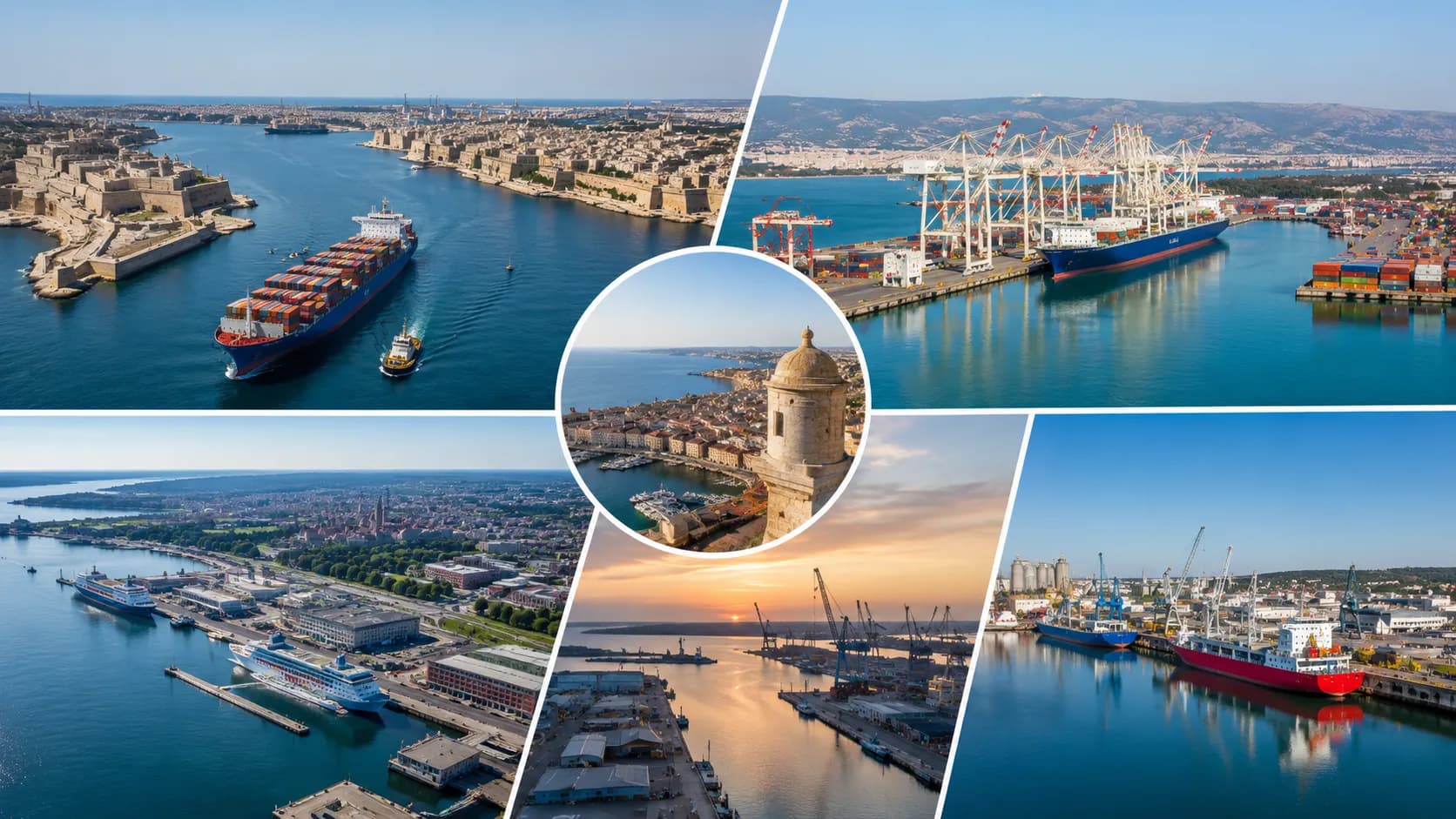
For Europe’s smaller coastal states, ports are far more than transport infrastructure. They are gateways to international markets, logistics platforms, tourism hubs and, increasingly, strategic assets for energy and supply-chain security.
The importance of these facilities has become more visible in 2026 as the European Union places ports at the centre of its economic-security strategy. The European Commission estimates that EU ports handle more than 3.4 billion tonnes of goods and around 395 million passengers annually. Port-related activities generated roughly €90 billion in turnover and supported about 423,000 direct jobs in 2022.
For smaller European economies such as Malta, Slovenia, Estonia, Lithuania and Cyprus, however, the economic significance of ports can be greater than their absolute cargo volumes suggest.
Malta: Geography Becomes an Economic Asset
Malta demonstrates how a small island economy can transform geographic position into commercial value.
Located between Europe, North Africa and the major Mediterranean shipping routes, Malta Freeport operates primarily as an international transshipment hub. The terminal handled 2.87 million TEUs and recorded 1,495 ship calls in 2025. Around 96% of its container traffic consists of transshipment cargo.
This means Malta does not need a large domestic industrial base to generate maritime activity. Containers moving between other countries can be transferred through Maltese infrastructure, creating demand for terminal operations, shipping services, logistics, maintenance and related businesses.
The strategic importance of this model was highlighted again in July 2026, when the Maltese government welcomed proposed changes to the EU Emissions Trading System designed to protect the competitiveness of Malta Freeport against non-EU Mediterranean transshipment hubs.
For Malta, therefore, port competitiveness is closely connected to national competitiveness.
Slovenia: Koper Connects Central Europe
Slovenia provides a different model.
The Port of Koper does not depend only on Slovenia’s domestic economy. Its economic significance comes from its position as an Adriatic gateway serving markets deeper inside Central Europe.
In 2025, the Port of Koper handled 21.7 million tonnes of cargo. Containerised cargo reached 10 million tonnes, while container traffic measured in TEUs increased by 12% compared with the previous year.
This gives Slovenia an economic role disproportionate to its geographic and demographic size.
Koper effectively allows the country to participate in supply chains connecting the Mediterranean with Central European manufacturing and consumer markets. Railways, warehouses, freight forwarding, customs services and logistics companies surrounding the port extend its economic impact well beyond the docks themselves.
The port therefore acts not simply as an import-export facility, but as an instrument through which Slovenia can position itself within European trade corridors.
Estonia: Ports Support a Northern Gateway
Estonia shows another dimension of the small-state port economy.
In 2025, nearly 14 million tonnes of cargo and more than 8 million passengers passed through Port of Tallinn facilities. Cargo volumes increased by approximately 5% compared with the previous year.
Tallinn’s importance comes from the combination of freight, ferry connections, passenger traffic and regional logistics.
For a country with a relatively small domestic market, maritime connections help overcome the limitations of economic scale. Ports connect Estonia with Finland, Sweden and other Baltic markets while supporting tourism, trade and transport services.
This makes maritime connectivity part of the country's wider economic infrastructure rather than an isolated transport sector.
Lithuania: Klaipėda Anchors the Blue Economy
Lithuania's maritime economy illustrates how ports can generate activity across several interconnected industries.
The country's established Blue Economy sectors generated approximately €1.1 billion in gross value added in 2023 and directly employed about 32,600 people. Together, they represented around 1.7% of national GVA and 2.4% of employment.
Port activities alone accounted for approximately 15% of Lithuania's Blue Economy GVA. Klaipėda, the country's main multipurpose deep-water port, remains the central gateway connecting Lithuania with Baltic and Scandinavian markets.
Its significance extends into ship repair, logistics, industrial services and ferry transportation, demonstrating how a major port can support an entire maritime business ecosystem.
Cyprus: Ports Are Part of Island Economic Security
Cyprus faces a structural reality shared by island economies: maritime connectivity is essential.
Ports therefore contribute not only to trade but also to the reliability of supply chains connecting the island with international markets.
Port activities represent around 7% of Cyprus's established Blue Economy GVA, while port activities and shipbuilding and repair together account for approximately 13%.
For Cyprus, maritime infrastructure also interacts with shipping services, tourism and the country's broader ambition to expand its role in the Eastern Mediterranean economy.
Small States Can Gain More From Every Port
The experience of Europe’s smaller maritime countries reveals an important economic principle: the value of a port cannot be measured only by the amount of cargo crossing its docks.
Malta uses its location to capture transshipment activity. Slovenia uses Koper to connect Central Europe with the Adriatic. Estonia combines freight with strong passenger connectivity, Lithuania has developed a broader maritime industrial ecosystem around Klaipėda, while Cyprus depends on ports as essential infrastructure for an island economy.
This is increasingly consistent with EU policy. Brussels now describes ports as trade gateways, energy platforms, industrial hubs and strategic infrastructure. The EU’s 2026 ports strategy also gives specific attention to small, medium-sized and island ports because of their importance for regional economies, connectivity and critical supply chains.
For Europe’s smaller countries, this creates an opportunity. They may not be able to compete with Europe's largest economies in industrial scale, but a strategically located and efficiently managed port can give a small state an economic reach far beyond the size of its domestic market.
Ahmet Balakan
Contributing writer at EUReflect.
Follow EUReflect
See more of our reporting on Google
Mark EUReflect as a preferred source and our stories are ranked higher for you in Top Stories, Discover and Google News — and carry a “preferred” badge when they are cited in AI results.
Add EUReflect as a preferred source