Washington Reshapes Its Middle East Strategy
The shift follows months of direct confrontation with Iran, with economic sanctions now taking priority over military strikes.
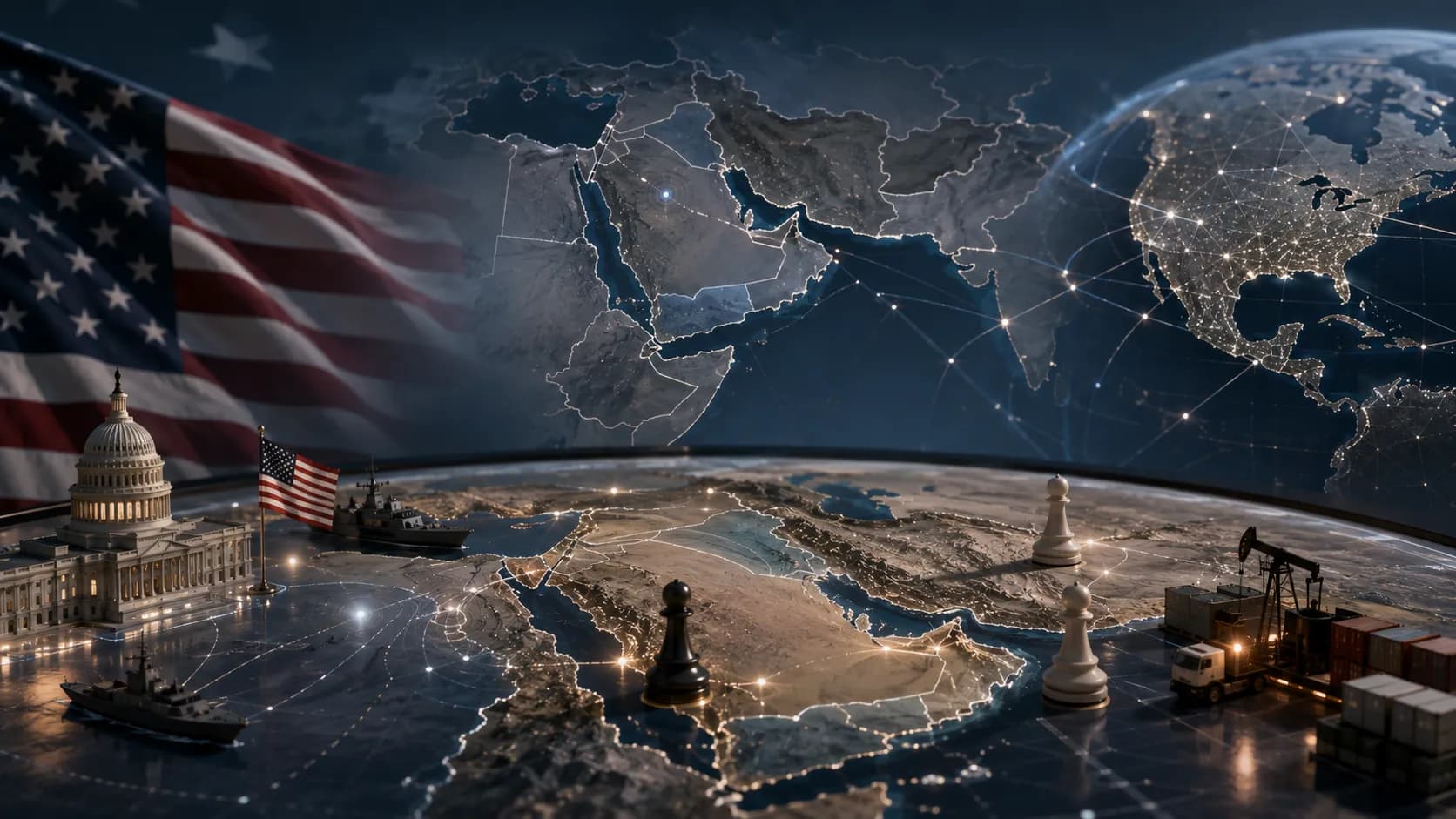
U.S. policy in the Middle East is undergoing another major transformation in 2026 as Washington attempts to combine military power, economic pressure, support for Israel and Gulf security with a growing need for regional diplomacy.
The clearest shift is visible in Iran.
After months of direct U.S.-Iran confrontation, Secretary of State Marco Rubio has told allies that Washington is moving, at least temporarily, from military strikes toward intensified economic sanctions. At the same time, the United States continues to maintain military pressure around the Strait of Hormuz and is seeking to protect the flow of global energy supplies.
The emerging strategy suggests that Washington is not withdrawing from the Middle East. Instead, it is attempting to reshape how American power is used across the region.
Iran Remains the Central Challenge
Iran currently sits at the center of U.S. Middle East policy.
On August 24, the Trump administration launched what it calls “Operation Economic Outcast,” a broad campaign intended to further isolate Iran financially and restrict revenue available to the government and Islamic Revolutionary Guard Corps.
Washington simultaneously expanded sanctions and restrictions covering sectors including aviation, digital assets, gold, shipping and technology.
This represents an important transition.
Military pressure has not disappeared, but economic warfare is again becoming a primary instrument. The objective is to increase the cost of Iranian resistance without immediately returning to another large-scale phase of direct military confrontation.
The Strait of Hormuz makes the confrontation global. Any serious disruption there can affect oil prices, shipping costs and energy security far beyond the Middle East.
For this reason, Washington is also coordinating closely with Gulf governments and emphasizing freedom of navigation through the strait.
Israel Remains the Strategic Anchor
Israel continues to occupy a central position in American regional strategy.
The United States maintains its security partnership with Israel while simultaneously facing the difficult task of preventing conflicts involving Israel from expanding into broader regional confrontations.
Gaza remains part of this challenge, but Washington's calculations increasingly extend from the Palestinian territories to Lebanon, Syria and Iran.
The strategic problem is becoming more complicated: supporting Israel's security objectives while preventing escalation that could threaten U.S. forces, Gulf partners, international shipping and global energy markets.
That balancing act has become one of the defining characteristics of current American policy in the region.
Syria Shows a Different American Approach
Syria offers perhaps the clearest example of Washington's changing strategy.
On August 24, the United States formally removed Syria's designation as a State Sponsor of Terrorism and simultaneously removed Hay'at Tahrir al-Sham from key U.S. terrorism sanctions lists.
The move represents a significant break from decades of American policy toward Damascus.
Washington is increasingly attempting to use economic normalization and diplomacy to influence Syria's post-Assad political order rather than relying primarily on isolation.
The United States is also acting as a mediator between Syria and Israel.
American-mediated talks between Syrian and Israeli representatives were held in Jordan this week following renewed tensions and an Israeli strike near the Turkish border. The negotiations are aimed at establishing mechanisms capable of preventing military incidents from escalating.
Syria therefore illustrates another component of the new strategy: sanctions can be removed when Washington believes economic reintegration can produce political leverage.
Gulf States Are Becoming More Important
Saudi Arabia, the United Arab Emirates, Qatar, Oman, Bahrain and Kuwait are increasingly important to Washington not simply as energy producers but as diplomatic and security actors.
They provide military access, investment relationships and channels of communication with governments that Washington itself may struggle to reach.
But relations are not without tension.
Recent reporting indicates growing frustration among several Gulf governments over Washington's handling of the Iran confrontation and uncertainty surrounding regional diplomacy.
This is significant because Gulf states today have considerably more strategic options than they did two decades ago.
They maintain relationships not only with Washington but also with China, India, Russia and other emerging powers.
The United States therefore increasingly has to compete for influence rather than assume automatic alignment.
Lebanon Remains Part of the Iran Strategy
Lebanon is also closely connected to Washington's confrontation with Tehran.
The United States announced new measures on August 20 targeting a network accused of transferring hundreds of millions of dollars between Iran's Quds Force and Hezbollah through Lebanon, Türkiye, the UAE and Iran.
This demonstrates how Washington increasingly views Iran's regional influence as a network rather than simply a state-to-state security problem.
Financial sanctions, intelligence cooperation and pressure on intermediary networks are therefore becoming as important as conventional military deterrence.
Diplomacy Is Returning
There are also indications that Washington is preparing for a more active diplomatic phase.
The State Department is increasing staffing at several Middle Eastern diplomatic missions after earlier reductions connected with the Iran conflict.
Diplomats could return to missions in Israel, Lebanon, Saudi Arabia, Qatar, Jordan, Oman, Iraq and Kuwait as Washington adjusts its regional security posture.
The move suggests that the United States does not currently expect an immediate return to full-scale regional war.
More importantly, it shows that diplomacy is again becoming an important instrument alongside sanctions and military deterrence.
America Is Not Leaving the Middle East
For years, analysts have debated whether the United States was gradually withdrawing from the Middle East in order to concentrate more resources on China and the Indo-Pacific.
Developments in 2026 suggest a more complicated reality.
Washington still wants to reduce the costs of permanent military involvement, but the region remains too strategically important to abandon.
Iran's nuclear and military capabilities, Israel's security, Gulf energy supplies, the Strait of Hormuz, Syria's political transformation, Hezbollah and other armed networks all continue to connect the Middle East directly to American national-security interests.
The emerging U.S. strategy therefore appears less focused on controlling the region and more focused on controlling escalation.
Military force remains available. Sanctions are becoming more aggressive. Israel remains a central partner. Gulf states are becoming increasingly important diplomatic actors, while Syria demonstrates that Washington is also willing to use normalization as leverage.
The United States is therefore not disappearing from the Middle East.
It is attempting to replace permanent intervention with a more flexible combination of military deterrence, economic pressure and selective diplomacy — while ensuring that no regional power can fundamentally reshape the Middle Eastern balance against American interests.
Ahmet Balakan
Contributing writer at EUReflect.
Follow EUReflect
See more of our reporting on Google
Mark EUReflect as a preferred source and our stories are ranked higher for you in Top Stories, Discover and Google News — and carry a “preferred” badge when they are cited in AI results.
Add EUReflect as a preferred source