Why Central Asia Is Moving onto the U.S. Investment Map: The Uzbekistan Opportunity
In Dialogue with Nazar Astanov, CEO of North Star Investment Group Mirshod Shakirov and Nazar Astanov discuss U.S. capital, Uzbekistan’s investment transformation and Central Asia’s emerging place in the global economy.
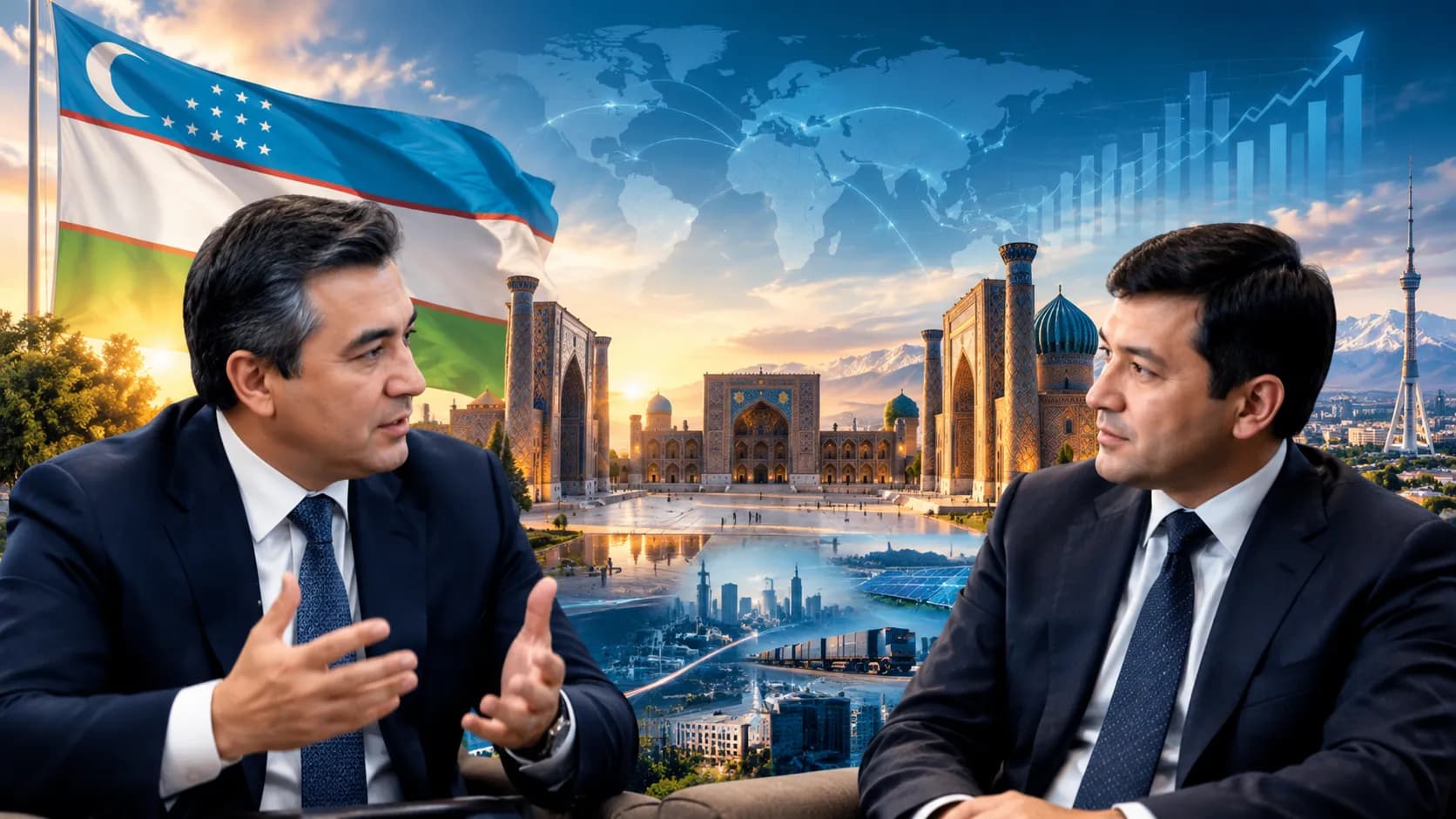
In Dialogue with Nazar Astanov, CEO of North Star Investment Group
Mirshod Shakirov and Nazar Astanov discuss U.S. capital, Uzbekistan’s investment transformation and Central Asia’s emerging place in the global economy.
For much of the international investment community, Central Asia has remained a region understood more for its strategic geography than for its place in global capital markets. That equation is beginning to change.
At the centre of that shift is Uzbekistan, a country of nearly 40 million people undergoing a period of economic opening, institutional reform and increasing engagement with international investors. Positioned between major economic powers and historic trading routes, Uzbekistan is seeking to translate its geography, demographics and natural resources into a new role within the global economy.
For the United States, the relationship is also acquiring a broader economic dimension. The question is no longer simply whether American companies should pay attention to Central Asia, but where the most credible opportunities lie, what still prevents international capital from entering at scale, and whether Uzbekistan can develop from an individual emerging market into a platform connecting investors with the wider region.
These questions sit naturally within the emerging field of business diplomacy: the space where entrepreneurship, commercial interests, international relationships and institutions increasingly intersect.
For this edition of IN DIALOGUE, Mirshod Shakirov FRSA FRAS, an international entrepreneur and Founder and President of Business Diplomat, the world’s first Think-Do Tank dedicated to business diplomacy on the Modern Silk Road, speaks with Nazar Astanov, CEO of North Star Investment Group (NSIG), about Uzbekistan’s investment proposition, the changing American perception of Central Asia and what a deeper economic relationship between the United States and Uzbekistan could look like.
Shakirov approaches the conversation from the intersection of entrepreneurship, international business and institutional engagement. As an entrepreneur and institution builder, his work has increasingly focused on creating platforms that connect business leaders, investors and institutions across markets, while advancing business diplomacy as a practical discipline for navigating an increasingly interconnected global economy.
At the centre of this edition is Nazar Astanov, whose work through North Star Investment Group focuses on connecting U.S. investors and businesses with opportunities in Uzbekistan and the wider Central Asian region. Astanov represents a generation of internationally oriented investment professionals looking at Central Asia not as a peripheral emerging market, but as a region entering a new phase of economic relevance.
His perspective is grounded in the practical questions facing investors: where capital can be deployed, which sectors offer the strongest opportunities, what international investors still misunderstand about Uzbekistan, and what institutional changes will be necessary for the country to attract capital at substantially greater scale.
Their conversation moves beyond the simple question of whether Uzbekistan is an attractive emerging market. It examines what is changing, where the opportunities lie, what international investors still misunderstand and what Uzbekistan itself must do if it wants to compete for substantially larger pools of global capital.
MIRSHOD SHAKIROV: Why now? For many American investors, Central Asia has historically been a relatively distant market. What has changed, and why should U.S. investors be paying closer attention to Uzbekistan and the wider region today?
NAZAR ASTANOV: What has changed is that the region as a whole is transforming, and the numbers now prove it. Uzbekistan is emerging as the Singapore of Central Asia, and it is still in the early stages of that journey. Foreign direct investment grew more than 50 percent in 2024 to nearly $12 billion, and the government’s Uzbekistan-2030 strategy is driving reform across every part of the economy, from tax and regulation to privatization, with close to twenty companies lined up for public listings. The country is at a crucial turning point in its history, with serious initiatives underway across technology, finance, mining, tourism, and sustainable, green growth. Kazakhstan offers a useful case study: its growth shows what is possible in this region, and we believe Uzbekistan can achieve a similar trajectory on an even wider scale, given its substantial holdings of precious metals, its rich history, and its position at the crossroads of the ancient Silk Road.
MIRSHOD SHAKIROV: What makes Uzbekistan particularly interesting within Central Asia? What distinguishes Uzbekistan from Kazakhstan and other economies in the region from an investor’s perspective?
NAZAR ASTANOV: Uzbekistan combines the region’s largest population - roughly 37 million people, with a median age under 28 - with a resource base few markets can match: a top-ten gold producer, a top-five uranium producer, and major copper reserves the government plans to expand several-fold by 2030. Add a deep history and a rich culture and cuisine - Samarkand, Bukhara, and Khiva are genuine global tourism assets - and you have a combination of demographic scale, resource wealth, and cultural depth that a single-factor economy cannot offer.
MIRSHOD SHAKIROV: Which sectors offer the strongest opportunities for U.S. investors over the next five to ten years?
NAZAR ASTANOV: We see the strongest potential in critical minerals, manufacturing, logistics, and financial services. Critical minerals, because Uzbekistan holds some of the world’s strongest gold and uranium positions - a top-ten gold producer and a top-five uranium producer - with plans to multiply copper output, and Washington has made supply-chain diversification a priority: Uzbekistan is an early participant in the U.S.-led critical minerals framework. Manufacturing, because lower labor costs, one of the region’s youngest workforces, and direct access to raw materials meet a government that actively incentivizes production - a national network of free economic and special industrial zones offering tax and customs preferences - as the country moves up the value chain from extraction into processing and production. Logistics, because in a double-landlocked country, the companies that solve logistics own a very profitable niche - and the Middle Corridor is already scaling fast, with its share of Uzbekistan’s cargo rising from 12 percent in 2021 to 28 percent in 2025. And financial services, because the government is pushing the sector hard - the Central Bank is developing a national fintech strategy together with the Global Finance & Technology Network under the Monetary Authority of Singapore - while banking reform, privatization, and a young capital market leave enormous room to build.
MIRSHOD SHAKIROV: What do American investors most often misunderstand about Uzbekistan?
NAZAR ASTANOV: The biggest gap starts with awareness: many Americans are simply not familiar with Central Asia as a region. On top of that, outdated perceptions of the region’s history and worries about navigating local politics scare investors off. Our view from the ground is different. Uzbekistan is a safe, friendly nation with a strong foundation for international businesses to grow, and the investors who actually visit tend to leave surprised by how different the reality is from the perception.
MIRSHOD SHAKIROV: What is still preventing more U.S. capital from entering Uzbekistan?
NAZAR ASTANOV: It is mainly awareness - people are not aware of the opportunities. Some investors also worry about legal protection, but in our view they should not be. The country is actively pushing toward international investment: the 2019 Law on Investments and Investment Activity guarantees foreign investors’ rights and provides access to international arbitration, and the government keeps bringing in regulations that are familiar to international investors. The only thing left is awareness and showing people the opportunities that are available.
MIRSHOD SHAKIROV: What would Uzbekistan need to do to attract substantially more institutional U.S. capital?
NAZAR ASTANOV: Uzbekistan has already done the hardest first part: opening up. Since 2017, it has liberalized its currency, modernized its investment laws, and begun meaningful privatization. The next stage is about depth and predictability. Institutional investors need consistent enforcement of existing rules, stronger commercial courts and arbitration that meet international standards, and continued privatization of state-owned enterprises so the private sector competes on a level playing field. Deeper capital markets matter too. More IPOs, a stronger bond market, and reliable IFRS reporting would give funds clearer ways to enter and exit. WTO accession would be another major signal because it would anchor reforms in international commitments. The direction is right; what global capital is waiting for now is a sustained track record of implementation.
MIRSHOD SHAKIROV: How does Uzbekistan compete for capital globally, against markets like Southeast Asia, the Gulf, Eastern Europe, India, or Latin America?
NAZAR ASTANOV: Uzbekistan is at an earlier stage than most of those markets, and that is precisely the opportunity. It offers a stable environment, a very large, young, and educated population across the region, and entry points at a lower cost - in part because awareness is still limited. Valuations and entry multiples in more crowded markets already price in their growth stories; Uzbekistan’s does not. On top of that, its policies and legislation are increasingly open to international investment, and the momentum is visible: foreign direct investment has been growing at double-digit rates. Investors who move before the market becomes crowded are the ones who benefit most from that combination.
MIRSHOD SHAKIROV: Does Uzbekistan’s geography represent a constraint or an opportunity?
NAZAR ASTANOV: Inexperienced investors might see being double-landlocked as a flaw. Seasoned investors understand that with modern technology, logistics is not something to fear - and that the perceived barrier actually works in their favor, because it filters out the majority of the competition and leaves more of the market to those who move in time. Uzbekistan is also pursuing initiatives that make access easier than ever. The China-Kyrgyzstan-Uzbekistan railway, now under construction, will connect Central Asia directly to China and, through onward links, to Europe. At the same time, cargo moving west through the Caspian Middle Corridor has been growing rapidly. Geography is becoming one of the country’s strongest cards.
MIRSHOD SHAKIROV: Can Uzbekistan become a regional platform rather than simply a domestic market?
NAZAR ASTANOV: Absolutely. The region is still early, and the laws and policies being released are still very new, which allows for higher multiple-fold growth in the future than in other Central Asian countries - some of which are less stable, and some of which have already put mature policies in place, leaving less room for that kind of upside. Uzbekistan is the region’s largest consumer market and its natural center of gravity. A U.S. company entering Uzbekistan today can realistically use it as a base for expansion across Central Asia and the wider Eurasian market.
MIRSHOD SHAKIROV: What role can the United States realistically play in Uzbekistan’s economic development?
NAZAR ASTANOV: American capital brings more than money. Combined with the right technology, management expertise, and a willingness to expand aggressively, U.S. investment tends to be more centralized and systemized in how it executes. That organization and unity of approach is a distinctive strength alongside what partners from China, Russia, the Gulf, and Europe bring. You can already see what that looks like: in September 2025, President Mirziyoyev’s visit to New York produced an $8.5 billion Boeing agreement for up to 22 Dreamliners - the largest commercial aviation deal of its kind in Central Asia - alongside agreements with Citigroup and Oppenheimer. American capital, technology, management, and financial institutions add something distinctive, and that is exactly the layer NSIG works to expand.
MIRSHOD SHAKIROV: What would a stronger U.S. investment presence mean for Uzbekistan itself?
NAZAR ASTANOV: Beyond the volume of capital, it can contribute to improving the country in ways people feel directly: housing, jobs, and opportunity; stronger corporate governance and international standards; a push toward greener, more sustainable growth; greater international recognition and connections; deeper integration into global trade; and better access to technology. Those are the contributions we believe greater American participation can make.
MIRSHOD SHAKIROV: Where does NSIG fit into this emerging investment relationship?
NAZAR ASTANOV: What North Star Investment Group (NSIG) does is not only work to bring capital to Central Asia - it aims to help transform the region as a whole. In practice, we find unique opportunities in Uzbekistan through select partnerships and agreements with firms and government bodies, which can give our clients access to projects before they reach the broader market. We match the best opportunities with select clients and the right investors with project owners, vetting each opportunity carefully on both sides. We prepare projects and proposals on behalf of companies, help them work with local governments, and guide U.S. firms entering the market. We see a future with far more jobs, far more international recognition, and far more opportunities for people whose quality of life can rise as the economy grows. NSIG’s role is to be the bridge: the connector between U.S. capital and Uzbekistan’s opportunities, helping put Uzbekistan on the world market in a way that traditional investment-promotion channels have not.
MIRSHOD SHAKIROV: Looking ahead to 2030 and beyond, what could success look like?
NAZAR ASTANOV: A successful relationship looks like U.S. firms established in Uzbekistan and across Central Asia. It looks like Uzbek unicorn companies succeeding on the world stage, high-level jobs and careers created across the country, and Uzbek professionals and companies becoming involved in the United States and seeing tremendous success there as well. Success is a free flow in both directions - capital, companies, talent, and ideas moving between the two countries. The Boeing and banking agreements of the past year are the first chapter of that story, not the last.
Beyond Capital: Building the Bridges
The conversation points to something larger than the investment case for one emerging market.
For Nazar Astanov, the opportunity rests substantially on timing. Uzbekistan remains early enough in its development for significant opportunities to exist, while reforms, infrastructure and international engagement are beginning to make those opportunities increasingly accessible to international capital.
His argument is that an important gap remains between global perceptions of Uzbekistan and the economic transformation taking place inside the country. Through NSIG, Astanov is seeking to operate within that gap, connecting U.S. investors and companies with opportunities in a region that he believes remains insufficiently understood by international capital.
For Mirshod Shakirov, the discussion illustrates a wider proposition behind business diplomacy itself.
Capital rarely moves on financial analysis alone. International business depends on trust, access, relationships, local understanding and the ability to navigate different commercial, institutional and cultural environments. As economies become more interconnected, the traditional boundaries between entrepreneurship, investment and diplomacy are becoming less distinct.
Shakirov’s own work sits within that intersection. As an international entrepreneur and institution builder, he has sought to bring business leaders, investors, diplomatic communities and international institutions into common platforms, treating business diplomacy not simply as a concept, but as a practical instrument for creating relationships across markets.
Central Asia’s next stage of economic development may therefore depend not only on attracting capital, but on building the institutional and human bridges capable of moving investment, companies, expertise and ideas across borders.
It is this changing landscape that IN DIALOGUE with Mirshod Shakirov will continue to explore.
Through conversations with entrepreneurs, investors, diplomats, academics, policymakers and institutional leaders, IN DIALOGUE examines the people, ideas and relationships shaping the evolving intersection of business, diplomacy and global affairs.
About Mirshod Shakirov
Mirshod Shakirov FRSA FRAS is an international entrepreneur, institution builder and the Founder and President of Business Diplomat, the world’s first Think-Do Tank dedicated to business diplomacy on the Modern Silk Road. He is also the Founder of the World Business Diplomacy Council. His work spans entrepreneurship, business diplomacy and international economic engagement, with a particular focus on building platforms and networks connecting business leaders, investors and institutions across international markets.
About Nazar Astanov
Nazar Astanov is the CEO of North Star Investment Group (NSIG), an investment group focused on connecting U.S. capital and businesses with opportunities in Uzbekistan and the wider Central Asian region. His work focuses on identifying investment opportunities, facilitating market entry and developing commercial connections between American investors and one of Central Asia’s rapidly evolving economies.
Mirshod Shakirov
Founder and President of Business Diplomat
Follow EUReflect
See more of our reporting on Google
Mark EUReflect as a preferred source and our stories are ranked higher for you in Top Stories, Discover and Google News — and carry a “preferred” badge when they are cited in AI results.
Add EUReflect as a preferred source