Brussels Prepares and Its Vulnerable Citizens
The CPAS of Brussels plans massive renovations of its 2,300 housing units and iconic properties via public-private partnerships, property sales, and rent adjustments—but critics warn the focus on workers and profitability risks sidelining the city’s most vulnerable.
A colossal heritage in need of renovation
A colossal heritage in need of renovation
The CPAS (Public Center for Social Welfare) of the City of Brussels owns an exceptional real estate portfolio: 2,300 housing units, 150 ground-floor commercial spaces (including some on the prestigious Boulevard de Waterloo and in the Sablon), farmland and forests in Wallonia and Flanders, as well as iconic buildings such as the Grand Hospice and the Atelier des Tanneurs.
The challenge is considerable: much of this real estate is aging. According to David Weytsman (MR), president of the CPAS, €100 million would be needed to bring the entire residential stock up to standard.
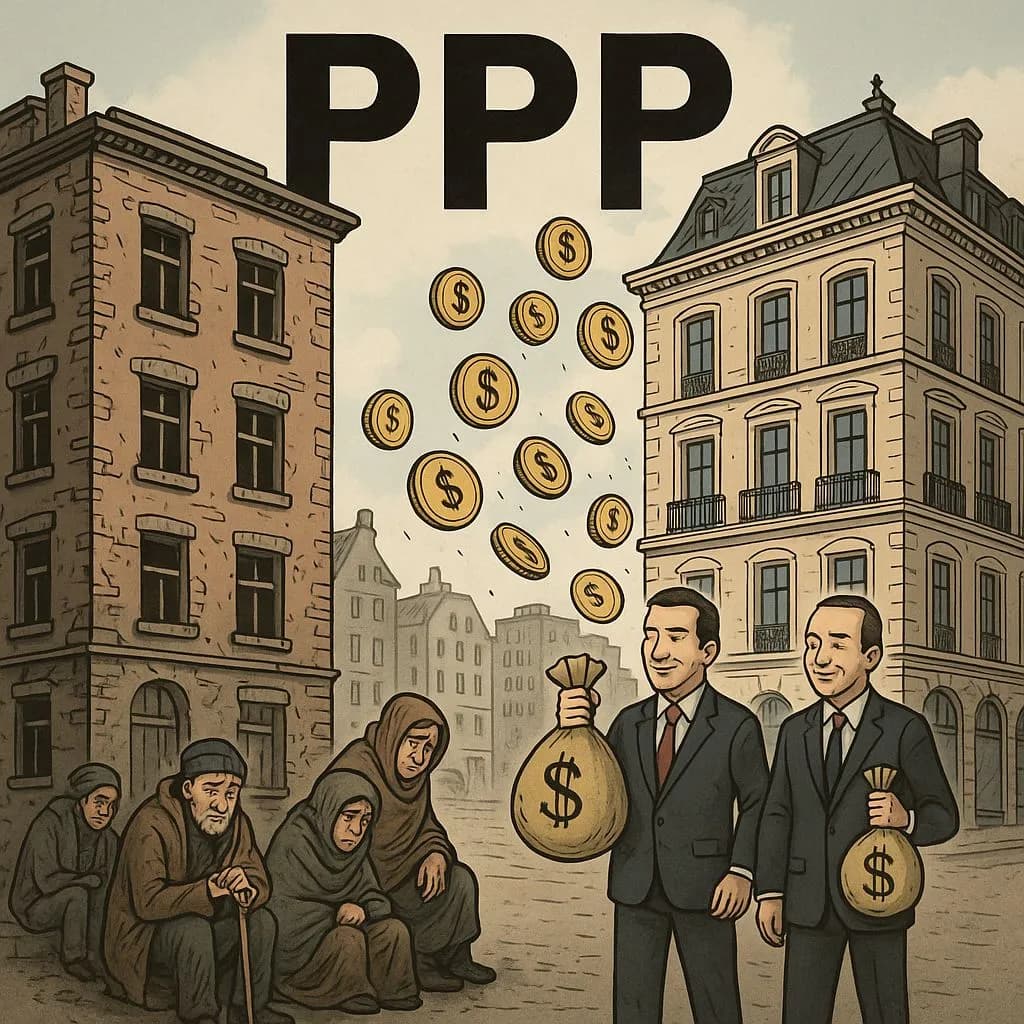
At a time when 11 out of 19 Brussels municipalities are under regional supervision, the City of Brussels—one of the few that has escaped this oversight—is desperately searching for ways to finance this ambitious modernization. Its solution? Massive reliance on public-private partnerships (PPPs): the private sector funds the renovations, the CPAS retains ownership, and pays an annual fee. The renovation of the Grand Hospice illustrates this strategy perfectly.
⸻
PPPs, sales, and tariff adjustments
To finance this colossal renovation, the CPAS has rolled out a three-pronged strategy:
• Public-private partnerships (PPPs): the preferred solution to accelerate modernization without immediately mobilizing public funds.
• Targeted sales: certain properties located outside Brussels will be sold. For 2025, around €10 million is expected from these transactions.
• High-end rent revaluation: about 10–15% of the CPAS residential stock consists of upscale housing. These rents will be aligned with private market prices to generate income for social policy.
This approach echoes other regional initiatives. In Schaerbeek, where Mayor Audrey Henry also belongs to the MR party, the municipal majority is already advocating the sale of public buildings to lighten municipal charges and fill budget gaps.
⸻
A new social philosophy: employment first
A new social philosophy: employment first
David Weytsman intends to revolutionize CPAS social policy around one principle: systematically linking housing with employment.
New priorities:
• Beneficiaries engaged in professional reintegration programs will receive privileged access.
• Workers in shortage sectors and CPAS employees living outside Brussels will be given easier access to the housing stock.
• An innovative system of partial rent capitalization will allow tenants to become homeowners after 5 or 10 years of renting.
However, this raises major concerns. Social housing has traditionally served as a temporary springboard, helping beneficiaries stabilize before making way for others in need. By turning a significant portion of the stock into acquired property, this policy risks permanently shrinking the available supply and drifting away from the fundamental mission: guaranteeing shelter for the most vulnerable.
The announcement that some new constructions will be sold below market prices reinforces this logic of gradually ceding public assets.
⸻
The controversy: “A CPAS turned into a real estate company”
The controversy: “A CPAS turned into a real estate company”
This “modernization” strategy has sparked strong criticism. The MR party is accused of wanting to run the CPAS as a profit-oriented real estate company, multiplying collaborations with the private sector and pursuing a more aggressive pricing policy.
More worrying still: giving priority to workers could result in the systematic marginalization of the most vulnerable groups—elderly people, persons with disabilities, long-term welfare recipients deemed “unemployable.” Some observers denounce a veritable “hunt against Brussels’ most fragile,” marking a radical break with the CPAS’s historical mission of unconditional solidarity.
⸻
When the CPAS loses sight of its purpose
When the CPAS loses sight of its purpose
The CPAS leadership seems to have lost sight of what their acronym stands for: Centre Public d’Aide Sociale—Public Center for Social Aid.
This reform represents a troubling departure from its essential mission: to provide assistance first and foremost to the destitute. The CPAS was never meant to prioritize the most autonomous or “productive,” but to serve as a safety net for those who have lost everything.
Today, the logic is reversed: the primary beneficiaries would now be those best integrated into the labor market, while the most fragile risk being permanently pushed to the margins of social assistance.
⸻
Emergency housing and administrative restructuring
Emergency housing and administrative restructuring
The CPAS currently has 72 transitional housing units, half of which are uninhabitable due to poor condition. The objective is to speed up renovations to increase the number to 100 operational emergency units.
At the same time, the CPAS will merge several services with the City of Brussels (IT, printing, human resources) and relocate its offices to Brucity. The restructuring foresees no layoffs, but rather a gradual non-replacement of retirees.
⸻
Reform between managerial efficiency and solidarity
Reform between managerial efficiency and solidarity
The stated ambition is clear: to transform the CPAS into a more efficient actor, less dependent on public subsidies, while modernizing its real estate assets.
But this transformation raises a fundamental question: will the CPAS remain a tool of universal solidarity, or will it morph into a selective real estate machine serving only those deemed “profitable”?
David Weytsman fully embraces this entrepreneurial approach: “Our real estate assets must become a true lever of social emancipation.”
For critics, however, this ideological shift signals above all the end of the CPAS as the last refuge for society’s outcasts.
There is, in this ambitious project, both good and bad. The idea of upgrading dilapidated assets and putting them at the service of the community is legitimate.
But the right balance must be found between financial efficiency and social mission. Without it, Brussels risks losing both its heritage… and its most vulnerable citizens.
Kadir Duran
Contributing writer at EUReflect.
Follow EUReflect
See more of our reporting on Google
Mark EUReflect as a preferred source and our stories are ranked higher for you in Top Stories, Discover and Google News — and carry a “preferred” badge when they are cited in AI results.
Add EUReflect as a preferred source