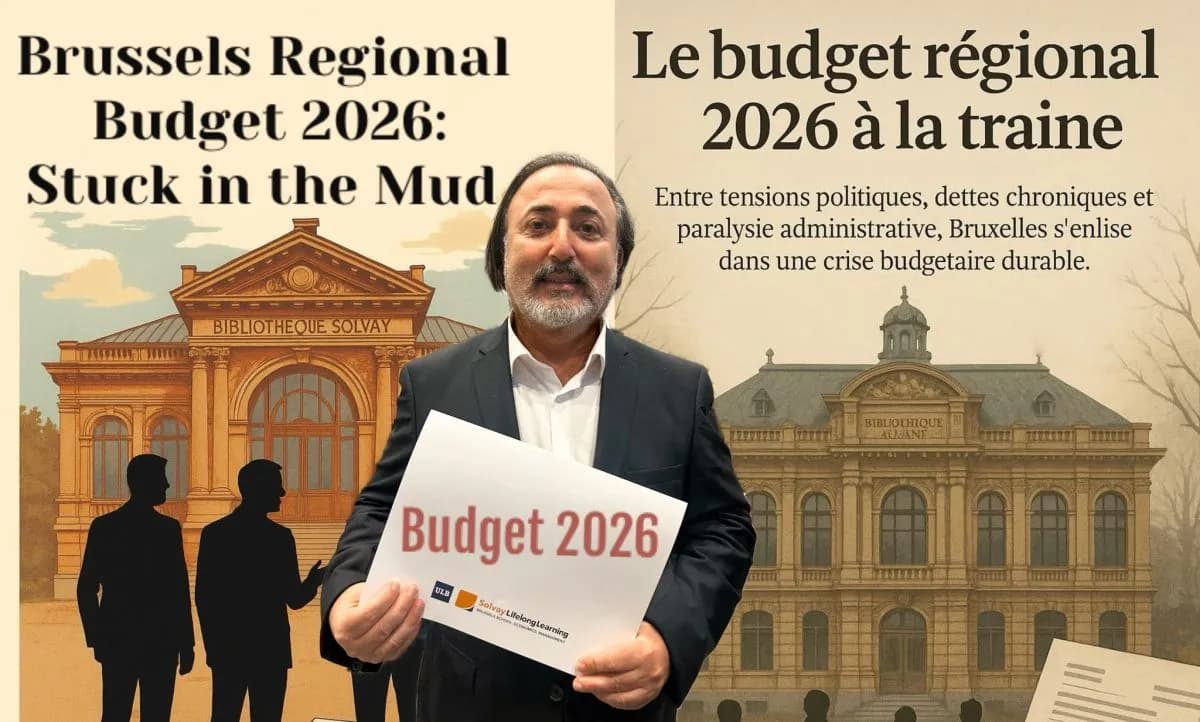
Brussels Regional Budget 2026: Stuck in the Mud
Regional budget talks are paralyzed by ideological gridlock, risking an estimated €1.5 billion deficit and forcing a spending freeze ("provisional twelfths"). Formateur Leisterh struggles as parties refuse to cut. The consequence: municipal projects stall, social services face underfunding, and Brussels' credibility erodes. Critics warn the capital lacks a coherent vision, living on borrowed time as debt piles up.
€1.2 or €1.5 Billion in the Red?
Brussels: A Capital in Deficit, A Governance in Denial
Editorial – By Kadir Duran, Bruxelles Korner
Brussels is once again living to the rhythm of its crises.
This time, it’s not housing, mobility, or politics setting off alarms — it’s the budget. A billion euros in savings to find, empty coffers, and a political class seemingly surprised by the scale of the hole it has dug.
Negotiations Going Nowhere
The 2026 regional budget talks have stalled into bureaucratic quicksand.
Formateur David Leisterh (MR) has been trying for weeks to reach a deal among the six parties involved, but the discussions increasingly resemble a dialogue between the deaf.
Meetings at the Solvay Library follow one another without any real breakthrough. Between pledges of fiscal discipline and pressure from social groups, each side remains entrenched.
The shared conclusion: Brussels still lacks a credible fiscal trajectory for next year. The deficit — already estimated at €1.5 billion for 2025 — could deepen further if no structural measures are adopted by year’s end.
Real Consequences on the Ground
This is not just an administrative delay. It has tangible impacts.
Municipalities, already squeezed by energy costs and mounting debt, are waiting for regional transfers to launch infrastructure projects and keep social services afloat.
Local CPAS welfare centers fear underfunding in 2026 as requests for aid surge.
Even strategic investments — such as the extension of Metro Line 3 and key STIB transport works — risk being slowed due to financial uncertainty.
Within several administrations, the idea of extending the “provisional twelfths” regime is already being floated — a code word for paralysis and spending freezes.
Such a scenario would further erode Brussels’ credibility with both the federal government and EU institutions, already alarmed by the region’s debt trajectory.
A Capital Without Direction
The sluggish pace of negotiations reveals a deeper malaise: Brussels has lost coherent economic leadership.
Parties bicker over where to cut a billion euros, but few dare ask the real question: why does the Region spend so much?
Administrative layers overlap, social policies duplicate, and operating costs explode.
The 2026 budget was supposed to mark a fiscal turnaround. It risks becoming another exercise in delay — reforms postponed to avoid confrontation.
Leisterh is trying to keep control, but without a clear consensus among PS, Les Engagés, Groen and Open VLD, meaningful reform seems out of reach.
A Capital Living on Credit
Brussels increasingly looks like a capital living on borrowed time and borrowed money.
Fiscal credit, political credit, and even credit of patience are all running out.
Deficits pile up, recovery plans multiply, coalitions crumble.
The rhetoric of “responsibility” no longer suffices , what’s needed is a shock of truth.
The 2026 budget was meant to be a turning point. Instead, it has become the symbol of a Region deferring the inevitable: confronting its own governance model before it collapses under its contradictions.
At the Solvay Library, negotiators come and go in a kind of “ball of illusions.” Everyone preaches responsibility, yet none are willing to make sacrifices.
Formateur David Leisterh (MR), to his credit, is trying to impose order on institutional chaos.
But the truth is harsh: Brussels spends more than it produces, subsidizes more than it reforms, and delays tough decisions year after year.
Community rifts, partisan quarrels, and fragile majorities have frozen the regional machinery.
A Region on the Edge
What’s unfolding at the Solvay Library goes far beyond fiscal arithmetic , it’s the mirror of a governance system on the brink.
Parties cling to rigid ideological lines while the coffers are empty.
Leisterh’s “realistic scenario” of a €1.5 billion deficit is, in reality, an attempt to impose lucidity where denial still reigns.
Without a shared political vision and the courage to say where and how to cut, the coming budget will lack any backbone.
And Brussels capital of Europe will continue to manage its debt like a chronic patient on financial life support.
Behind the figures lies a political truth: Brussels suffers from a deficit of vision.
Parties manage the capital as if it were an electoral budget, not a city in need of rebuilding.
As long as coalition arithmetic outweighs fiscal reality, the so-called “Brussels model” remains a fiction — a European capital unable to assume its local responsibilities.
Political Voices
Clémentine Barzin (MR):
“The 2025 deficit adds €1,295 of debt per resident in the capital — a burden largely carried by a middle class already leaving the city. But there’s still room for optimism,” she said, urging Parliament to show responsibility and rally around a plan to cut €1 billion from the annual deficit between 2026 and 2029.
Moussa Diallo (Les Engagés):
“The absence of a Brussels government more than fifteen months after the elections plunges us into total uncertainty about our future. The consequence is growing public distrust, administrative demotivation, and a loss of confidence from businesses,” he warned.
Zakia Khattabi (Groen):
“Yes, savings will be necessary,” she acknowledged. “But real discipline does not mean blind austerity. If cuts target social, environmental, or educational priorities, they’ll cost us far more tomorrow — in both prosperity and social cohesion.”
Benjamin Dalle (CD&V):
“The budget is the backbone of any government project. Work on it must begin on day one,” he insisted, criticizing his party’s exclusion from the talks. “I find it incomprehensible that the CD&V is left out.”
Alexia Bertrand (Open VLD):
“The budgetary situation in Brussels is catastrophic: a €1.6 billion deficit on an €8 billion budget,” she stated bluntly.
Kadir Duran
Contributing writer at EUReflect.
Follow EUReflect
See more of our reporting on Google
Mark EUReflect as a preferred source and our stories are ranked higher for you in Top Stories, Discover and Google News — and carry a “preferred” badge when they are cited in AI results.
Add EUReflect as a preferred source