G-20 Summit 2025 and Global Challenges
Johannesburg made plain that the agenda of global governance is shifting: development, equity and climate resilience have moved higher up the global list of priorities, driven by the moral and economic urgency felt in the Global South. The summit also revealed a fragile architecture — the G-20 can still produce consensus statements, but the absence of a top leader from a superpower (the U.S.) and other partial delegations changes how that consensus will be implemented and perceived.
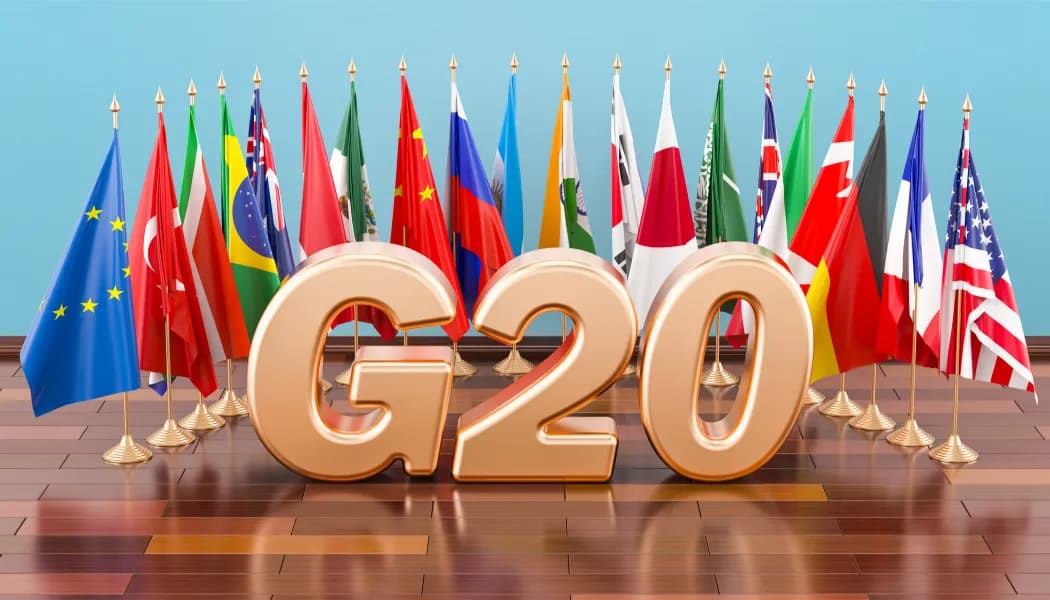
The 2025 G-20 Leaders’ Summit in Johannesburg was a landmark: the first G-20 summit held on African soil and one that foregrounded Global-South priorities — debt relief, climate resilience, inclusive growth and digital governance. The summit produced a joint declaration early in the meeting and signaled momentum for institutional reforms in the international financial architecture. Yet the event was overshadowed by an unprecedented political rupture: the U.S. presidential boycott by Donald Trump, leaving the summit without full participation from two of the world’s largest economies and raising questions about legitimacy and follow-through. The summit mapped ambitious strategic pathways, but implementation will require sustained political will, financing commitments and new mechanisms to translate consensus into action.
Context and significance
Holding the G-20 in Johannesburg was both symbolic and strategic: for the first time in the forum’s history the leaders of the world’s major economies convened on the African continent, amplifying calls to make multilateral governance more representative of the Global South. South Africa’s presidency used the platform to prioritize “solidarity, equality and sustainability” and to spotlight issues — debt sustainability, food security, energy transition and critical minerals — that disproportionately affect developing countries. This host-driven agenda reframed the summit away from a purely macroeconomic or Western-centered conversation and toward development and distributional questions.
At the same time, geopolitical friction was high. Several major leaders either did not attend in person or curtailed participation, and the United States formally boycotted the summit. That political backdrop amplified the stakes: could the G-20 still produce meaningful cooperative outcomes when the two largest economies were not fully engaged at leader level? The answer from Johannesburg was mixed — a substantive leaders’ declaration was adopted, but the absence of the U.S. president (and other top leaders) complicated consensus, optics, and the mechanics of the G-20 presidency handover.
Debt, finance and global equity
Johannesburg’s leaders made explicit commitments on debt sustainability and on making international finance more “inclusive, efficient and representative.” The declaration recognized that debt vulnerabilities constrain low-income countries’ fiscal space and recommended voluntary instruments (e.g., crisis-resilient clauses, liability management) and closer coordination across multilateral development banks to mobilize climate and development finance. This is a substantive pivot: the focus moved beyond exhortation to a more operational conversation about instruments and the interoperability of finance vehicles. However, the declaration’s measures are largely non-binding and will require concrete financing pledges and country-level implementation plans to matter.
Climate, just energy transition and disaster resilience
The summit reiterated strong commitments to the Paris goals and called for mobilizing greater climate finance for adaptation and disaster recovery — with a specific emphasis on bridging the funding gap for energy transitions in developing countries. Johannesburg foregrounded “just energy transition” language, acknowledging national circumstances and the need for finance to enable equitable shiftstoward renewables — a practical emphasis likely to resonate in Africa and other developing regions that both need energy and must decarbonize.
Trade, critical minerals and digital governance
Leaders stressed the WTO’s role and the need for stable trade rules to support development. The summit also elevated critical minerals (for renewables and digital tech) and supply-chain resilience as strategic priorities — a recognition that industrial transitions are geopolitical as well as economic. On digital governance and AI, the G-20 discussed norms to reduce cross-border harms while enabling developing countries to capture value from digitalization; the language signaled willingness to coordinate but not yet to enshrine binding rules. These are arena-shaping debates: without shared technical standards and financing to upgrade local value-chains, supply-chain resilience may remain a declared objective rather than an operational one.
Politics, legitimacy and the Trump absence
Donald Trump’s decision to boycott the Johannesburg summit — and to bar senior officials from substantive participation — was a singular development with both symbolic and practical consequences. The U.S. framed its move on political/diplomatic grounds related to alleged human-rights claims against South Africa; Pretoria rejected those claims and declined to accept a low-level representative as a substitute for the president. The result: no normal ceremonial handover of the G-20 presidency and the first leaders’ summit in which the United States was not meaningfully represented at the top tier.
Strategically, the Trump absence did several things:
Leadership vacuum and influence shift: With the U.S. largely absent from high-level discussions, other powers — notably China, the EU and India — were better positioned to drive outcomes and shape the declaration’s text. Observers flagged this as a potential longer-term shift in agenda-setting power within multilateral fora. Questions of legitimacy vs. substance: Some G-20 members argued that decisions reached without full U.S. participation did not lack practical value — many countries proceeded to adopt a joint declaration — but critics said the absence undermined the G-20’s traditional role as the premier venue for consensus among the world’s largest economies. This tension between legitimacy (who signs) and substance (what is agreed) will shape how external actors respond and whether pledges are implemented.
Risks, fragilities and implementation gaps
Implementation gap: Across debt relief, climate finance and digital rules the common theme is that commitments remain largely declaratory. The Johannesburg declaration contains policy direction and frameworks, but lacks the large, concrete multiyear financing packages and binding institutional changes that would ensure follow-through. The crucial next step is reconciling ambition with budget lines, conditionality and governance mechanisms.
Geopolitical fragmentation risk: The absence of top leaders from major powers, plus notable delegations not led by heads of state, increases the risk that G-20 decisions could fracture into regional or coalition-based implementations — undermining universality and raising transaction costs for global public goods. If China and the EU step into leadership roles, the G-20 may become a forum where blocs advance different governance models, increasing systemic complexity.
Credibility and timing constraints: Some summit priorities (e.g., scaling climate adaptation finance quickly) require time-sensitive action; political cycles, competing national priorities and limited fiscalheadroom make rapid scaling hard.If the follow-up architecture is slow, the gap between promise and impact could erode trust in multilateral processes.
Strategic pathways emerging from Johannesburg
a)Coalition building around implementation vehicles. The Johannesburg text implicitly invited MDBs, climate funds and the private sector to co-finance packages. Operationalizing this requires formal coalitions (e.g., EU-China-African Development Bank working groups) with agreed metrics and disbursal timelines. Without coalitions that share risk and returns, private finance will remain cautious.
b) Normalization of a more plural leadership model. With uneven leader attendance, a more networked approach — where issue coalitions (climate, digital governance, debt) coalesce across like-minded members — is likely to become the practical mode of global governance. That can speed action, but may reduce single-forum legitimacy. Managing that trade-off is central to the G-20’s future relevance.
c)Focus on implementable, small-wins. To preserve credibility, G-20 members should prioritize a small number of measurable, fundable initiatives (e.g., a pilot debt-resilience facility for five African countries; a joint critical-minerals transparency mechanism). These produce visible outcomes and build trust for larger reforms.
d)Newmetrics for legitimacy. As summit attendance patterns shift, legitimacy will be judged less by who sits at the table and more by who implements. Adopting transparent tracking, independent monitoring, and periodic public reporting on progress will keep the G-20 accountable even when consensus is asymmetric.
e) Reinforced multilateral finance architecture. The summit’s emphasis on MDB interoperability points to a pathway for assembling blended finance instruments that combine concessional public funds, guarantees, and private capital — specifically targeted at adaptation, energy transitions and smallholder agriculture. This is feasible only with co-ordinatedcommitments from major donors.
Conclusion — what Johannesburg means going forward
Johannesburg made plain that the agenda of global governance is shifting: development, equity and climate resilience have moved higher up the global list of priorities, driven by the moral and economic urgency felt in the Global South. The summit also revealed a fragile architecture — the G-20 can still produce consensus statements, but the absence of a top leader from a superpower (the U.S.) and other partial delegations changes how that consensus will be implemented and perceived. To convert the summit’s strategic pathways into durable progress requires pragmatic coalitions, measurable pilots, and credible financing vehicles — exactly the kinds of instruments recommended above. If G-20 members follow the actionable steps listed here, Johannesburg can be remembered not just for symbolism, but for launching concrete, measurable advances in inclusive global governance. If not, it risks being a notable diplomatic moment with limited long-term impact.
REFERENCES
https://www.consilium.europa.eu/en/meetings/international-summit/2025/11/22-23/
https://g20.org/track-news/g20-summit-world-leaders-begin-leaving-joburg/
Elbek Qo'chqarov
Contributing writer at EUReflect.
Follow EUReflect
See more of our reporting on Google
Mark EUReflect as a preferred source and our stories are ranked higher for you in Top Stories, Discover and Google News — and carry a “preferred” badge when they are cited in AI results.
Add EUReflect as a preferred source