Malaysia’s Position in the World Economy
Electrical and electronic products made up nearly half of Malaysia's exports in July 2026, with a 51% year-on-year surge in the sector.
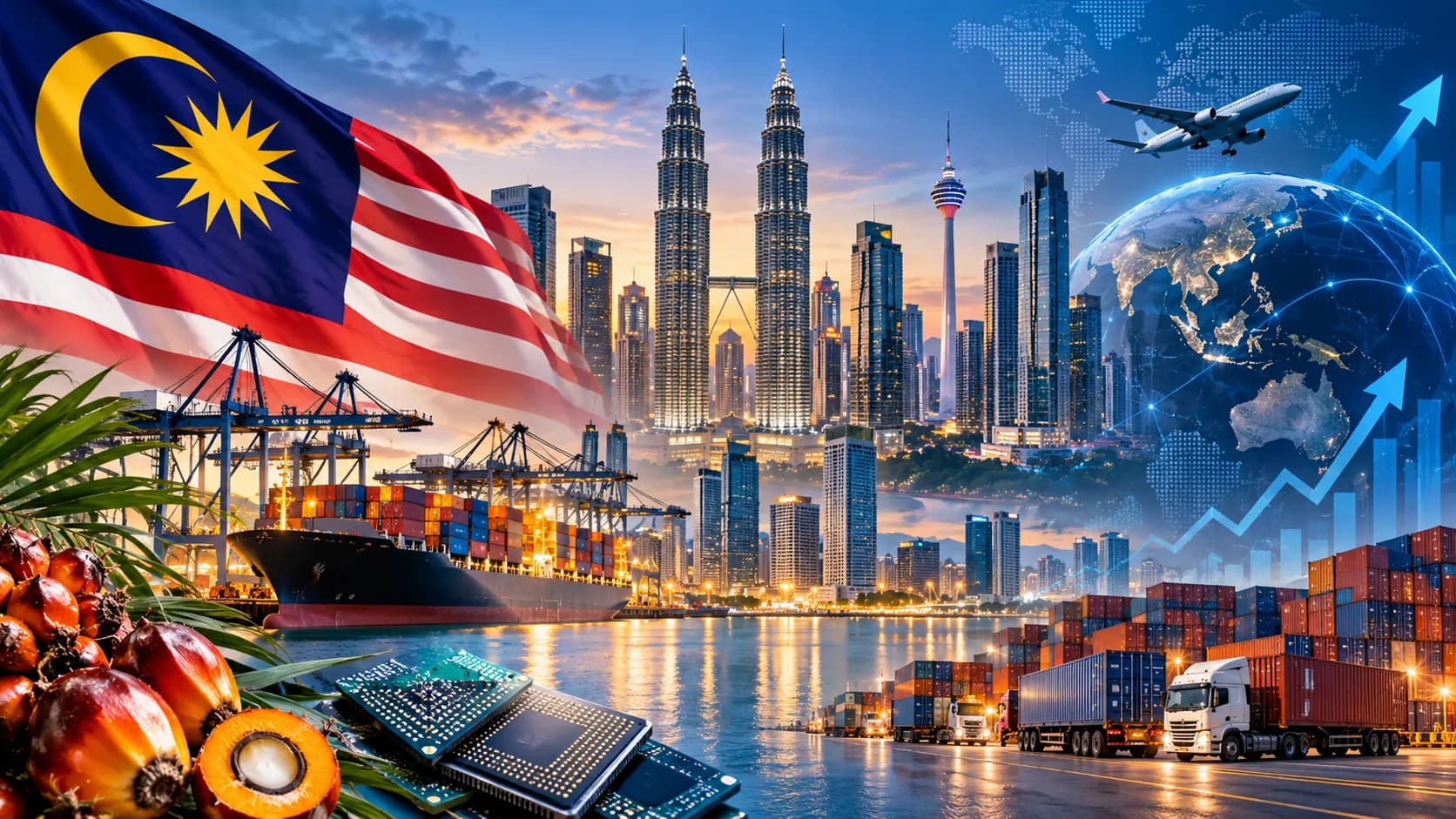
Malaysia is strengthening its position in the global economy in 2026, driven by rapid trade growth, a sophisticated manufacturing base and rising international demand for semiconductors and electronic products.
Although Malaysia remains roughly among the world’s top 40 economies by nominal GDP, its importance in international trade is considerably greater than its economic size alone suggests. The country has developed into one of Southeast Asia’s key manufacturing, technology and trading hubs.
Its strategic position between the South China Sea and the Strait of Malacca also connects Malaysia directly to some of the world’s most important maritime supply chains.
More Than $500 Billion in Trade in Seven Months
Malaysia’s 2026 trade figures demonstrate the scale of this economic model.
During the first seven months of 2026, total merchandise trade reached approximately $529 billion, based on the July exchange-rate benchmark.
Exports amounted to approximately $286 billion, while imports reached about $244 billion. This generated a merchandise trade surplus of roughly $41.8 billion.
In local-currency terms, Malaysia recorded RM2.16 trillion in total trade, RM1.165 trillion in exports and RM994.71 billion in imports during January–July. All reached record levels for the period.
July alone was particularly strong. Malaysia exported approximately $47.5 billion and imported about $42 billion worth of goods during the month.
What Does Malaysia Sell?
The most important feature of Malaysia’s export economy is technology.
Electrical and electronic products — particularly products connected to the semiconductor industry — dominate the country's exports.
In July 2026, Malaysia exported approximately $23.4 billion in electrical and electronic products. They accounted for an extraordinary 49.4% of all Malaysian exports during the month.
Other major July exports included approximately:
Electrical & electronic products: $23.4 billion
Petroleum products: $2.53 billion
Machinery, equipment & parts: $2.37 billion
Optical & scientific equipment: $1.87 billion
Palm oil and related agricultural products: $1.78 billion
Official data show E&E exports increased 51% year-on-year, demonstrating how strongly Malaysia is benefiting from global demand for semiconductors and high-value electronics.
This changes the traditional image of Malaysia as primarily a palm-oil, petroleum and commodity exporter.
Malaysia is increasingly a technology-exporting economy.
What Does Malaysia Buy?
Malaysia’s imports also reveal the industrial structure behind its economic success.
During the first seven months of 2026, approximately $113.5 billion of imports consisted of intermediate goods — components, materials and other inputs required by Malaysian industry.
Capital-goods imports were approximately $32.1 billion, while consumer-goods imports were around $17.5 billion.
Intermediate goods alone represented almost half of imports in July.
This means Malaysia imports enormous quantities of components, industrial equipment and production inputs, adds value through manufacturing and processing, and subsequently exports higher-value products.
The model can be summarised as:
Import components and machinery → manufacture and process → export semiconductors, electronics, machinery and other higher-value products.
China Supplies, America Buys
China plays a central role on the import side.
During January–July 2026, Malaysia imported approximately $64.6 billion worth of goods from China while exporting around $31.3 billion to the Chinese market.
Total Malaysia–China merchandise trade therefore approached $96 billion during the seven-month period.
The United States presents a very different picture.
Malaysia exported approximately $50.6 billion to the US during January–July 2026, while imports from the US were around $18.3 billion.
Most strikingly, Malaysian exports to the United States increased 58.3% year-on-year, largely due to booming demand for electrical and electronic products.
ASEAN remains equally important. Malaysia exported approximately $77 billion to other ASEAN economies during the first seven months of 2026.
The EU also represents a significant market, receiving approximately $22.2 billion in Malaysian exports during the same period.
From Palm Oil to Semiconductors
Perhaps the most important transformation in Malaysia’s economy can be seen by comparing two export industries.
Malaysia remains one of the world's best-known palm oil producers. Yet in July 2026, palm oil and palm oil-based agricultural exports were worth approximately $1.8 billion.
Electrical and electronic exports reached about $23.4 billion in the same month.
In other words, Malaysia exported more than 13 times as much E&E products as palm oil-related agricultural products by value during July.
This is an important indicator of Malaysia's economic transformation.
Palm oil, petroleum and LNG remain strategic industries, but the country's future growth is increasingly connected to semiconductors, electronics, artificial intelligence infrastructure, data centres and advanced manufacturing.
Malaysia’s Global Economic Position
Malaysia is not yet comparable with China, Japan, Germany or the United States in overall GDP size.
But economic influence cannot be measured through GDP alone.
Malaysia combines several strategic advantages: a strong manufacturing base, access to commodities and energy, semiconductor capabilities, developed infrastructure, integration with ASEAN, close commercial ties with China, growing exports to the United States and a strategic geographical position on global shipping routes.
The fact that Malaysia recorded approximately $529 billion in merchandise trade in only the first seven months of 2026 illustrates the international orientation of its economy.
The country is therefore emerging as something more important than simply a middle-sized Southeast Asian economy.
Malaysia increasingly functions as a manufacturing and technology bridge connecting Asian supply chains, Chinese industrial inputs, American technology demand, European markets and ASEAN economies.
In 2026, that position is becoming one of Malaysia’s most important economic advantages.
Botakoz Unbayeva
Contributing writer at EUReflect.
Follow EUReflect
See more of our reporting on Google
Mark EUReflect as a preferred source and our stories are ranked higher for you in Top Stories, Discover and Google News — and carry a “preferred” badge when they are cited in AI results.
Add EUReflect as a preferred source