China Moves Closer to Europe Through Egypt
Chinese investment in Egypt's Suez Canal corridor is bringing manufacturing and logistics closer to Europe's southern frontier, with bilateral trade reaching $20.7 billion in 2025.
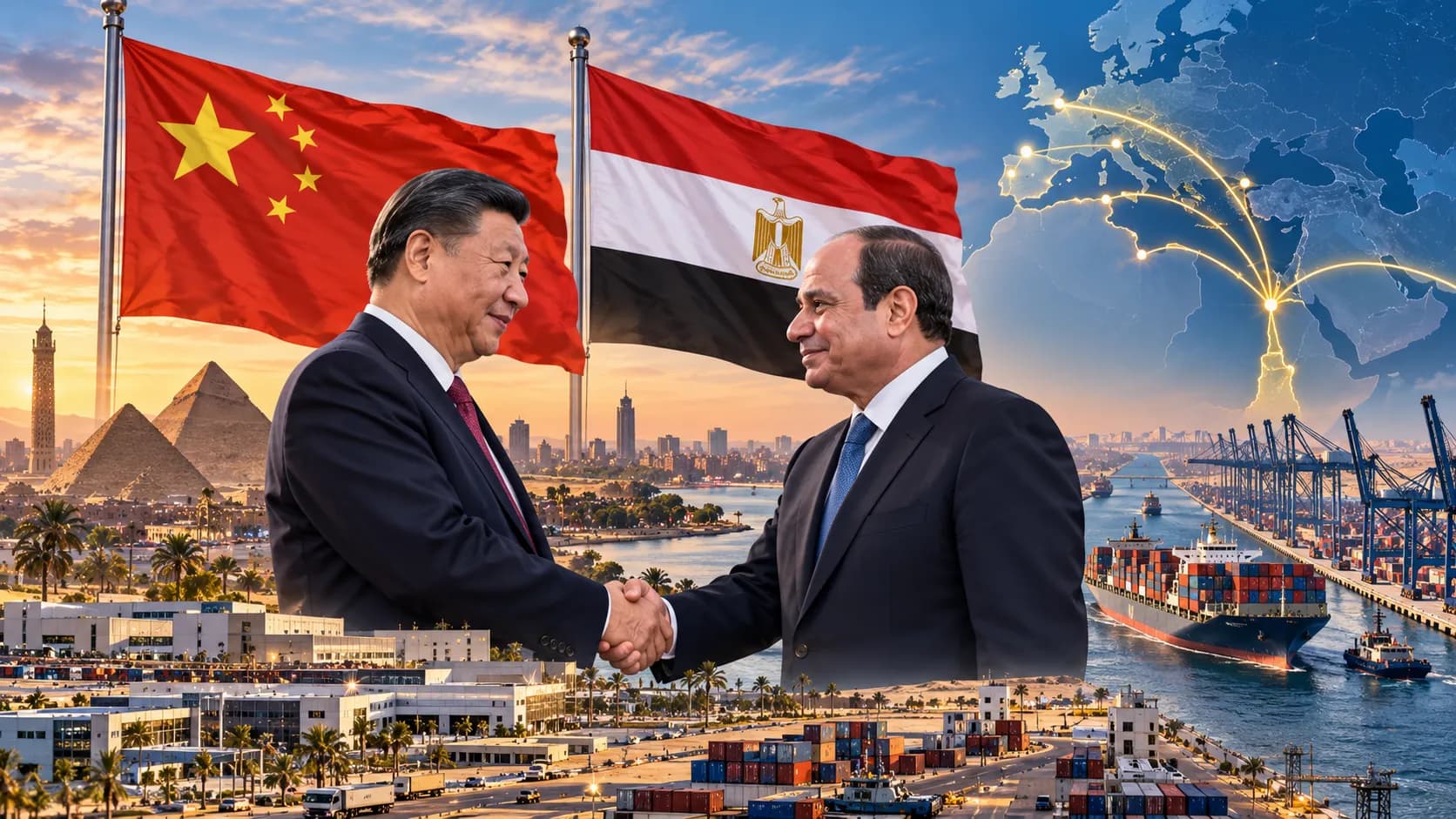
Chinese President Xi Jinping’s state visit to Egypt on 1–2 September 2026 was more than a celebration of 70 years of diplomatic relations. It highlighted how Beijing is steadily expanding its economic and strategic presence along one of the most important corridors connecting Asia, Africa and Europe.
During talks in Cairo, Xi Jinping and Egyptian President Abdel Fattah el-Sisi agreed to further deepen the countries’ Comprehensive Strategic Partnership, with cooperation extending across trade, investment, manufacturing, infrastructure, technology, energy and security.
For Europe, the importance lies largely in geography.
Egypt sits at the gateway to the Suez Canal, one of the principal arteries connecting Asian production centres with European markets. China's expanding industrial presence around this corridor consequently places Chinese companies increasingly close to Europe's southern commercial frontier.
China Builds an Industrial Base Near Europe
China is already Egypt's largest trading partner in non-petroleum goods.
Bilateral trade reached approximately $20.7 billion in 2025, while trade during the first six months of 2026 reached around $11.3 billion. Egyptian exports to China almost tripled to approximately $841 million, while Chinese exports to Egypt reached about $10.4 billion.
But Beijing's strategy increasingly extends beyond selling Chinese products to Egypt.
Chinese companies are investing in local manufacturing, logistics and infrastructure.
The China-Egypt TEDA Cooperation Zone near Ain Sokhna and the Suez Canal has become one of the most visible examples. The zone now hosts hundreds of companies and represents billions of dollars in investment.
Its location is strategically significant.
Goods manufactured around the Suez economic corridor can potentially serve Egypt, African markets, the Middle East and markets across the Mediterranean.
China is therefore not simply exporting to the region. It is increasingly developing production capacity inside the region.
Technology Becomes the Next Stage
The relationship is also expanding beyond traditional infrastructure.
During Xi's visit, Cairo emphasised its desire for greater industrial localisation and technology transfer, while the two governments signed new agreements and memoranda covering investment and industrial development.
Artificial intelligence, advanced manufacturing, electric vehicles, electronics, renewable technologies and digital infrastructure are increasingly appearing within the wider China-Egypt economic agenda.
The shift is important for Europe's competitive environment.
China's economic relationship with Egypt is gradually evolving from infrastructure construction toward a combination of manufacturing + technology + logistics + investment.
The Chinese-built business district in Egypt's New Administrative Capital, transport infrastructure and industrial projects around Suez demonstrate the scale of this expanding footprint.
The Suez Canal Connects the Strategy to Europe
The geographical logic becomes particularly clear when viewed from Europe.
The Suez Canal is the shortest major maritime connection between Asian production networks and European markets.
China's Belt and Road strategy has long prioritised ports, railways, industrial zones and logistics corridors.
Egypt provides something especially valuable within that network: a location connecting the Mediterranean, Red Sea, Middle East and Africa.
As Chinese manufacturing investment expands around Suez, Beijing strengthens its position along a commercial corridor directly connected to Europe.
This does not necessarily mean China is replacing European economic influence in Egypt.
Instead, it demonstrates that Beijing is systematically increasing its presence in regions immediately connected to Europe's supply chains.
Energy Adds Another Dimension
Energy could become another important element.
China and Egypt have identified new energy as an area for deeper cooperation, while Chinese companies have already become active in Egyptian renewable-energy and green-industry projects.
For Beijing, this fits a much larger industrial strategy.
China already possesses enormous manufacturing capacity in solar panels, batteries, electric vehicles and other clean technologies. Egypt, meanwhile, offers renewable-energy potential, industrial land and proximity to both European and African markets.
The combination could eventually make Egypt an increasingly important manufacturing and energy bridge between China and markets surrounding the Mediterranean.
Beyond Economics
Xi's visit also demonstrated that relations are expanding into security.
China and Egypt agreed to strengthen military and security exchanges, while their armed forces have already conducted joint air exercises.
That development adds another dimension to China's presence in a country traditionally connected to Western defence structures.
Yet Beijing's approach remains primarily economic and diplomatic.
Infrastructure creates connectivity. Manufacturing creates long-term economic relationships. Technology creates dependency and integration. Trade provides scale.
Together, these instruments gradually translate economic presence into strategic influence.
China Is Moving Westward
Xi Jinping's Cairo visit therefore matters far beyond bilateral China-Egypt relations.
Egypt gives China access to three strategically important spaces simultaneously: Africa, the Middle East and the Mediterranean.
Beyond the Mediterranean lies Europe.
The emerging picture is not necessarily one of confrontation between China and Europe. Instead, it reflects a gradual geographical convergence.
China's economic networks are moving westward through Central Asia, the Gulf, Africa and now increasingly through industrial and logistics hubs surrounding the Mediterranean.
Egypt could become one of the most important nodes in that network.
For Europe, the development creates a new economic reality on its southern horizon: Chinese capital, manufacturing capacity, technology and infrastructure are moving progressively closer to European markets.
Xi's visit to Cairo illustrates the broader transformation.
China is not waiting for global economic geography to change. It is actively building the routes, factories and partnerships that could shape it.
Alvara Merrick
Contributing writer at EUReflect.
Follow EUReflect
See more of our reporting on Google
Mark EUReflect as a preferred source and our stories are ranked higher for you in Top Stories, Discover and Google News — and carry a “preferred” badge when they are cited in AI results.
Add EUReflect as a preferred source