Historic Record in Global Military Spending
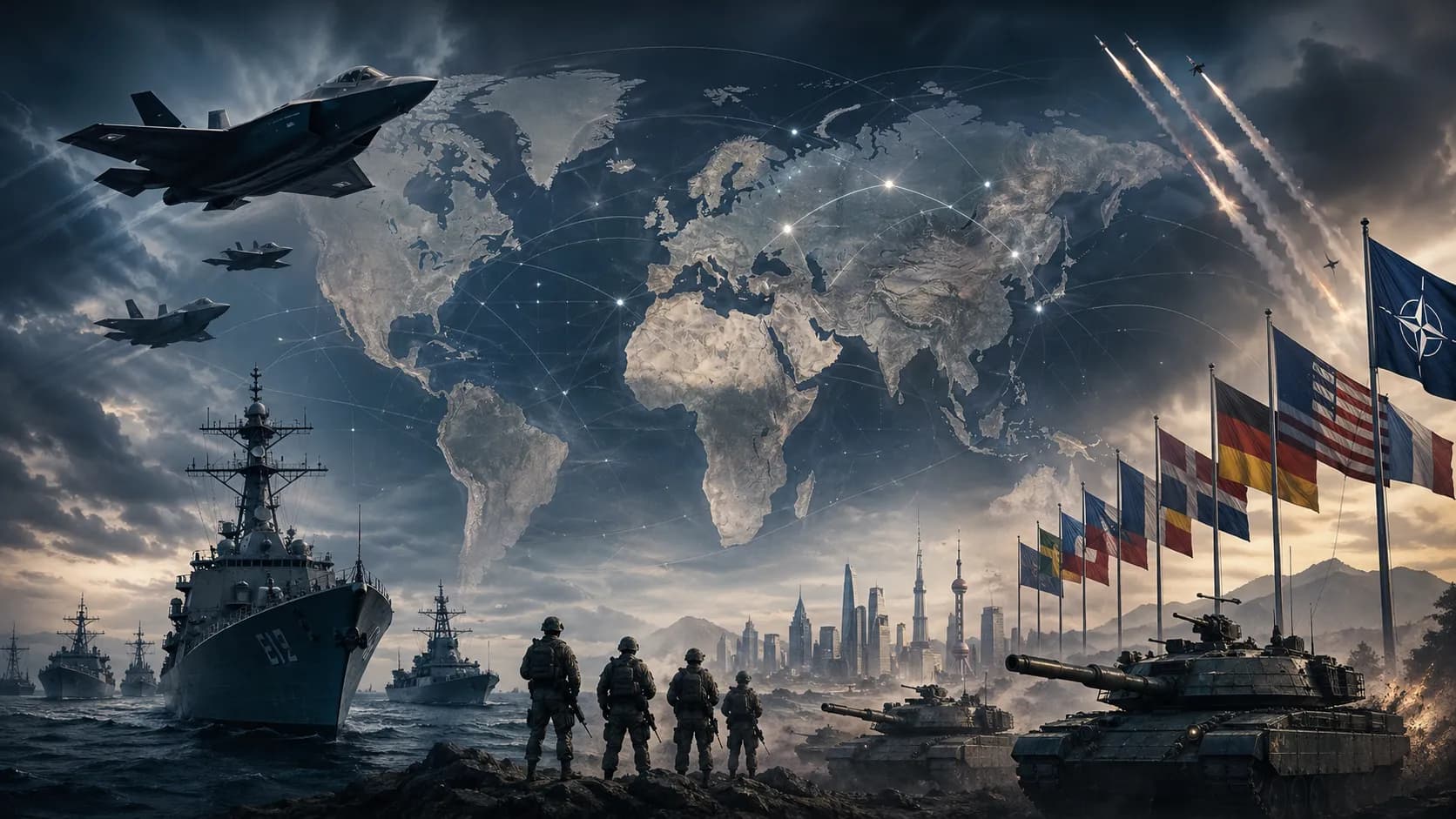
Global military spending hit a record $2.9 trillion in 2025. Europe led growth through rearmament, Asia-Pacific spending rose amid China tensions, and the Russia-Ukraine war sustained high budgets. Defense competition and strategic uncertainty continue to shape global security dynamics.
Introduction
Global military expenditure reached an unprecedented level of approximately $2.9 trillion in 2025, according to data published by the Stockholm International Peace Research Institute (SIPRI). This represents the eleventh consecutive year of sustained growth in global defense spending, reflecting a structural shift in the international security environment rather than a cyclical fluctuation. The trend is driven by intensifying geopolitical rivalry among major powers, the proliferation of regional conflicts, and the gradual erosion of post-Cold War security assumptions.
From an international security perspective, this development signals the re-emergence of hard security logic as a dominant factor in state behavior. Strategic competition between major powers, especially in Europe, the Indo-Pacific, and Eurasia, is reshaping defense doctrines, alliance structures, and military modernization priorities. The global security architecture is increasingly characterized by deterrence-based strategies, rapid militarization, and declining confidence in multilateral risk-reduction mechanisms.
1. European Rearmament and the Structural Transformation of NATO
Europe emerged as the principal driver of global military expenditure growth in 2025. Total defense spending across the continent increased by 14% to $864 billion, the highest level ever recorded by SIPRI. Among NATO’s European members, this represents the fastest rate of increase since the early Cold War period, specifically 1953, highlighting a profound strategic reorientation.
This surge is closely linked to the ongoing war in Ukraine, perceived Russian assertiveness, and heightened uncertainty over long-term U.S. security guarantees. Germany’s defense spending rose by 24% to $114 billion, surpassing the 2% of GDP NATO benchmark for the first time since reunification in 1990. More importantly, Berlin’s commitment to reaching 3.5% of GDP by 2029 indicates a structural shift away from post-Cold War restraint toward sustained military expansion.
Similarly, Spain increased its defense budget by 50% to $40.2 billion, crossing the symbolic 2% threshold for the first time since 1994. Poland’s allocation of 4.5% of GDP to defense represents the highest military burden within NATO, underscoring the centrality of deterrence against Russia in Eastern European security thinking.
At the systemic level, NATO’s total spending reached $1.581 trillion, accounting for 55% of global military expenditure. However, the alliance’s evolving methodology—particularly the inclusion of loosely defined “security-related” expenditures—raises concerns regarding comparability, transparency, and the potential inflation of defense figures for political signaling purposes.
2. Strategic Competition and Militarization in the Asia-Pacific
The Asia-Pacific region recorded an 8.1% increase in military expenditure, reaching $681 billion in 2025, marking the sharpest regional rise since 2009. This reflects an accelerating security dilemma driven primarily by China’s sustained military modernization and the corresponding balancing responses of neighboring states.
China’s defense budget increased by 7.4% to approximately $336 billion, marking its 31st consecutive year of growth. This long-term trajectory underscores China’s transition from regional power consolidation to global strategic competition, particularly in maritime domains and advanced military technologies. The absence of transparency in Chinese defense accounting further contributes to regional uncertainty and arms competition.
Taiwan’s 14% increase in military spending to $18.2 billion reflects growing deterrence concerns amid intensified Chinese military exercises and coercive signaling around the Taiwan Strait. Japan’s defense expenditure reached $62.2 billion, or 1.4% of GDP, the highest level since 1958. This marks a significant departure from Japan’s post-World War II pacifist defense posture and reflects its evolving role as a frontline security actor in the Indo-Pacific.
Collectively, these trends indicate a classic security dilemma dynamic, where defensive measures by one actor are perceived as offensive threats by others, thereby generating a self-reinforcing cycle of militarization.
3. The Russia–Ukraine War and the Redistribution of Global Security Burdens
The ongoing Russia–Ukraine war remains one of the most significant drivers of global military expenditure. Russia allocated approximately $190 billion to defense in 2025, equivalent to 7.5% of GDP and 20% of total government expenditure. This level of militarization indicates a wartime economic structure increasingly dependent on sustained defense production and resource mobilization.
Ukraine’s defense spending reached $84.1 billion, representing an extraordinary 40% of GDP and 63% of government expenditure. This places Ukraine among the most militarized states in modern history, reflecting the existential nature of the conflict and its full-scale mobilization of national resources.
The United States, by contrast, experienced a 7.5% decline in military spending to $954 billion, primarily due to the absence of new Ukraine-related supplemental appropriations in 2025. However, this decline is widely interpreted as temporary, with congressional allocations for subsequent years already signaling a return to upward growth.
Importantly, SIPRI data shows that military spending outside the United States increased by 9.2%, indicating a gradual redistribution of the global security burden away from Washington toward regional and middle powers. This trend suggests an evolving multipolar security structure, in which defense responsibilities are becoming more diffuse and less centralized.
Conclusion
The 2025 global military expenditure data reflect a clear transformation in the structure of international security. Rather than a temporary increase in defense budgets, the trend indicates a systemic shift toward sustained militarization, driven by great-power rivalry, regional conflicts, and declining trust in collective security mechanisms.
Europe’s rearmament, the intensification of strategic competition in the Asia-Pacific, and the prolonged Russia–Ukraine war collectively reinforce a global environment characterized by persistent insecurity and strategic uncertainty. While the United States remains the dominant military actor, the redistribution of defense spending toward other regions suggests a gradual movement toward a more multipolar security order.
In this context, military expenditure is no longer merely a measure of defense capacity, but a key indicator of geopolitical alignment, strategic intent, and the evolving architecture of global power.
Alvara Merrick
Contributing writer at EUReflect.
Follow EUReflect
See more of our reporting on Google
Mark EUReflect as a preferred source and our stories are ranked higher for you in Top Stories, Discover and Google News — and carry a “preferred” badge when they are cited in AI results.
Add EUReflect as a preferred source