Kashmir Tensions Rise Again
Pakistan summoned the U.S. chargé d'affaires after remarks describing Kashmir as part of India, while New Delhi rejects third-party mediation.
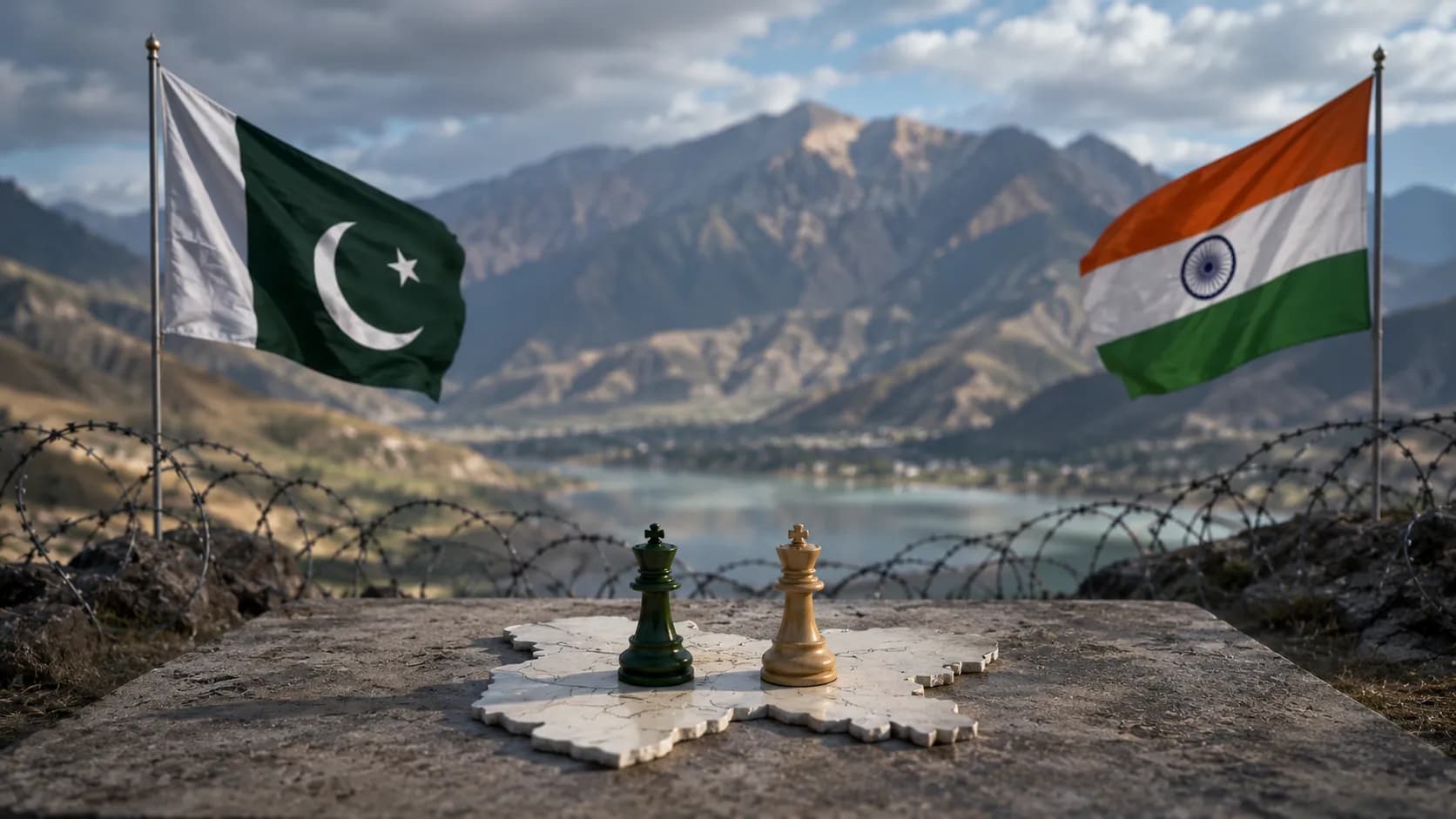
Tensions between nuclear-armed India and Pakistan are again intensifying around Kashmir, with disputes over territory, terrorism, water and international mediation increasingly overlapping.
More than a year after the two countries experienced their most serious military confrontation in years, the ceasefire reached in May 2025 continues to prevent another large-scale clash. But developments in August 2026 suggest that the political foundations of the India-Pakistan relationship remain extremely fragile.
The most important change is that the Kashmir dispute is no longer only about territory. Water security, militancy and competing diplomatic narratives are becoming part of the same confrontation.
Kashmir Returns to Diplomacy
A new diplomatic dispute emerged this month after comments by the U.S. ambassador to India concerning Jammu and Kashmir.
Pakistan summoned the U.S. chargé d'affaires in Islamabad on August 19 and formally protested against language describing Jammu and Kashmir as part of India. Islamabad insisted that Kashmir remains an internationally disputed territory whose final status has not been resolved.
India takes the opposite position. New Delhi considers Jammu and Kashmir an integral part of India and consistently rejects third-party mediation, arguing that outstanding issues with Pakistan should be handled bilaterally.
This disagreement explains why even diplomatic terminology surrounding Kashmir can generate tensions between the two countries.
Water Becomes the New Front
The most dangerous new dimension may be water.
India's decision to hold the Indus Waters Treaty in abeyance following the 2025 crisis has transformed a technical water-sharing agreement into a major national-security issue.
The treaty, signed in 1960, survived wars and decades of confrontation between India and Pakistan. Its weakening therefore represents an important break with the mechanisms that previously helped insulate water cooperation from political conflict.
Pakistan has responded with increasingly strong warnings.
Prime Minister Shehbaz Sharif recently described Pakistan's water rights as a “red line,” while Planning Minister Ahsan Iqbal argued on August 25 that India's action had effectively introduced the “weaponization” of water into the bilateral confrontation.
For Pakistan, the issue is particularly sensitive because the Indus river system is fundamental to agriculture, food production and water security.
The danger is that a territorial dispute that has already produced several wars could increasingly become connected to competition over one of South Asia's most strategically important natural resources.
Militancy Keeps Security Pressure High
Security concerns are simultaneously increasing inside India.
Indian Home Minister Amit Shah said this month that security agencies had arrested more than 200 suspected operatives connected to what New Delhi described as a Pakistan-backed network and had prevented potential attacks ahead of India's Independence Day.
Indian authorities said weapons, grenades and explosives were recovered during operations across 14 states. Pakistan has historically denied Indian accusations that it sponsors militant organizations conducting attacks inside India.
These accusations remain particularly dangerous because militant attacks in Kashmir have repeatedly triggered interstate crises.
The April 2025 attack that killed 26 tourists in Indian-administered Kashmir was followed by a four-day military confrontation between India and Pakistan before a ceasefire was established.
Another major attack could therefore rapidly transform political tensions into military escalation.
The UN Remains Present
The Kashmir dispute also retains an international dimension.
The United Nations Military Observer Group in India and Pakistan, UNMOGIP, continues operating along the Line of Control and the Working Boundary. Its mandate includes observing developments affecting the ceasefire and investigating alleged ceasefire violations when complaints are submitted.
But the two countries fundamentally disagree over the international status of the dispute.
Pakistan regularly refers to UN Security Council resolutions and seeks greater international involvement. Its diplomatic representative in New Delhi again raised Kashmir and UN resolutions during Pakistan's Independence Day events this month.
India, by contrast, strongly resists efforts to internationalize Kashmir and favors direct bilateral engagement.
That difference significantly limits the possibility of an internationally mediated settlement.
A Crisis With Several Fronts
The current India-Pakistan tension is therefore more complicated than the traditional territorial confrontation over Kashmir.
Four issues are increasingly interacting:
Kashmir's political status, cross-border militancy, the Indus water system and competing efforts to shape international diplomacy.
Each issue can intensify the others.
A militant attack can produce military retaliation. Military confrontation can undermine water cooperation. Water pressure can increase political hostility. International statements on Kashmir can then create new diplomatic disputes.
The ceasefire currently provides an important barrier against escalation, but it does not resolve these underlying problems.
For two nuclear-armed states, that distinction matters.
The immediate danger is not necessarily that India and Pakistan are preparing for another war. It is that Kashmir now sits at the center of several interconnected disputes capable of turning a single incident into a much larger regional crisis.
Ahmet Balakan
Contributing writer at EUReflect.
Follow EUReflect
See more of our reporting on Google
Mark EUReflect as a preferred source and our stories are ranked higher for you in Top Stories, Discover and Google News — and carry a “preferred” badge when they are cited in AI results.
Add EUReflect as a preferred source