Kazakhstan at the Crossroads: Can It Become a True Eurasian Logistics Hub?
Kazakhstan is investing in major road, rail, and port projects to strengthen the Middle Corridor and become a leading Eurasian logistics hub. Success will depend on infrastructure delivery, regional cooperation, digitalization, and overcoming environmental and geopolitical challenges by 2029.
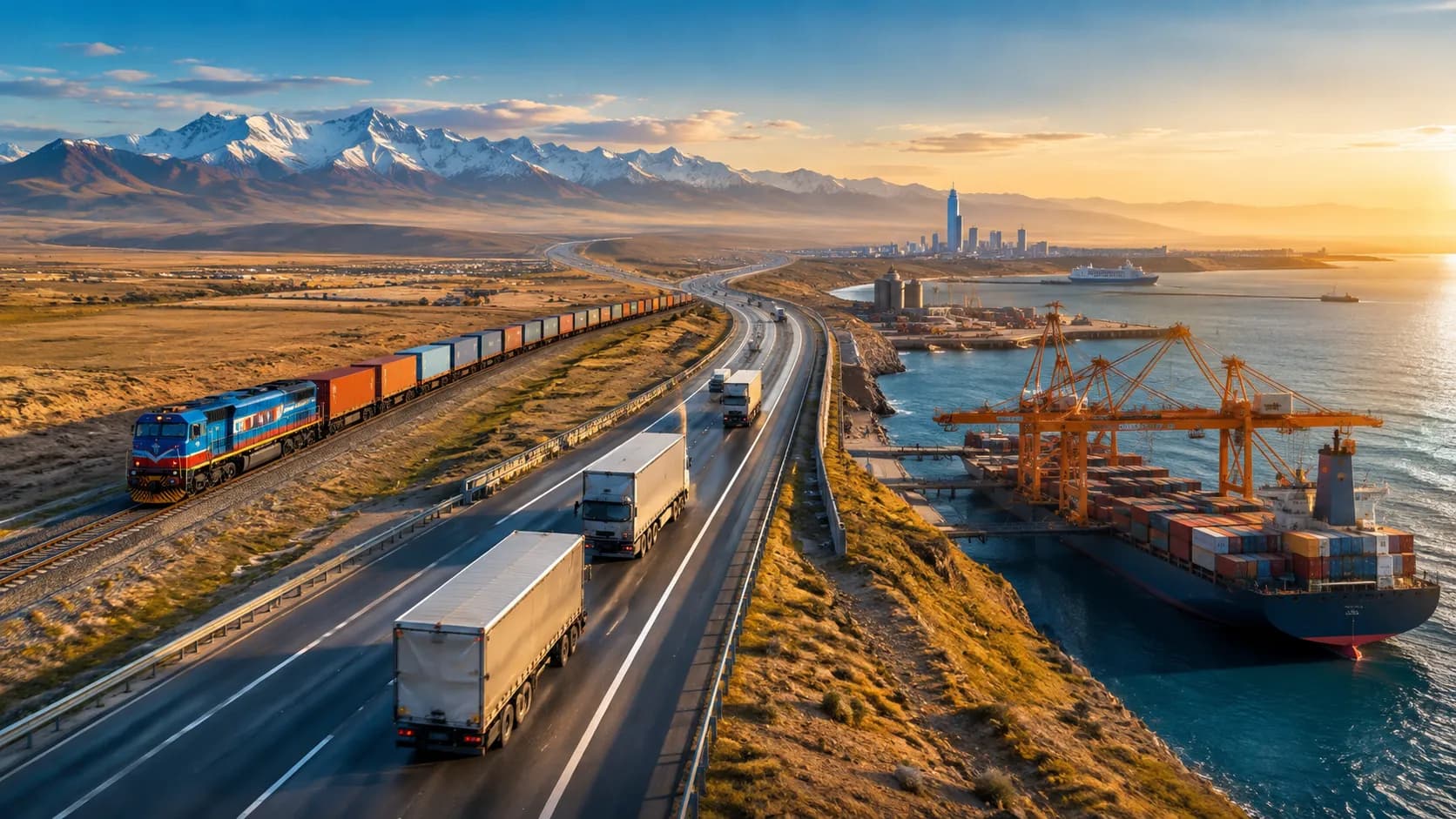
In August 2026, talk of Kazakhstan’s geographic position is no longer a conventional description. President Kassym-Jomart Tokayev launched three strategic road projects, the most prominent of which is the Beineu–Saksaulsk highway, which he proposed naming the “Aral–Caspian Highway.” Together with the expansion of the Kyzylorda–Saksaulsk and Ulgaysyn–Saksaulsk roads, the projects stretch more than 1,500 kilometers and will directly connect border crossings with China to the Caspian ports of Aktau and Kuryk. The announced outcomes are clear: roughly 1,000 kilometers cut from the China–Europe freight distance, delivery times shortened by up to three days, annual freight volumes rising 2.5-fold to 13.2 million tons by 2029, and more than 10,000 jobs for local companies.
These are not merely infrastructure projects. They represent a serious attempt to transform Kazakhstan from a transit corridor into an active logistics hub in Eurasia. The real question is no longer “Will the roads be built?” but “Does Kazakhstan have the capacity to build a system capable of sustainable competition?”
Geography Turns into Numbers: What Lies Behind the Aral–Caspian Highway
The new roads fill an important land gap by facilitating east–west movement within Kazakhstan itself, after historical networks had long favored a north–south orientation. They complement rather than replace the railways. Progress continues on lines such as Moyynty–Kyzylzhar and Darbaza–Maktaaral (expected this year) and Bakhty–Ayagoz (2027), while capacity expansions proceed at Aktau and Kuryk. Road transport has already doubled in five years, with revenues approaching those of the railways—evidence that the sector has become a genuine growth driver.
The Middle Corridor: Forced Alternative or Sustainable Choice?
The Middle Corridor (TITR) is no longer secondary. After the war in Ukraine and Western sanctions on Russia, global companies shifted away from the Northern Corridor. Volumes rose from under one million tons a few years ago to around 4.1–4.5 million tons in 2024–2025, with containers reaching approximately 77,000 TEU in 2025. The target is 300,000 TEU by 2029.
Its decisive competitive edge is time. Shipments can reach Europe in roughly 15–18 days (sometimes cited in the 12–25-day range depending on the segment), compared with 35–60 days by sea via Suez or the longer Cape of Good Hope route. For time-sensitive or higher-value cargo, this advantage often outweighs the higher per-unit cost and multimodal complexity.
Yet comparisons remain sobering. The Northern Corridor still carries several times the volume. Maritime routes remain cheaper for bulk. The Middle Corridor suffers from multiple borders and mode changes, port bottlenecks in Kazakhstan, Azerbaijan and Georgia, and coordination challenges.
China supports the route as useful diversification within the Belt and Road framework and has invested in facilities such as the Aktau container hub, while carefully balancing ties with Moscow. Russia views the corridor’s growth warily: it weakens a long-standing source of leverage over east–west overland trade. Moscow responds by deepening the North–South Corridor, expanding bilateral transit with Kazakhstan, and seeking to co-opt rather than openly block Caspian capacity. Turkey, as the western terminus, actively promotes the corridor through bilateral agreements with Astana, trilateral coordination with Azerbaijan and Georgia, and its broader connectivity ambitions. The European Union has elevated the route within its Global Gateway strategy, committing substantial financing—including packages exceeding several hundred million dollars and broader multi-billion-euro frameworks—for roads, railways, ports and digital systems, viewing it as essential for supply-chain resilience and access to critical raw materials.
Nature’s Obstacles and Political Calculations: Challenges Before 2029
The declining level of the Caspian Sea—more than half a meter in five years—has already cut vessel loads to 75–80 percent of capacity at Aktau and Kuryk. Continuous dredging is required: Kuryk has been deepened to 7–8 meters, and major works at Aktau aim for 6–7 meters by the end of 2026. Longer-term adaptation will demand shallow-draft vessels, quay modifications and recurring costs shared with Azerbaijan. These are not temporary inconveniences; they represent structural expenses that must be factored into competitiveness.
Other risks persist. Heavy reliance on Chinese transit volumes means any slowdown in China immediately affects throughput. Regional competition, especially from Uzbekistan, is real. Digitalization and unified customs procedures still require deeper cross-border coordination. Major infrastructure projects in the region frequently face delays or cost overruns.
Two scenarios remain plausible. The optimistic path assumes completion by 2029, successful digitalization, tighter coordination with Azerbaijan, Georgia and Turkey, sustained geopolitical demand for alternatives, and effective management of Caspian constraints. In that case the corridor could surpass ten million tons before the decade ends and become a primary rather than residual option. The cautious path assumes persistent bottlenecks, slower investment, and coordination failures—leaving Kazakhstan an important but not leading hub.
Given the visible political will in Astana, the multi-vector support from China, the EU, Turkey and international lenders, and the concrete progress on roads, rail and ports, the balance of evidence currently tilts toward the more optimistic trajectory—provided execution stays disciplined.
The decisive indicators to watch are actual volumes on the Aral–Caspian route after opening, real end-to-end transit times, utilization rates at Aktau and Kuryk, modernization of customs crossings by 2027, and the ability to attract value-added logistics services beyond pure transit.
Kazakhstan is not merely laying asphalt. It is betting that geography, backed by political determination and diversified partnerships, can reshape Eurasian trade maps. Between today and 2029 the answer will become clear: whether the country converts its position into a lasting competitive advantage or remains primarily a transit corridor on the global map.
Abdul Hamid Hamid Al-Kba
Contributing writer at EUReflect.
Follow EUReflect
See more of our reporting on Google
Mark EUReflect as a preferred source and our stories are ranked higher for you in Top Stories, Discover and Google News — and carry a “preferred” badge when they are cited in AI results.
Add EUReflect as a preferred source