The Great Diversification: Why the World is Moving Away from the Dollar
Written by journalist Hashim Alam. For nearly eighty years, the U.S. dollar has been the undisputed leader of the global economy. Since the 1944 Bretton Woods Agreement, it has served as the world’s primary reserve currency, the default for oil prices, and the "safe haven" during times of crisis. However, the first quarter of the 21st century is witnessing a historic retreat. Recent data from the IMF and central bank reports show that the dollar’s share of global reserves has fallen to its lowest point since the early 1990s.
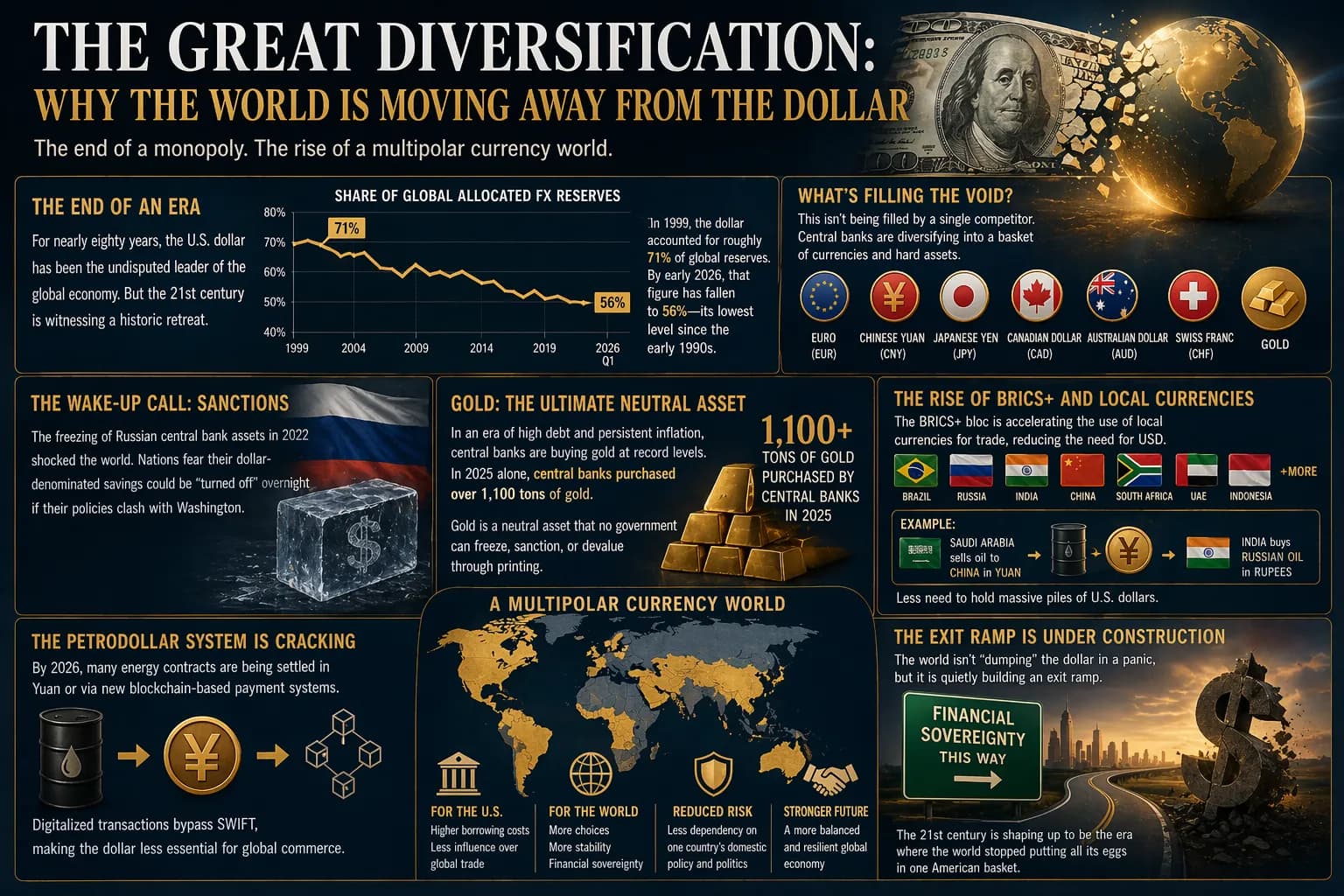
In 1999, the dollar accounted for roughly 71% of the world’s allocated foreign exchange reserves. By early 2026, that figure had drifted toward 56%. While this isn't a sudden collapse, it represents a fundamental rebalancing of how nations store their wealth. This vacuum isn't being filled by a single competitor like the Euro or the Yuan. Instead, central banks are diversifying into a basket of smaller currencies, such as the Canadian dollar, Australian dollar, and Swiss franc, and, most notably, gold.
The frequent use of financial sanctions (such as freezing Russian central bank assets in 2022) has served as a wake-up call for many nations. Countries now fear that if their policies clash with Washington, their dollar-denominated savings could be "turned off" overnight. In an era of high debt and persistent inflation, central banks have become net buyers of gold at record levels. In 2025 alone, central banks purchased over 1,100 tons of gold, viewing it as a neutral asset that no government can freeze or devalue through printing. The rise of the BRICS+ bloc (including China, India, Brazil, and now newcomers like the UAE and Indonesia) has accelerated the use of local currencies for trade. If Saudi Arabia sells oil to China in Yuan, or India buys Russian oil in Rupees, the need to hold massive piles of U.S. dollars diminishes.
The "Petrodollar" system, where oil is sold exclusively in USD, is showing cracks. By 2026, many energy contracts are being settled in Yuan or via new blockchain-based payment systems. Digitalized transactions allow countries to bypass the traditional SWIFT system, making the dollar less essential for day-to-day international commerce.
We are likely moving toward a multipolar currency world. In this new era, the dollar remains the largest single player due to the depth of U.S. financial markets, but it is no longer the only player. For the United States, this trend could mean higher borrowing costs and less influence over global trade. For the rest of the world, it is a move toward "financial sovereignty", an attempt to ensure that no single country's domestic policy can crash the global neighborhood.
The world isn't “dumping” the dollar in a panic, but it is quietly building an exit ramp. The 21st century is shaping up to be the era where the world stopped putting all its eggs in one American basket.
EUReflect News
Site Administrator
Follow EUReflect
See more of our reporting on Google
Mark EUReflect as a preferred source and our stories are ranked higher for you in Top Stories, Discover and Google News — and carry a “preferred” badge when they are cited in AI results.
Add EUReflect as a preferred source