Türkiye and Russia Redefine Syria
Ankara's backing of the SDF dissolution marks a shift from its previous policy of fragmentation, aiming to stabilize Syria's central authority.
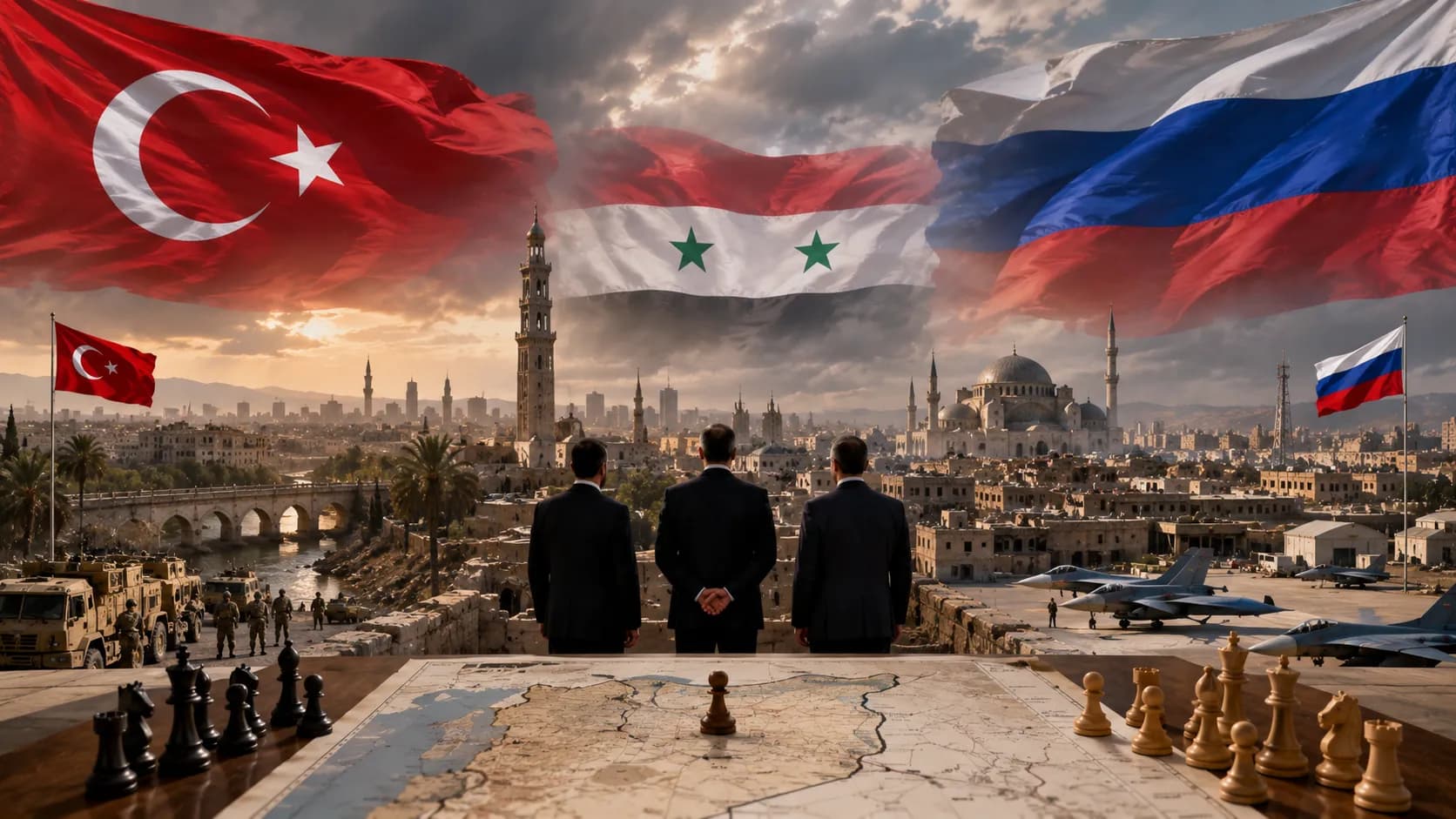
Türkiye and Russia Redefine Syria
Syria’s post-Assad political order is entering a new stage in 2026. President Ahmed al-Sharaa’s government is attempting to restore central authority, rebuild state institutions and diversify its foreign relations after more than a decade of civil war.
Two countries that stood on opposite sides of the Syrian conflict — Türkiye and Russia — are now adapting to this new reality in very different ways.
Türkiye is emerging as one of Damascus’s closest political, economic and security partners. Russia, meanwhile, is trying to preserve part of the strategic influence it accumulated during the Assad era while rebuilding relations with the very forces that once fought against it.
The result is not simply Turkish-Russian competition. Syria is increasingly becoming a test of whether Ankara and Moscow can operate simultaneously within a new regional balance.
Türkiye Moves Closer to Damascus
Türkiye has gained considerable influence since Bashar al-Assad’s government collapsed in December 2024.
Ankara backed Syrian opposition forces during the civil war and has since developed close relations with the new government. Türkiye is helping train Syrian forces, supporting the reconstruction of state institutions and providing political and diplomatic backing to Damascus.
Syrian Foreign Minister Asaad Hassan al-Shaibani described Türkiye last week as a “key partner” in Syria’s reconstruction, highlighting the more than 1,000-kilometre border connecting the two countries.
For Ankara, however, the relationship is about considerably more than reconstruction.
Türkiye wants a stable Syrian government capable of controlling its borders, preventing another migration wave and eliminating armed structures that Ankara considers security threats.
The SDF Question Changes the Equation
The most important recent development came on August 26.
Türkiye welcomed the announced dissolution of the Kurdish-led Syrian Democratic Forces and their integration into Syria’s armed forces under an agreement with Damascus. Ankara has long regarded the SDF as connected to the PKK.
This development could substantially alter Türkiye’s Syria strategy.
For years, one of Ankara’s primary objectives was preventing an autonomous armed structure controlled by the SDF along its southern border. Integration under Damascus potentially strengthens the central Syrian state while addressing one of Türkiye’s central security concerns.
Türkiye nevertheless continues to maintain thousands of troops in northern Syria and says withdrawal will occur only when the security threats it identifies have disappeared.
The emerging Turkish strategy can therefore be summarized as centralization through Damascus rather than fragmentation through competing armed groups.
Russia Chooses Pragmatism
Russia faces an almost opposite situation.
Moscow was Assad’s most important military supporter and its 2015 intervention was critical to keeping his government in power for almost another decade.
Assad’s fall therefore represented a major strategic defeat for Russia.
Yet Moscow has not abandoned Syria.
Instead, Russia has rapidly transformed its policy from defending the Assad government to negotiating with the new Syrian leadership.
On August 9, Damascus and Moscow signed a memorandum restructuring Russia’s presence at the Hmeimim airbase and Tartous naval facility after approximately 18 months of negotiations.
The agreement significantly changes Russia’s position.
Syria will take control of civilian facilities at Hmeimim and the commercial section of Tartous, while military facilities are expected to become joint Syrian-Russian training centers. Some Russian forces will remain.
Russia therefore loses part of the privileged position it enjoyed under Assad but avoids being expelled entirely.
Putin and Sharaa Keep the Door Open
The new relationship became even clearer on August 26 when Putin and Sharaa spoke by telephone.
Both sides emphasized continued political, economic and humanitarian cooperation, while Putin reiterated Russian support for Syria’s sovereignty and territorial integrity. They also discussed implementation of the agreement restructuring Russia’s military facilities.
This represents a remarkable geopolitical adjustment.
Russia spent years conducting military operations against forces associated with Syria’s current rulers. Yet Moscow and Damascus now appear willing to separate those historical hostilities from their current strategic interests.
Damascus needs reconstruction, energy, wheat, investment and international partnerships.
Russia needs access to the Mediterranean and wants to preserve influence in the Middle East and Africa.
Their relationship is consequently becoming increasingly transactional.
Israel Creates a New Turkish Security Problem
The biggest complication for Türkiye may increasingly come from Israel rather than Russia.
Israel continues military operations inside Syria and has expressed concern about Türkiye expanding its military presence there.
The danger became evident on August 18 when Israel struck the Abu al-Dahur airbase in northwestern Syria, relatively close to the Turkish border. Türkiye had not been warned beforehand. U.S. Syria envoy Tom Barrack said Turkish forces could reasonably have prepared a response after observing aircraft approaching their territory.
Washington is now working on a stronger Türkiye–Syria–Israel deconfliction mechanism designed to prevent accidental military confrontation.
This introduces a new strategic dimension.
Türkiye’s expanding influence in Syria increasingly intersects with Israel’s security calculations.
Ankara and Moscow Want Different Things
Türkiye and Russia therefore approach the new Syria from different starting positions.
Türkiye wants consolidation. Ankara benefits from a functioning Syrian central government capable of controlling territory, containing Kurdish armed groups, facilitating refugee returns and creating economic opportunities for reconstruction.
Russia wants preservation. Moscow’s immediate objective is to retain sufficient military and political presence to remain relevant in Syria, the Mediterranean and its wider operations toward Africa.
Yet these objectives are not necessarily incompatible.
Both Türkiye and Russia now publicly support Syria’s territorial integrity. Both want influence in Damascus. Neither currently appears to benefit from another large-scale Syrian civil war.
The difference is that Türkiye enters the new period with increasing influence, while Russia is attempting to protect a reduced but still strategically valuable position.
Syria Is No Longer Anyone’s Client
The most significant transformation may ultimately be taking place in Damascus itself.
The new Syrian government appears reluctant to replace dependence on Russia with dependence on another single power.
Instead, Damascus is developing relations simultaneously with Türkiye, Russia, Gulf states, Western countries and other regional actors.
The reorganization of Russia’s bases illustrates this approach particularly clearly: Syria is reclaiming greater sovereign control while allowing Moscow to retain a limited strategic presence.
This suggests that the emerging Syrian foreign policy will be increasingly multi-directional.
For Türkiye, that means influence without complete dominance.
For Russia, it means accepting that the privileges of the Assad period are over if Moscow wants to remain inside Syria at all.
The new geopolitical contest is therefore not simply about who controls Syria.
It is about who can build the strongest relationship with a Syrian state that increasingly wants to control itself.
Ahmet Balakan
Contributing writer at EUReflect.
Follow EUReflect
See more of our reporting on Google
Mark EUReflect as a preferred source and our stories are ranked higher for you in Top Stories, Discover and Google News — and carry a “preferred” badge when they are cited in AI results.
Add EUReflect as a preferred source