Turkmenistan 2026: High-Stakes Opportunities in a Closed Economy
Turkmenistan, rich in natural gas and cultural assets like the Akhal-Teke horse, is gradually opening its state-led economy to foreign investors. While energy and niche exports offer opportunities, dual exchange rates, internet restrictions, and limited legal independence pose significant investment risks.

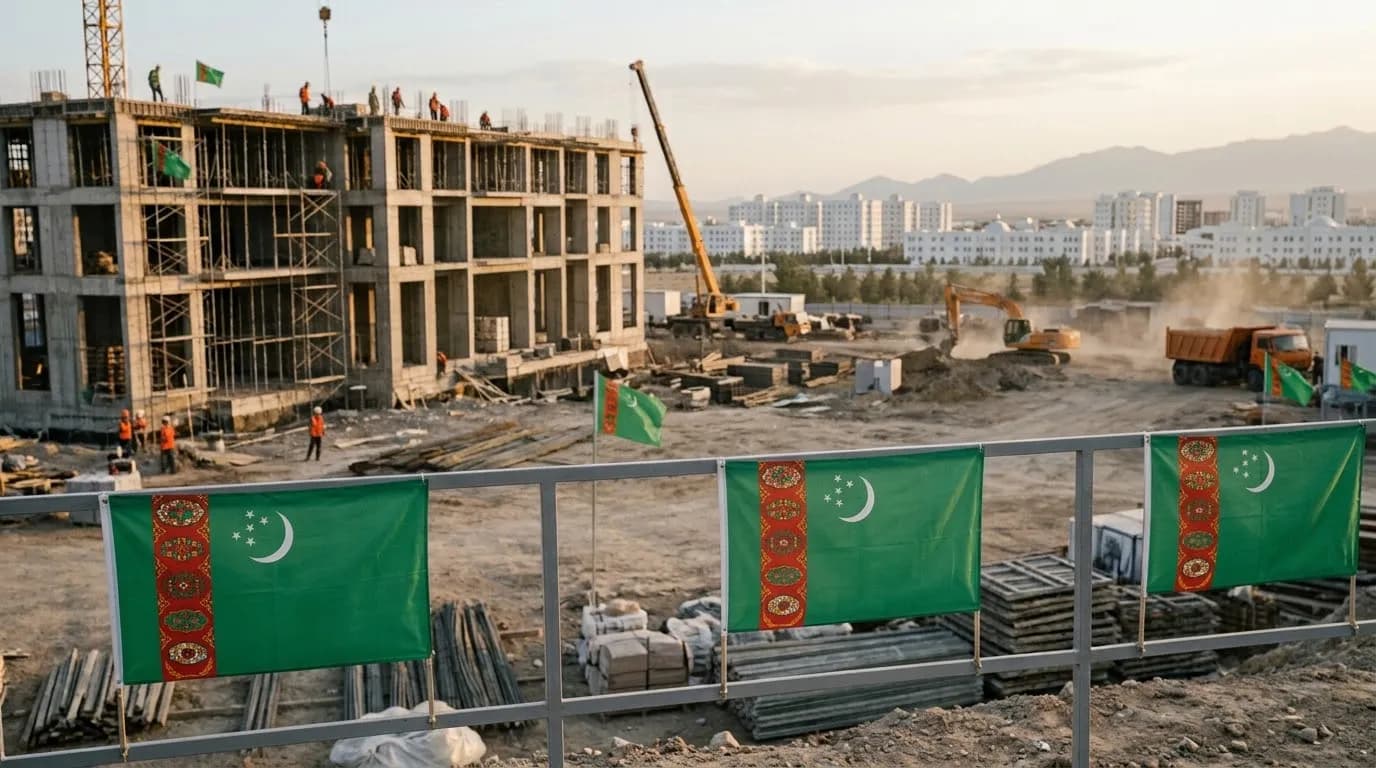
Turkmenistan is among the Central Asian countries attracting global investors, a nation defined by its ‘White Marble’ capital, Ashgabat, and a state-led economic model that is only beginning to open up. To fly into Ashgabat is to enter a city of strong ambition. Row after row of white marble high-rises shine under the Central Asian sun, showing the country’s vast natural gas wealth. But for global investors, Turkmenistan remains a land of large untapped resources, protected by one of the world's most closed regulatory systems.
Turkmenistan’s economic focus begins and ends with energy. Holding roughly 10% of the world’s proven natural gas reserves, the nation has long treated China as its main customer. However, 2026 marks a shift. With the TAPI (Turkmenistan-Afghanistan-Pakistan-India) pipeline finally seeing local operational testing, the government is signaling interest in foreign technical partnerships. Apart from that, the government is also actively seeking expertise in ‘green’ gas processing and carbon capture, offering a good opportunity for firms specializing in the energy transition.
Beyond the heavy industry of the Caspian, Turkmenistan is focusing on its cultural symbol: the Akhal-Teke horse. These ‘Golden Horses’ are known for their metallic shine and strong endurance. They are being positioned as a luxury export, similar to fine art. The government has recently established specialized Equestrian Free Economic Zones to attract European and Middle Eastern breeders. Yet, the industry faces a transparency issue. International buyers often hesitate due to differences between local pedigree records and the World Akhal-Teke Organization (MAAK), an issue that can cut the resale value of a $100,000 stallion by half once it crosses the border. However, for patient investors, fixing this gap represents an early opportunity in a niche market that is just starting to gain international exposure.
Despite being labeled a new "smart city," Arkadag, the internal investment climate still has serious “red flags” that continue to limit Private Foreign Direct Investment (FDI). The biggest issue remains the dual exchange rate. While the official rate is fixed at 3.50 TMT to the Dollar, the black market rate is often 5 to 6 times higher. For businesses, this creates a “profit trap”: you can earn money inside the country, but converting it to USD and sending it abroad is very difficult and often requires high-level political approval. In addition, in an era of AI and instant data, Turkmenistan’s internet remains heavily censored and very slow. For a modern firm, not being able to access standard global cloud services or secure communication tools is often a dealbreaker. Lastly, there is no truly "independent" judiciary by Western standards. Contract disputes are decided by the state, and history shows that in conflicts between foreign firms and state-owned companies, the state rarely loses.
Despite these challenges, the mood in Ashgabat is cautiously optimistic. The country’s move toward WTO accession later this decade is pushing slow but steady modernization of trade laws. We are seeing the start of a model where the state is more willing to trade some control for modernization. The risks are real, but so is the change. As Turkmenistan begins to balance its traditions with modern business, investors who stay patient may find themselves in a very strong position in a market that is still largely untapped.
Hashim Aslam Khan
Contributing writer at EUReflect.
Follow EUReflect
See more of our reporting on Google
Mark EUReflect as a preferred source and our stories are ranked higher for you in Top Stories, Discover and Google News — and carry a “preferred” badge when they are cited in AI results.
Add EUReflect as a preferred source