Turkmenistan’s Hidden Wealth: Salt, Brine, Sulfur, and Sand
Turkmenistan is widely known for natural gas, but its geological wealth extends far beyond hydrocarbons. From potash-bearing evaporite basins and iodine-bromine brines to sulfur from sour-gas processing and quartz-rich sands for glassmaking, the country’s hidden resources reveal a broader industrial story shaped by chemistry, climate, and ancient seas.
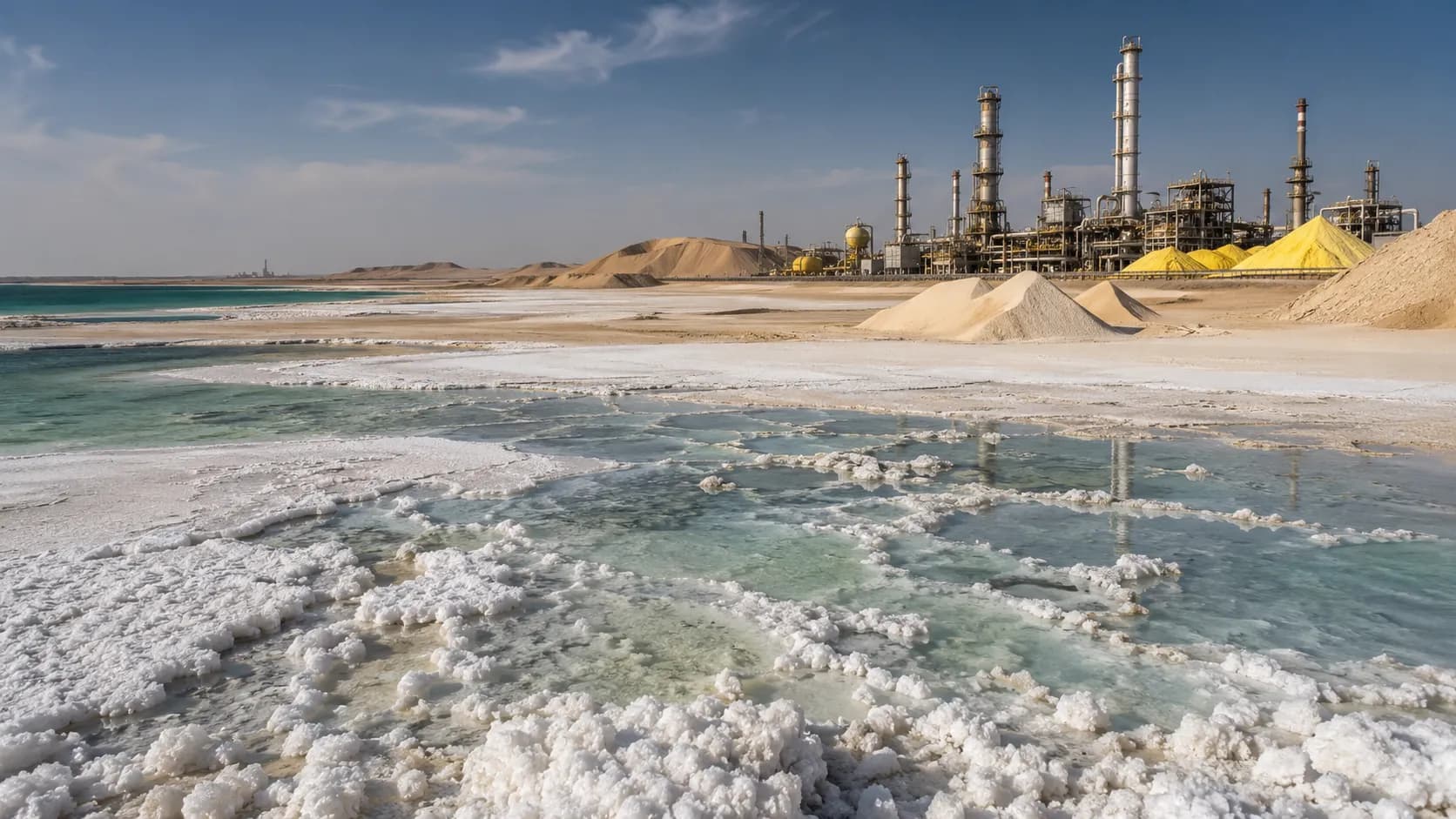
Turkmenistan is known above all for natural gas. But to stop there is to miss a quieter, older, and in some ways more surprising story. When ancient waters evaporate, they leave behind more than scenery. They leave chemistry. They leave salt plains, mineral-rich brines, sulfur, industrial feedstocks, and other resources that can remain important long after individual oil and gas cycles rise and fall. In Turkmenistan, this geology of concentration rather than combustion may be one of the country’s most interesting forms of hidden wealth.
The key idea begins with evaporation. In restricted basins, when inflow is limited and evaporation is intense, dissolved salts become progressively concentrated until minerals begin to precipitate in sequence. This is how evaporite systems form. Potash and related soluble salts were created in such settings, where ancient seawater dried up and left behind salt compounds over geological time. Turkmenistan lies within this broader Central Asian evaporite province, which helps explain why its mineral story includes not only ordinary salt but also potassium-bearing deposits of wider agricultural importance.
Potash is the clearest example of a mineral opportunity rooted in that evaporite history. Undiscovered potash resources were assessed in the Central Asia Salt Basin of Turkmenistan, Uzbekistan, Tajikistan, and Afghanistan as part of a global mineral resource study. Potash matters because potassium is essential to modern agriculture and has no real substitute as a plant nutrient. In recent mineral commodity summaries, potash has also gained greater strategic attention. That does not mean every potash-bearing country immediately becomes a dominant producer, but it does show that evaporite basins now sit at the intersection of food security, industry, and resource strategy.
Turkmenistan’s coastal chemistry adds another dimension: brines rich in iodine and bromine. Both of these elements commonly occur in underground brines associated with petroleum systems and evaporitic environments. That is exactly the kind of geological setting found in parts of western Turkmenistan and along the Caspian margin. In this sense, the country’s resource base includes not only hydrocarbons, but also chemically valuable waters with industrial and export potential.
It is easy to overstate the idea of “hidden wealth” in mineral discussions, especially when international reporting standards vary from one commodity to another. In Turkmenistan’s case, however, the evidence strongly supports the presence of iodine-bromine brines and their industrial relevance. The more careful and accurate point is not that every resource should be presented in headline terms, but that Turkmenistan’s subsurface is more diverse than it is often assumed to be.
Sulfur belongs to a slightly different category. It is not mainly a deposit waiting passively underground, but a by-product of processing sour gas. The Galkynysh gas field produces sour gas and has large gas-treatment and sulfur-handling facilities. Hydrogen sulfide must be removed from sour gas for safety, corrosion control, and commercial use, and that process yields recoverable elemental sulfur. In other words, one of Turkmenistan’s other important resources is created as its flagship gas wealth is prepared for market.
In this context, sulfur-based construction materials, including sulfur concrete and polymer concrete, have attracted attention as promising areas of applied research. They reflect a practical interest in turning sulfur generated during gas purification into a useful industrial resource. The underlying logic is straightforward: when a country processes large volumes of sour gas, sulfur management becomes not only an environmental and technical necessity, but also an opportunity for industrial innovation.
Another understated form of natural wealth lies in Turkmenistan’s quartz-rich sands. Quartz is one of the world’s most useful industrial minerals and is widely used in glass, ceramics, and construction materials. In Turkmenistan, this is not merely a theoretical possibility: the Annau quartz-sand deposit is identified as suitable for glass production, while quartz sands from other deposits have been used in industrial materials and manufacturing. Quartz sand is also a principal raw material for the country’s glass industry, including the Ovadandepe complex. This gives part of Turkmenistan’s desert and sedimentary landscape an added economic meaning: it is not only a geographic feature, but also a source of industrial raw materials.
At the same time, it is worth being precise. Not every desert sand is automatically suitable for high-value industrial use. The economic importance of silica sand depends on factors such as purity, grain size, shape, and low levels of impurities. That is why it is better to speak about specific deposits and proven applications rather than treating all dune sand as equally valuable. In Turkmenistan’s case, the stronger point is that certain quartz-rich sands already have recognized industrial relevance.
Then there is salt itself, which in Turkmenistan is anything but ordinary. Kara-Bogaz-Gol, the highly saline embayment on the eastern Caspian coast, is described as containing the world’s largest deposit of natural marine salts. Its extreme evaporation continuously concentrates dissolved minerals, making it one of the planet’s most striking natural evaporation systems. For Turkmenistan, that means part of its western landscape functions almost like a vast natural chemical concentrator – a place where geology and climate work together over long stretches of time.
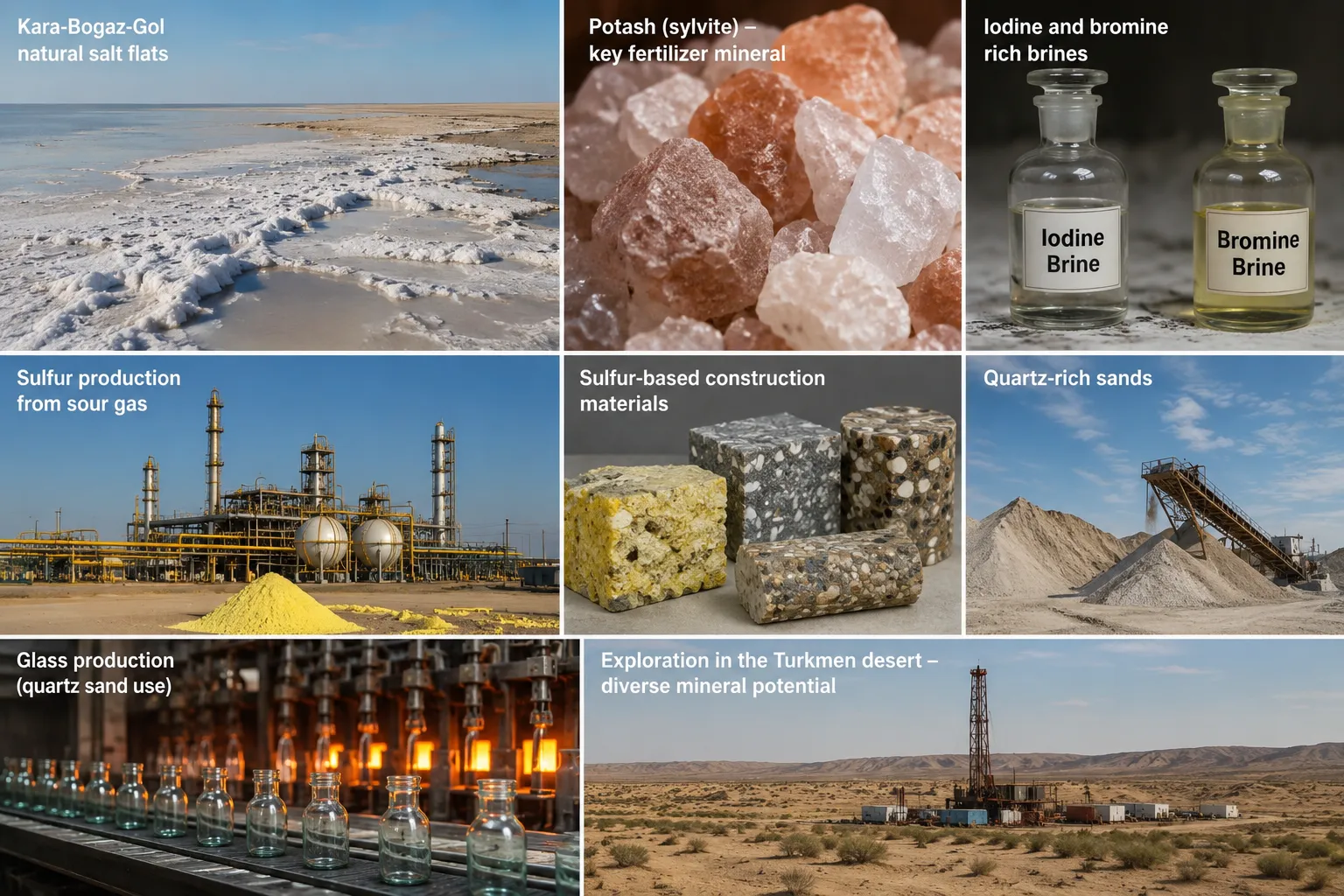
Does all this make Turkmenistan a major critical-raw-materials state in exactly the same way that it is a gas state? Not yet in the fully established, globally documented sense. The answer is more nuanced. Turkmenistan clearly has important non-fuel mineral and chemical assets linked to evaporites, brines, gas processing, and industrial sands. Potash is geologically credible and strategically relevant; iodine and bromine are industrially important; sulfur is directly tied to the country’s gas-processing chain; and quartz-rich sands support domestic industrial production. At the same time, the publicly available evidence is stronger for some commodities than for others, and the step from “resource potential” to “globally decisive producer” should be made carefully.
Even so, the broader strategic trend is moving in Turkmenistan’s favor. Global attention to mineral security has widened well beyond lithium and rare earths to include fertilizer minerals, halogens, industrial chemicals, and supply-chain resilience. In that wider context, the country’s non-hydrocarbon resource base deserves more attention than it often receives.
So the hidden wealth is not hidden because it is uncertain. It is hidden because natural gas has long dominated the conversation. Yet alongside the country’s better-known hydrocarbon resources lies another inheritance: evaporite basins that can host potash, brines that can yield iodine and bromine, coastal systems that concentrate marine salts, sour-gas processing that turns sulfur into a usable industrial material, and quartz-rich sands that support glassmaking and other industries. For a country whose international image is so closely associated with natural gas, this broader perspective is worth emphasizing: Turkmenistan’s geological wealth extends well beyond a single resource.
Hudayberdi Kochumov
Contributing writer at EUReflect.
Follow EUReflect
See more of our reporting on Google
Mark EUReflect as a preferred source and our stories are ranked higher for you in Top Stories, Discover and Google News — and carry a “preferred” badge when they are cited in AI results.
Add EUReflect as a preferred source