Angola: Africa’s Next Tourism Giant
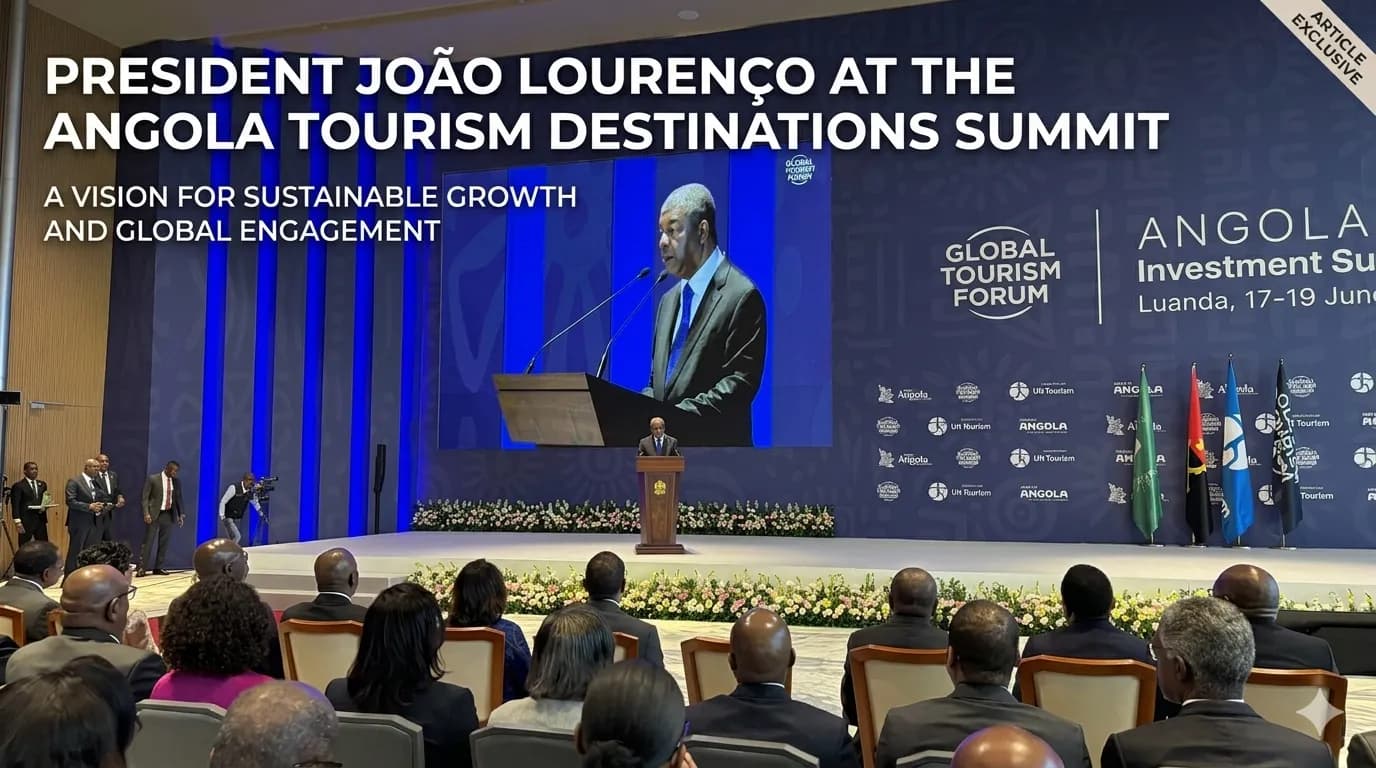
Angola is reducing its dependence on oil by positioning tourism as its new “green oil.” In 2025, tourist arrivals rose by 20–30%, generating $667 million in revenue. Visa-free entry, a new international airport, and major investments are helping make Angola Africa’s fastest-growing tourism destination.
Luanda — While much attention has gone to Angola's headline ambitions, the clearest sign of where the real transformation is happening comes from a modest but striking data point in a desert conservation area in the country's southwest. In Iona National Park, co-managed with the NGO African Parks, tourism activity rose by 80% between 2023 and 2024, and 57% of those visitors were Angolan nationals. Rarely covered in the international press, the figure shows that Angola's tourism boom is not just an export-facing showcase — it is taking root in the domestic market as well. African Parks
Minister of Tourism Márcio Daniel sums up the new strategy with a single metaphor: tourism is now Angola's "green oil." After decades of dependence on petroleum, the economy is pivoting toward a cleaner, more sustainable revenue stream — one that, unlike crude, regenerates rather than depletes. The Washington Informer
What the numbers say
For Angola, 2025 marked a turning point. The country has been recognized as Africa's fastest-growing tourism destination; according to figures presented by Minister Daniel, as reported by the Washington Informer, the nation recorded a roughly 20% increase in international tourist arrivals in 2025, while other industry reports put the rise as high as 30% and place Angola fourth globally among the fastest-growing tourism destinations, with the sector generating 667 million US dollars in revenue in 2025. The Washington InformerTravel And Tour World
Concrete policy moves underpin this momentum. According to Travel Tomorrow, Presidential Decree No. 189/23 introduced visa exemptions for citizens of 98 countries, dramatically easing entry for would-be visitors. On the connectivity front, the new Dr. António Agostinho Neto International Airport is positioned to become a regional aviation hub and relieve pressure on Luanda's aging airport.
The ambition is codified in the national tourism plan, PLANATUR. According to an economic analysis carried by ITB, the government aims to double tourism revenues by 2027, create around 50,000 new jobs, and raise the sector's contribution to GDP to 1.9%. To get there, Breaking Travel News reports that nearly 7 trillion Angolan Kwanza (about €8.23 billion) is being channeled into development and infrastructure projects and into supporting private-sector tourism investment. Separately, Tourism Update notes that the promotion plan has set aside roughly 3 billion US dollars for investment across designated "poles of development." ITB + 2
The private sector is responding. As the Washington Informer reports, Marriott International, IHG Hotels & Resorts, and Accor have all announced or advanced projects in Angola, while a new investment guide developed with UN Tourism, "Tourism Doing Business: Investing in Angola," lays out a pipeline of bankable coastal resorts, eco-lodges, and heritage developments. The Washington Informer
The attractions: a continent's "last places"
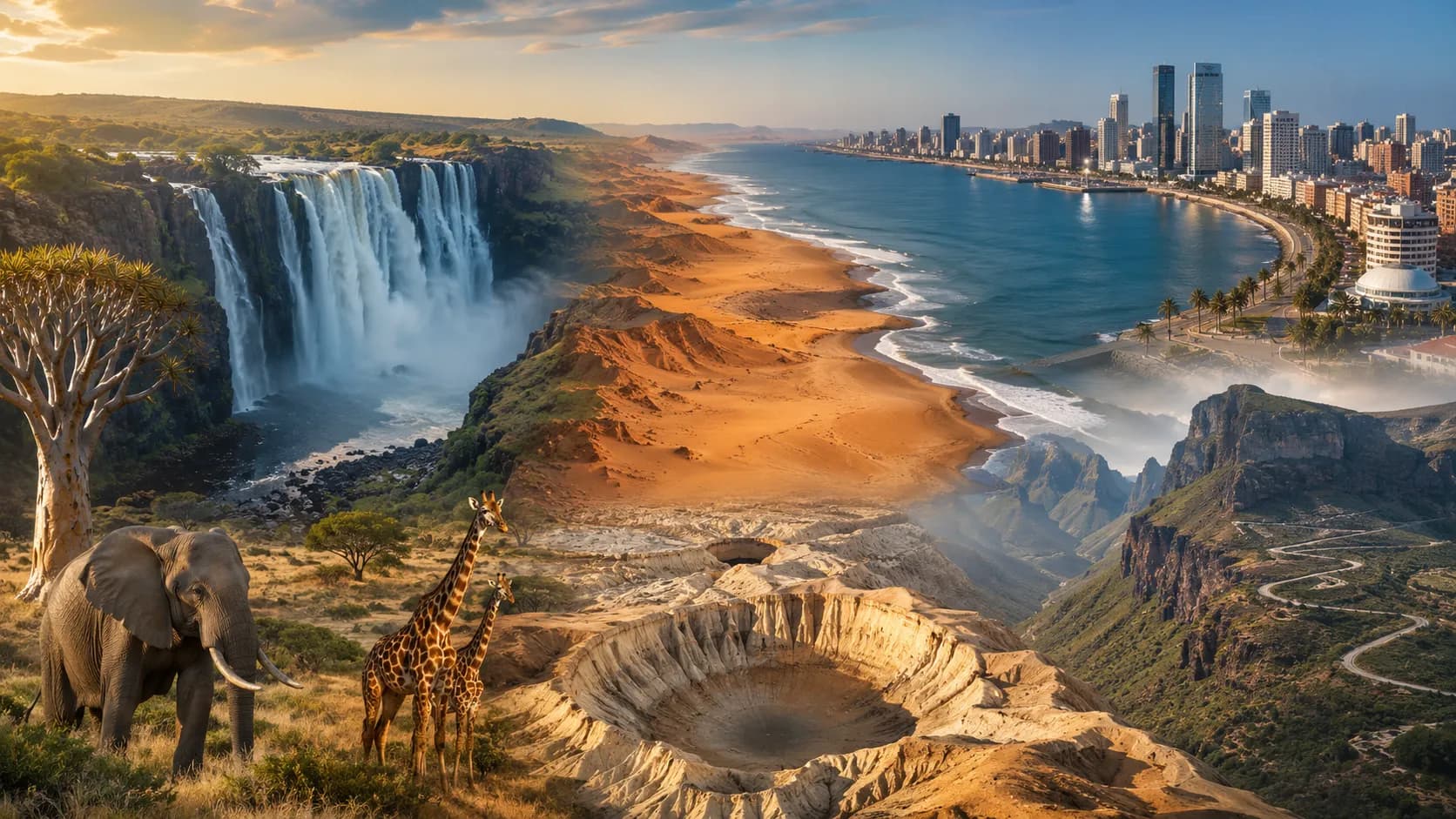
Angola's appeal is unusually varied. In the interior, the Kalandula Falls — among the largest waterfalls in Africa — thunder into mist-filled gorges in Malanje province. To the southwest lies Iona, where the Namib, considered one of the world's oldest deserts, meets the Atlantic. Along the coast, the Mussulo Peninsula's beaches and the lunar craters of the Miradouro da Lua sit within easy reach of Luanda, while inland the Tundavala Gap and the switchbacks of the Serra da Leba draw adventurers to the Huíla highlands. National parks such as Kissama offer elephant sightings, and crucially, as Tourism Update highlights, the Angolan Highlands form a "Water Tower" whose lakes supply 95% of the water flowing into the Okavango Delta — placing Angola at the very source of one of southern Africa's greatest natural wonders. Tourismupdate
These assets are being organized into specific investment zones. Tourism Update reports that planners have identified the Cuando Cubango region — home to the source lakes of the Okavango — as a candidate for ultra-luxury safari investment, Malanje (with Kalandula Falls) for adventure and sightseeing, Namibe and Huíla for desert and cultural tourism, and Benguela on the central coast for cultural and beach tourism. Tourismupdate
Africa-specific analysis
Angola's strongest card is precisely what it lacks: crowds. As the established safari circuits of Kenya, Tanzania, Botswana, and South Africa approach saturation, Angola is positioning itself in the low-density, "last places" segment. Minister Daniel captured this with a memorable image, reported: Angola shares ecosystems and wildlife corridors with neighbors such as Namibia and offers comparable safari and nature experiences, yet remains an insider destination with vast untapped potential.
Three dynamics stand out for the continent. First, governance models: Iona's co-management with African Parks — including the translocation of Angolan giraffes from Namibia in 2023 and 2024 — offers a working template for the public–NGO conservation partnerships spreading across Africa. Second, the strength of the domestic market: with more than half of Iona's visitors being Angolans, intra-continental and domestic tourism act as a buffer against over-reliance on foreign arrivals. Third, multi-country itineraries: Angola's position alongside the southern African safari circuits makes it naturally packageable into regional routes, supporting the kind of cross-border integration that benefits the whole region. The UN Tourism program to strengthen Angola's tourism statistics reinforces the institutional foundations needed to sustain this growth.
World-specific analysis
Globally, the timing works in Angola's favor. Drawing on IPK International's World Travel Monitor, that international travel grew by 4% in 2025, extending the positive momentum of recent years. As travelers in saturated markets increasingly seek authenticity and lesser-visited destinations, Angola is aimed squarely at that gap.
The strategy rests on several pillars. Cultural and linguistic affinity with Lusophone markets — particularly Portugal and Brazil — lowers barriers for European and South American visitors. A growing MICE (meetings, incentives, conferences, and exhibitions) segment, anchored by new convention infrastructure in Luanda, targets high-value business travel. And the entry of global hotel chains signals investor confidence. All of this sits within a broader macroeconomic story: according to IMF-based analysis, Angola posted real GDP growth of 4.4% in 2024 — its strongest in five years — driven largely by the non-oil sector, a structural shift in which tourism plays a central role. ITB
The realistic caveats remain. Infrastructure is developing unevenly, and meeting local demand still poses challenges. But the direction is unmistakable. In a country where oil revenues are set to decline over the long term, tourism has moved to the center of both economic diversification and a refreshed international image — and the "green oil" metaphor is looking less like a slogan and more like a strategy.
Zhansaya Nurlanovna
Contributing writer at EUReflect.
Follow EUReflect
See more of our reporting on Google
Mark EUReflect as a preferred source and our stories are ranked higher for you in Top Stories, Discover and Google News — and carry a “preferred” badge when they are cited in AI results.
Add EUReflect as a preferred source