Belgium Refused to Be Europe’s Parachute
The EU Bought Ukraine at a Discount
The EU Bought Ukraine at a Discount
€90 Billion Without Making Russia Pay: When Europe Pays, and Belgium Says Stop
By Kadir Duran / Bruxelles Korner
Brussels, December 2025
The European Union did not seize Russian assets.
It opened its checkbook.
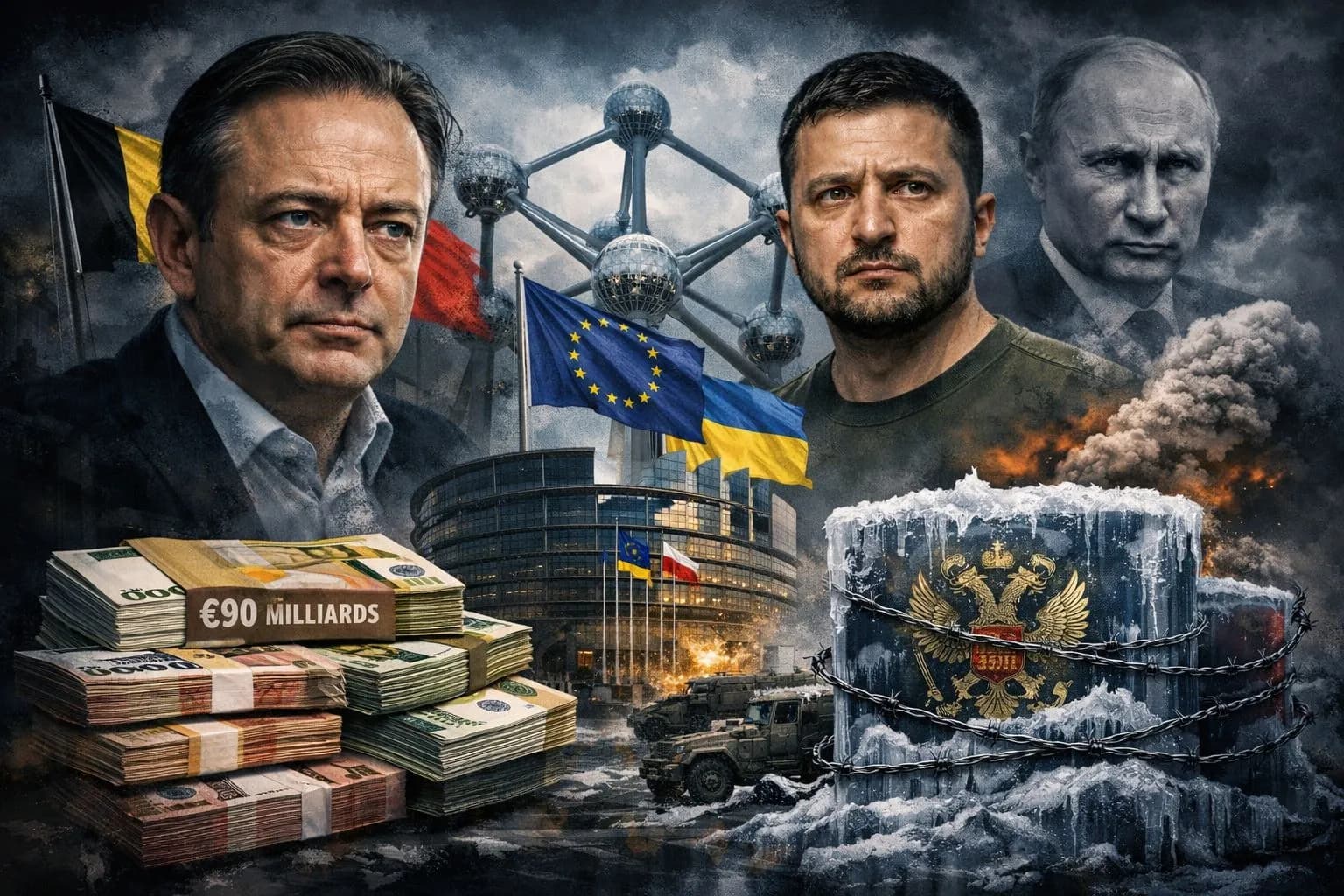
At the end of a tense European summit marked by hours of overnight negotiations, the Twenty-Seven found €90 billion to finance Ukraine over the 2026–2027 period. A colossal sum, vital for Kyiv. But secured without touching the €210 billion in frozen Russian assets, even though those assets are already located on European soil.
The blunt outcome:
Russia does not pay,
Europe pays,
and Ukraine is financed… on credit.
Hence the uncomfortable conclusion no one dares to state officially:
the EU did not make the aggressor pay; it bought Ukraine’s survival at a discount.
€90 Billion for Kyiv, Zero Taken from Moscow
Volodymyr Zelensky did not travel to Brussels for nothing. He leaves with money lots of it. But not with what he had been demanding for months: a strong political signal forcing Vladimir Putin’s Russia to pay directly.
The adopted compromise is clear:
a €90 billion European loan,
at zero interest,
financed through the EU budget,
with no mechanism to confiscate Russian assets.
An emergency solution, certainly.
But also a confession: the European Union prefers to take on debt rather than assume an explosive legal precedent.
The Russian Assets Taboo: Proclaimed Morality, Feared Law
Morally, the argument is straightforward:
Why should European taxpayers finance a war caused by Moscow when hundreds of billions of Russian assets are already frozen in Europe?
Legally and financially, the answer is far less comfortable:
risk of massive international litigation,
threat to the legal security of Europe’s financial system,
danger of Russian economic and diplomatic retaliation.
And above all:
one country would be on the front line if the storm hit.
Belgium Under Pressure: Alone Facing the Risk
That country is Belgium.
More than €210 billion in Russian assets are frozen on its territory, notably via Euroclear. In the event of seizure or forced confiscation, the consequences would not be European first—they would be Belgian.
Bart De Wever summed it up bluntly before Parliament:
“You need a parachute before you jump. If we’re asked to jump, then we all jump together.”
Political translation:
no blank check,
no verbal solidarity without written guarantees,
no European courage… when the risk is national.
European partners offered solidarity in principle.
But no sufficient guarantees to cover scenarios involving retaliation or large-scale legal proceedings.
Result: deadlock, then a workaround.
Bart De Wever: Realism Over Posturing
In a Europe often tempted by moral messaging before analyzing consequences, Belgium’s position stands out.
Bart De Wever did not say no to Ukraine.
He said no to:
a legally fragile decision,
a financially asymmetric one,
a politically poorly shared risk.
While some leaders called to “make Putin pay,”
Belgium recalled a less glamorous reality: when things go wrong, someone has to pay the bill.
This time, the balance of power was not media-driven—but accounting-driven.
A United Europe… Still Cautious
This summit reveals a truth Brussels struggles to admit publicly:
The European Union is ready to finance Ukraine.
But it is not yet ready to wage a full-scale legal war against Russia.
The message sent to Moscow is said to be “clear.”
In reality, it is expensive, cautious, and full of invisible clauses.
In practice:
Russia keeps its assets,
Europe goes into debt,
Ukraine survives—but on credit.
Bruxelles Korner’s Take
This summit is neither a resounding victory nor a total failure.
It is a classic European compromise: costly, cautious, uncomfortable.
But one thing is now clear:
the EU did not make Russia pay. It paid instead.
And in this diplomatic balancing act,
Belgium refused to be Europe’s parachute.
Bravo, Bart.
For a so-called “separatist,” you demonstrated a rare talent in Brussels:
defending Belgian interests when the European Union hesitates.
By refusing to turn Belgium into the legal shield of all Europe,
you did not serve a communitarian agenda
you preserved a state, its finances, and its legal security.
History’s irony:
it was not by dismantling Belgium,
but by protecting it,
that you scored points within the EU.
By Kadir Duran
Kadir Duran
Contributing writer at EUReflect.
Follow EUReflect
See more of our reporting on Google
Mark EUReflect as a preferred source and our stories are ranked higher for you in Top Stories, Discover and Google News — and carry a “preferred” badge when they are cited in AI results.
Add EUReflect as a preferred source