Europe Faces a Critical Test of Energy Security as Fuel Buffers Continue to Erode
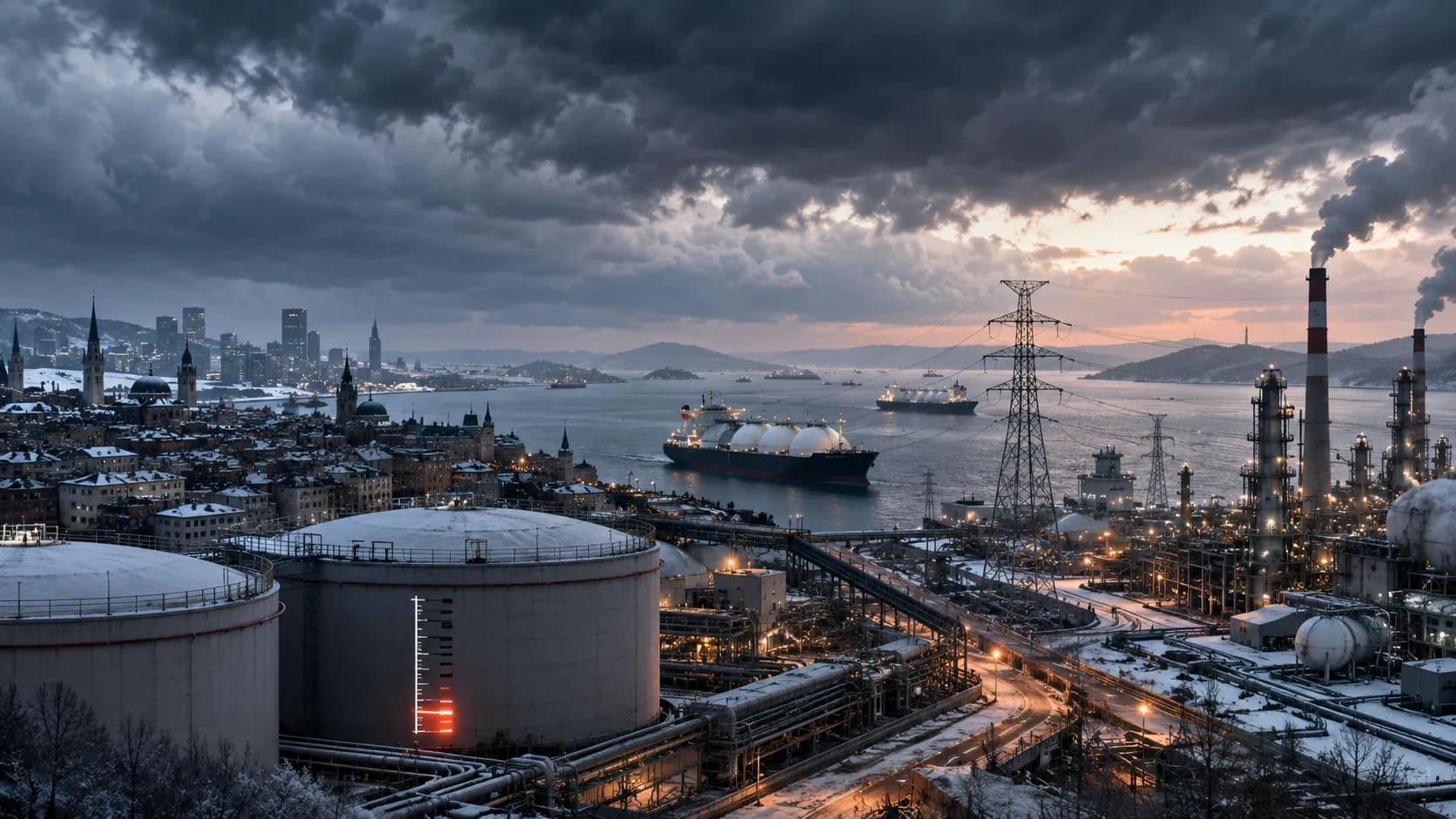
Europe is entering the winter with declining gas reserves, weaker LNG imports, and tightening diesel supplies. Global competition for fuel, geopolitical tensions in the Middle East, and supply disruptions are increasing pressure on Europe's energy security, raising concerns over its ability to withstand a harsh winter.
Europe Faces a Critical Test of Energy Security as Fuel Buffers Continue to Erode
Europe is once again confronting a familiar but increasingly complex challenge: securing sufficient energy supplies ahead of the winter season. Four years after Russia's invasion of Ukraine forced the continent to fundamentally reshape its energy strategy, European policymakers are discovering that reducing dependence on Russian pipeline gas has not eliminated vulnerability it has merely changed its form.
Today, Europe's energy security is shaped not only by domestic storage levels but also by global competition for liquefied natural gas (LNG), geopolitical instability in the Middle East, and disruptions affecting international fuel markets. Recent developments suggest that the continent is entering the winter with significantly less flexibility than in previous years, raising fresh concerns about supply resilience should colder-than-average weather materialize.
Natural gas remains the backbone of residential heating across Europe, supplying roughly one-third of household heating demand, while heating oil continues to play an important role in several member states. Consequently, maintaining adequate inventories before winter has become one of the European Union's primary energy objectives.
Current market indicators, however, reveal a growing imbalance between supply and expected seasonal demand. European underground gas storage facilities are approximately 55 percent full, marking the weakest position for this period of the year since 2021. Although storage injections continue, the pace is insufficient to comfortably achieve the European Union's target of reaching around 80 percent capacity before winter.
The changing dynamics of the global LNG market are a major reason for this slowdown. Since replacing Russian pipeline gas after 2022, Europe has become heavily dependent on imported LNG. This diversification strengthened political independence from Moscow but simultaneously exposed Europe to intense international competition for available cargoes.
Recent geopolitical developments have amplified these pressures. Following renewed instability involving Iran and continued uncertainty surrounding maritime transport through the Strait of Hormuz, LNG flows from the Gulf region have become increasingly unpredictable. Qatar, one of the world's largest LNG exporters, has faced difficulties restoring export volumes amid ongoing regional tensions, limiting additional supply for international markets.
At the same time, Asian economies have returned aggressively to the LNG market. Strong purchasing activity particularly from major Asian importers has redirected significant volumes of American LNG that might otherwise have been shipped to Europe. As competition intensifies, European buyers are increasingly required to pay higher prices to secure available cargoes.
These market conditions have already influenced prices. Benchmark European natural gas prices recently climbed above €60 per megawatt-hour, reaching their highest levels since early 2023 and surpassing previous peaks recorded during the recent Middle Eastern crisis.
Analysis
Although natural gas dominates public attention, Europe's diesel market may represent an equally significant source of vulnerability. Diesel occupies a unique position within the European economy because it supports freight transportation, industrial production, agriculture, and heating oil supplies simultaneously. Disruptions in diesel availability therefore affect multiple sectors beyond household energy consumption.
Unlike previous years, diesel inventories have continued to decline throughout the traditional summer stock-building period. Supply interruptions associated with the Middle East have reduced exports from an important producing region, forcing European consumers to rely increasingly on existing inventories. As a result, diesel stocks have fallen to their lowest levels in several years.
Global supply constraints have become even more severe due to policy decisions by two major exporters. China has limited fuel exports in an effort to prioritize domestic supply, while Russia has imposed restrictions on diesel exports following repeated attacks on refining infrastructure that affected domestic production capacity. Together, these developments have significantly reduced global diesel availability at a time when seasonal demand normally increases.
The consequence has been a sharp rise in refining margins and wholesale diesel prices across Europe. Elevated prices are beginning to suppress consumption, but demand destruction alone cannot resolve structural supply shortages if geopolitical disruptions persist.
From a broader strategic perspective, Europe's current position illustrates a fundamental transformation in energy security. Before 2022, the continent's primary concern centered on dependence upon a single supplier—Russia. Today, the challenge has evolved into dependence on a highly competitive global LNG market where events occurring thousands of kilometers away can immediately influence European supply conditions.
This shift introduces a different type of risk. Pipeline contracts offered relative predictability despite political tensions, whereas LNG markets operate under global competition, flexible cargo destinations, and rapidly changing price signals. Consequently, geopolitical events in the Persian Gulf, Asia, or North America now have a much more immediate impact on European energy stability.
Conclusion
Europe is not necessarily facing an imminent energy crisis, but the warning signs have become increasingly difficult to ignore. Lower gas inventories, constrained LNG imports, tightening diesel supplies, and persistent geopolitical uncertainty collectively reduce the margin for error as winter approaches.
Should temperatures remain relatively mild, existing reserves and continued imports may prove sufficient to avoid major disruptions. However, a prolonged period of cold weather would substantially increase heating demand, rapidly depleting inventories and placing additional pressure on already constrained global fuel markets.
Ultimately, Europe's experience demonstrates that energy security can no longer be measured solely by the quantity of fuel stored underground. It increasingly depends on resilient international supply chains, diversified energy partnerships, stable geopolitical conditions, and the capacity to respond rapidly to global market shocks.
As Europe prepares for another winter, the continent finds itself in a stronger position than during the immediate aftermath of the Ukraine crisis. Nevertheless, recent developments make one conclusion increasingly clear: despite years of diversification efforts, European energy security remains deeply interconnected with global geopolitics, leaving little room for strategic complacency.

İsmail Polat
Ph. D. in International Relations
Follow EUReflect
See more of our reporting on Google
Mark EUReflect as a preferred source and our stories are ranked higher for you in Top Stories, Discover and Google News — and carry a “preferred” badge when they are cited in AI results.
Add EUReflect as a preferred source